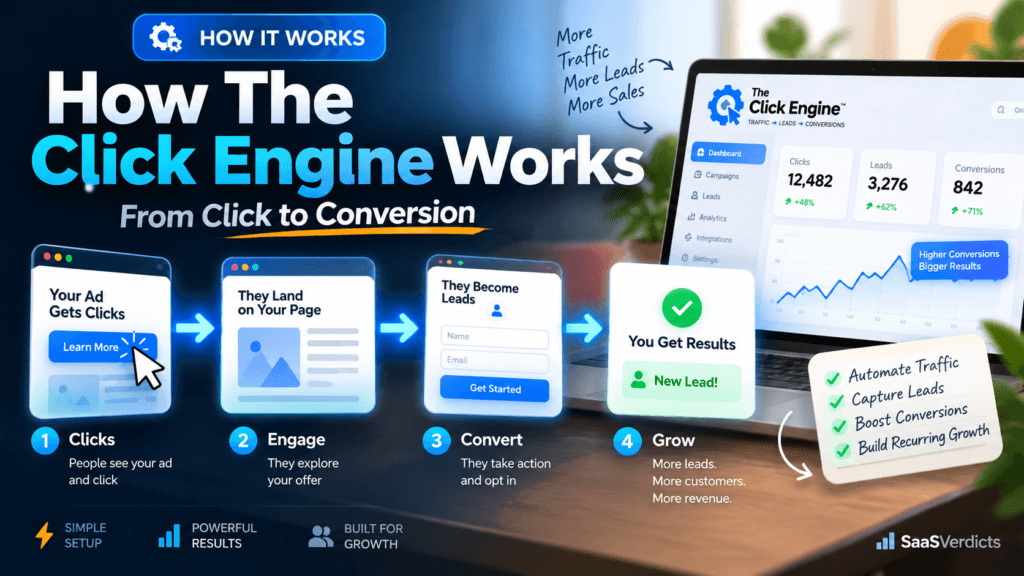
The Click Engine workflow is simple on the surface: join the membership, select the traffic opportunity, send visitors to a page and measure what happens. The part that separates useful traffic from vanity traffic happens before and after the click.
- Choose one offer and conversion goal.
- Build a focused landing or capture page.
- Set up tracking.
- Activate the traffic source.
- Collect enough data.
- Measure opt-ins, sales and revenue—not only visits.
- Optimize or stop.
Step 1: Decide What a Successful Click Looks Like
Do not send traffic anywhere until you can finish this sentence: “I want this visitor to ______.” Join an email list? Buy a product? Request a demo? Read a review and click through? A homepage usually contains too many competing actions. A campaign landing page gives you a cleaner measurement.
Step 2: Build a Page That Matches Visitor Intent
The Click Engine is marketed as buyer-oriented traffic, but even a motivated visitor needs message match. If your traffic promotion suggests “learn how to start a newsletter” and the destination page suddenly sells unrelated software, the traffic may bounce. Keep the headline, promise and next step tightly aligned.
Step 3: Track the Entire Path
- Unique visitors.
- Engagement or bounce behavior.
- Opt-in rate.
- Click-through to the offer.
- Sales/conversions.
- Revenue per visitor.
- Cost per lead and cost per sale.
Step 4: Start Small
The current $4.90 monthly special makes it tempting to jump in immediately, but the best first campaign is controlled. Use one landing page and one offer so the results mean something. If you change the traffic source, headline, offer and follow-up sequence simultaneously, you will not know which variable caused the outcome.
Step 5: Use the Included Promotional Ecosystem Carefully
The offer advertises eight free memberships in addition to the main access. Extra channels can be useful, but more traffic sources can also muddy your data. Test them separately. The affiliate/JV resources also contain an important compliance warning for promoters: do not route prohibited traffic-exchange or safelist traffic directly to affiliate links; use the provided compliant capture/splash funnels when required.
Step 6: Decide Using Economics
After a reasonable sample, calculate the numbers. Suppose 1,000 visitors produce 40 leads and two sales. The important question is not whether 1,000 sounds impressive; it is whether the value of those two sales and 40 leads exceeds the cost of acquiring them. If yes, improve and repeat. If no, test a better page or a different source.
Test The Click Engine Current Offer →
Frequently Asked Questions
Do I need a website?
You need a destination page you control or are allowed to promote. A focused capture or landing page is usually more measurable than a general homepage.
How long should I test?
Long enough to collect a meaningful sample for your funnel. Tiny samples can mislead; compare results over multiple batches before scaling.
What if I get clicks but no sales?
Check message match, page speed, tracking, offer quality, opt-in rate and follow-up before assuming the traffic itself is the only problem.