What if you could create a beautiful, fully illustrated children’s picture book in just a few hours—even if you’ve never written a story, drawn a single character, or published a book before?
A few years ago, that idea would have sounded unrealistic. Creating a children’s book typically meant hiring a writer, an illustrator, a designer, and spending weeks—or even months—bringing everything together before you could publish your first title.
Today, AI has changed that workflow dramatically.
Modern tools can help generate stories, illustrations, character concepts, cover designs, and publishing assets in a fraction of the time. Instead of starting with a blank page, creators can now begin with structured workflows that guide them from an idea to a finished book.
This shift has opened the door for entrepreneurs, educators, digital product creators, and aspiring self-publishers who want to build a catalog of children’s books for marketplaces like Amazon KDP, Etsy, Gumroad, and other digital storefronts.
But there’s still a challenge.
Using AI effectively is often harder than people expect.
Many beginners struggle with:
- Keeping the same character consistent across every page.
- Writing age-appropriate stories that feel natural when read aloud.
- Creating professional covers.
- Finding keywords that help books get discovered.
- Organizing dozens of illustrations into a publishable format.
In other words, AI can speed up the process—but only if you have a reliable workflow.
That’s where specialized prompt systems have started gaining attention.
Rather than asking ChatGPT or another AI model to “write a children’s book” and hoping for good results, these systems provide structured prompts that guide the entire process—from story development and character consistency to cover creation, page planning, and publishing preparation.
In this guide, you’ll learn:
- How AI is changing children’s book publishing.
- Whether creating AI-assisted picture books is a practical business model.
- What to look for in a storybook prompt system.
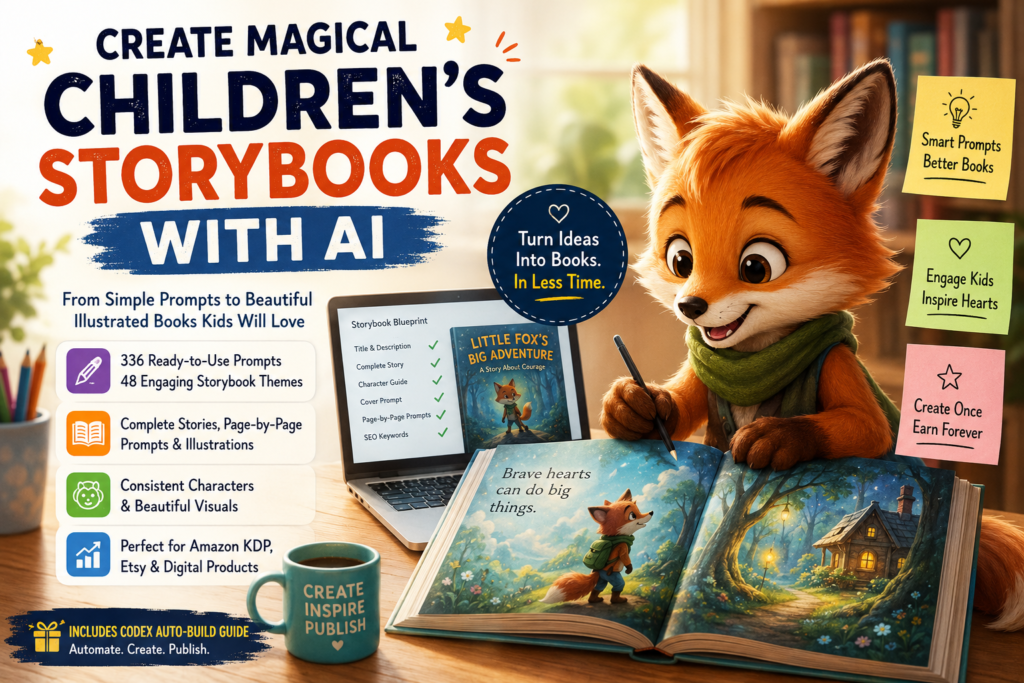
- How the 336 Prompts for Illustrated Children’s Storybooks package works.
- Whether it’s a worthwhile option if you want to publish on Amazon KDP or sell printable storybooks on Etsy.
By the end, you’ll have a clear understanding of the workflow, its strengths, its limitations, and whether it fits your publishing goals.
The Children’s Book Market Is Bigger Than Most People Realize
If you’re thinking about creating children’s picture books, you’re not entering a short-lived trend—you’re entering one of the most enduring categories in publishing.
Parents, grandparents, teachers, and caregivers have been buying children’s books for generations. While technology continues to reshape how books are created and distributed, the demand for engaging, age-appropriate stories remains remarkably consistent.
Children’s picture books are used for far more than entertainment. They help children build vocabulary, develop reading habits, understand emotions, strengthen family bonding during bedtime reading, and introduce important life lessons in ways young minds can understand.
Unlike many online business trends that come and go, children’s books benefit from a constant stream of new readers. Every year, millions of children reach the age where parents begin looking for bedtime stories, educational picture books, and books that support early learning.
For creators, this presents an interesting opportunity.
Instead of creating content that becomes outdated after a few weeks, a well-made children’s storybook can continue attracting readers for years. Seasonal books may perform well during holidays, while evergreen topics—such as kindness, friendship, courage, bedtime routines, emotions, and family—can remain relevant throughout the year.
Another advantage is the variety of publishing options available today. A single story can often be adapted into multiple formats, including:
- Paperback editions for Amazon KDP.
- Fixed-layout eBooks for Kindle.
- Printable PDF storybooks for Etsy.
- Educational resources for teachers and homeschool families.
- Digital downloads for marketplaces like Gumroad and Payhip.
This flexibility allows creators to build a catalog rather than relying on a single product.
However, identifying a good market is only one piece of the puzzle.
The real challenge has never been finding buyers.
The challenge has always been creating professional-quality books consistently.
Why Most Beginners Never Publish Their First Children’s Book
At first glance, creating a children’s picture book seems straightforward.
Write a short story.
Add a few illustrations.
Upload it to Amazon.
Unfortunately, the reality is much more demanding.
A professional children’s book requires several different skills working together.
You need a story that captures a child’s attention while remaining simple enough for parents to read aloud naturally.
You need illustrations that maintain the same artistic style from the first page to the last. Even small inconsistencies in a character’s appearance can make a book feel unprofessional.
You also need an eye-catching cover, an effective title, a compelling product description, appropriate keywords, and files formatted correctly for each marketplace.
Many aspiring publishers discover that they are expected to become:
- A writer.
- A children’s storyteller.
- An illustrator.
- A graphic designer.
- A publishing expert.
- A marketer.
- An SEO specialist.
Trying to master all of these skills before publishing a single book often leads to frustration and unfinished projects.
This is one of the biggest reasons many beginners give up long before their first book ever reaches Amazon or Etsy.
Fortunately, recent advances in AI have begun changing that workflow.
Instead of starting from a blank page, creators can now use AI to assist with brainstorming stories, generating illustrations, organizing page layouts, and preparing publishing assets. While AI doesn’t replace creativity or good judgment, it can significantly reduce the time spent on repetitive tasks.
The key is having a structured process that produces consistent, publishable results rather than random outputs.
That’s exactly where dedicated AI publishing workflows—and specialized prompt collections—can provide a significant advantage.
Can AI Really Create Professional Children’s Storybooks?
The short answer is yes—but not by itself.
Artificial intelligence has become incredibly capable of generating stories, illustrations, and creative ideas. However, anyone who has experimented with AI for more than a few minutes quickly discovers that great results rarely come from a single, vague prompt.
For example, asking an AI model to:
“Write a children’s story about a bunny.”
will usually produce a story.
But will it produce a story that’s ready for Amazon KDP or Etsy?
Probably not.
Most generic AI outputs suffer from one or more of these problems:
- Characters change appearance from page to page.
- The story lacks a meaningful emotional journey.
- Illustrations don’t follow a consistent visual style.
- Text may be too long, too short, or inappropriate for the target age group.
- Covers often look generic or contain formatting mistakes.
- Publishing details such as titles, subtitles, keywords, and descriptions are missing entirely.
In other words, AI can generate content—but it doesn’t automatically generate a professional publishing workflow.
Think of AI like hiring an incredibly talented assistant who can work at lightning speed but needs clear instructions.
If those instructions are vague, the results will usually be inconsistent.
If those instructions are structured and detailed, the quality improves dramatically.
That’s why prompt engineering has become one of the most valuable skills for AI creators.
A well-designed prompt doesn’t simply ask AI to “write a story.” It tells the model exactly how to structure the story, define the main character, maintain consistency across every page, generate marketplace-friendly metadata, and create illustrations that work together as a complete book.
The difference isn’t the AI model itself.
The difference is the quality of the instructions you give it.
Why Generic Prompts Often Lead to Frustration
Many beginners assume AI will handle every creative decision automatically.
In reality, creating a polished children’s picture book usually requires multiple steps:
- Brainstorming an original idea.
- Writing a complete story.
- Dividing the story into individual pages.
- Keeping the main character visually consistent.
- Creating a professional cover.
- Designing illustrations that match the story.
- Preparing keywords and descriptions for online marketplaces.
- Formatting everything for publication.
Trying to manage all of these tasks separately often means switching between different prompts, revising outputs repeatedly, and fixing inconsistencies manually.
For someone publishing a single book, that might be manageable.
For someone hoping to build a catalog of 20, 50, or even 100 books, it quickly becomes time-consuming.
That’s why many experienced AI creators now rely on structured prompt systems rather than starting from scratch every time.
These systems provide a repeatable workflow that reduces guesswork and helps maintain quality across multiple projects.
Instead of asking AI to invent everything from the beginning, you’re giving it a proven framework to follow.
A Structured Workflow Produces Better Results
Imagine trying to build a house without a blueprint.
You could eventually finish it—but every room would require new decisions, mistakes would be common, and progress would be slow.
Now imagine building with a detailed architectural plan.
Every step becomes clearer.
The same principle applies to AI-assisted publishing.
A structured prompt workflow can help you:
- Generate complete story concepts more consistently.
- Keep characters visually recognizable from beginning to end.
- Create page-by-page illustration prompts.
- Produce marketplace-ready titles and descriptions.
- Organize your book for publishing on platforms like Amazon KDP or Etsy.
Rather than replacing creativity, a structured workflow helps you spend more time refining ideas and less time fixing avoidable mistakes.
This is one of the reasons comprehensive prompt collections have become increasingly popular among AI creators and self-publishers.
Instead of reinventing the process for every new project, they provide a foundation that creators can customize, improve, and publish with greater confidence.
The next question, then, is simple:
What does a complete AI storybook prompt system actually include—and how does it compare to building everything manually?
What Is 336 Prompts for Illustrated Children’s Storybooks?
If you’ve ever tried creating a children’s picture book with AI, you’ve probably discovered that generating a single story is relatively easy—but creating a complete, publishable book is much harder.
That’s exactly the problem 336 Prompts for Illustrated Children’s Storybooks aims to solve.
Rather than functioning as an AI writing tool or illustration software, it’s a structured prompt library designed to guide AI models like ChatGPT through the entire book creation process.
Instead of asking AI dozens of separate questions, each prompt is built to generate a complete publishing blueprint for a children’s picture book.
Depending on the prompt you use, the output may include:
- A market-friendly book title and subtitle.
- A product description suitable for online marketplaces.
- Targeted keyword suggestions.
- A complete read-aloud story.
- A detailed character profile to improve visual consistency.
- A professionally structured cover prompt.
- Page-by-page illustration prompts.
- Guidance for assembling the final book for publication.
Instead of beginning with a blank page every time, you’re starting with a repeatable framework that can save hours of planning and organization.
More Than Just Story Prompts
One feature that makes this collection different from many basic AI prompt packs is its focus on workflow, not just creativity.
Many prompt libraries simply provide story ideas.
This collection is designed to help creators think through the publishing process from beginning to end.
For example, instead of generating only a bedtime story, the prompts are intended to help develop:
- A complete story structure.
- Character descriptions that remain consistent.
- Marketplace-ready metadata.
- Illustration guidance.
- Publishing assets that support listing a finished product.
That broader approach can be especially useful for creators planning to publish multiple books rather than treating each project as a one-time experiment.
Built Around Popular Children’s Book Themes
Another notable aspect of the collection is its focus on themes that have long been popular with parents, teachers, and caregivers.
Rather than relying on random story ideas, the prompts cover familiar children’s publishing categories such as:
- Bedtime stories.
- Friendship.
- Kindness.
- Courage.
- Big emotions.
- First-day experiences.
- Family.
- Gratitude.
- Confidence.
- Imagination.
These evergreen topics have remained relevant for years because they’re connected to everyday childhood experiences.
Of course, simply choosing a popular theme doesn’t guarantee success. Readers still expect engaging storytelling, appealing illustrations, and a polished final product. But beginning with themes that parents already look for can provide a stronger starting point than selecting topics at random.
Designed for AI-Assisted Publishing
It’s important to understand what this product is—and what it isn’t.
This isn’t software.
It isn’t an AI image generator.
It isn’t a publishing platform.
Instead, it’s a collection of structured prompts designed to work with AI tools.
The prompts act as detailed instructions that help guide models like ChatGPT through the creative and organizational stages of building a children’s picture book.
You’ll still use AI tools to generate text and illustrations, and you’ll still be responsible for reviewing, refining, and publishing your work.
Think of it this way:
Instead of handing you a finished book, the collection hands you a detailed production blueprint.
How much you customize that blueprint is entirely up to you.
Why Structured Prompt Libraries Are Becoming Popular
As AI tools become more powerful, the bottleneck is no longer the technology itself—it’s knowing how to use it effectively.
Many creators spend hours experimenting with prompts, adjusting wording, and repeating the same workflow every time they begin a new project.
Structured prompt systems help reduce that repetition.
Rather than reinventing the process for every book, creators can begin with a proven framework and focus their energy on improving the final product instead of rebuilding the workflow from scratch.
For entrepreneurs planning to create multiple books over time, that consistency can become just as valuable as speed.
The next logical question is:
What exactly do you receive inside the package, and how can those features support the publishing process?
Key Features Explained: Why This Prompt Collection Stands Out
At first glance, a collection of AI prompts might not seem very different from the thousands of prompts available online for free.
However, the real value isn’t found in the number of prompts—it’s found in how they’re structured.
A well-designed prompt doesn’t simply tell AI what to write. It guides the entire creative process from the initial idea to a finished, publishable book.
Let’s take a closer look at the features that make this workflow practical for aspiring self-publishers.
1. Complete Book Blueprint Instead of Random Ideas
One of the biggest frustrations with using AI is receiving incomplete or inconsistent results.
You ask for a story.
Then you ask for a title.
Then a cover idea.
Then keywords.
Then illustration prompts.
Then page layouts.
Before long, you’re juggling dozens of conversations and trying to piece everything together manually.
This prompt collection approaches the problem differently.
Instead of generating isolated pieces, each prompt is designed to produce a complete publishing blueprint. That means your title, subtitle, story, character guide, page plan, and supporting publishing information are generated within a single structured workflow.
For creators who plan to publish multiple books, this can save a considerable amount of planning time while keeping projects organized.
2. Character Consistency Across Every Page
One of the easiest ways to make an AI-generated children’s book look unprofessional is inconsistent characters.
Imagine a rabbit with blue overalls on page three, a green shirt on page six, and no clothing at all by the final page.
Children notice these details.
Parents notice them too.
Professional picture books rely on visual consistency because it helps readers connect emotionally with the main character.
The prompts in this collection are designed to describe each character in detail—including physical appearance, clothing, accessories, personality, and recurring visual elements—so AI has a much stronger reference point when generating illustrations.
While you should always review the final images, starting with a detailed character profile dramatically improves consistency compared to generic prompts.
3. Page-by-Page Illustration Guidance
Rather than asking AI to “illustrate the story,” each page is planned individually.
This offers several advantages.
Each illustration supports a specific moment in the story.
The pacing becomes more natural.
Important emotional moments receive appropriate visual attention.
And because every page has its own prompt, it’s easier to make adjustments without affecting the rest of the book.
This structured approach also reduces creative guesswork, especially for beginners who aren’t familiar with children’s book layouts.
4. Built-In Publishing Metadata
Creating a great book is only part of the publishing process.
Readers still need to find it.
That’s why marketplaces like Amazon KDP and Etsy rely on information such as titles, subtitles, descriptions, and keywords to understand what your book is about.
Many first-time publishers underestimate the importance of this metadata.
A compelling title and accurate keywords won’t guarantee visibility, but they can improve the chances of reaching the right audience when combined with a quality product and thoughtful listing optimization.
By including these elements in the workflow, the prompt collection encourages creators to think about discoverability from the beginning rather than treating it as an afterthought.
5. Evergreen Story Themes
Publishing one successful children’s book is exciting.
Building a recognizable catalog is even better.
The prompt collection focuses on themes that parents actively search for year after year, including bedtime, kindness, courage, friendship, emotional learning, gratitude, and family.
These topics remain relevant because they reflect common childhood experiences rather than short-term trends.
That gives creators the opportunity to expand into related books without constantly chasing the next viral idea.
6. Designed for Scale
If your goal is to publish only one book, almost any workflow can work.
But if you’re planning to build a long-term publishing business, efficiency becomes increasingly important.
Structured prompts make it easier to repeat the same production process while customizing the story, characters, and theme for each new project.
Instead of reinventing your workflow every time, you can focus on improving the quality of each book and growing your catalog over time.
For many creators, that consistency is one of the biggest long-term advantages.
See Everything Included in 336 Storybook Prompts →
A Tool Is Only as Good as the Person Using It
It’s worth remembering that no prompt collection—no matter how detailed—can replace creativity, editing, or understanding your audience. Think of these prompts as a professional framework rather than a shortcut. You’ll still need to review stories, refine illustrations, check text for accuracy, and ensure your final book delivers real value to young readers. The creators who see the best results are usually those who treat AI as a creative assistant rather than an autopilot. With the right expectations, a structured prompt system can significantly reduce repetitive work while allowing you to spend more time on storytelling, design, and publishing. The next step is understanding how all of these features fit together in a real publishing workflow—from choosing a theme to listing your finished book on Amazon KDP or Etsy.
How to Create Your First AI Children’s Storybook
Creating an AI-assisted children’s picture book can sound complicated when you look at all the individual tasks involved. In practice, the process becomes much easier when you follow a repeatable workflow instead of trying to figure out everything from scratch.
The basic process is straightforward: choose a story idea, generate the book blueprint, create the illustrations, assemble the pages, review the finished product, and publish it.
Here’s what that process can look like when using a structured prompt system such as 336 Prompts for Illustrated Children’s Storybooks.
Step 1: Choose a Story Theme
Start with a topic that has a clear purpose and an audience. You might create a bedtime story about overcoming fear of the dark, a friendship story about being left out, or a gentle emotional-learning book that helps children understand feelings.
The important thing is to begin with a specific concept rather than a vague idea such as “write a children’s book.”
A focused theme gives the story a clear direction and makes it easier to create a meaningful emotional arc.
For example, instead of simply creating “a story about a fox,” you could develop a story about a young fox learning how to express his feelings after being excluded from a game. That immediately gives you a character, a conflict, an emotional lesson, and a potential audience.
Step 2: Generate the Complete Book Blueprint
Once you’ve selected your theme, the next step is to generate the storybook blueprint using your chosen prompt.
This is where a structured prompt collection can save substantial planning time. Instead of separately asking an AI model for a title, story, character description, cover concept, keywords, and page ideas, the workflow brings those elements together.
The resulting blueprint can include the book title and subtitle, target age range, product description, SEO keyword suggestions, complete story, character and visual consistency guide, cover prompt, and individual prompts for the interior pages.
At this stage, don’t immediately publish anything. Treat the AI output as your first draft and review it carefully.
Step 3: Review and Refine the Story
AI can produce a complete story quickly, but speed shouldn’t replace editorial judgment.
Read the story from the perspective of the intended child and the parent reading it aloud. Is the language appropriate for the age group? Does the story have a clear beginning, middle, and ending? Does the conflict make sense? Does the lesson feel natural rather than forced?
You should also check for repetitive wording, awkward sentences, confusing character behavior, and anything that doesn’t fit the intended audience.
This review stage is important because the quality of the final book depends on more than the prompt itself.
Step 4: Establish the Main Character
Before generating dozens of illustrations, make sure your main character has a clearly defined visual identity.
For example, your character might be a small red fox with amber eyes, a cream-colored muzzle, a moss-green scarf, and a distinctive bent ear. Those details should remain consistent throughout the book.
The more specific the character description, the easier it is to give an image-generation model a consistent reference.
This is particularly important for children’s picture books because readers develop an emotional connection with recurring characters. A character who looks completely different from one page to another can make the entire book feel like a collection of unrelated AI images.
Step 5: Generate the Cover
The cover is one of the most important assets because it is often the first thing a potential buyer sees.
Your cover should communicate the story’s subject, mood, age range, and overall visual style quickly. It should also contain a readable title and avoid unnecessary visual clutter.
A strong cover doesn’t need to be complicated. A recognizable character, an appealing scene, clear typography, and an appropriate color palette can be far more effective than filling the image with too many elements.
Always inspect the generated cover carefully, particularly any text rendered by an AI image generator. If the title, subtitle, or author name is incorrect, regenerate or edit it before publishing.
Step 6: Generate the Interior Illustrations
Now you can move through the page-by-page prompts and generate the interior illustrations.
This is where the structured workflow becomes particularly useful. Instead of deciding from scratch what should appear on every page, you already have a visual plan connected to the story.
Each prompt should describe the relevant scene while reinforcing the character and visual style established earlier.
Review the images as a sequence rather than looking at them individually. A page may look excellent on its own but still feel wrong if the character’s appearance, proportions, clothing, lighting, or artistic style suddenly changes from the previous page.
Consistency matters more than producing one spectacular image.
Step 7: Check the Text and Illustrations
Before assembling the book, inspect every page carefully.
Look for spelling mistakes, missing words, incorrect character details, strange objects, distorted anatomy, inconsistent clothing, unwanted text, and visual elements that don’t belong in the story.
If text has been rendered directly into the illustration, check every word manually. AI-generated text can still contain errors, even when the prompt specifically instructs the model to reproduce the wording exactly.
This quality-control step should never be skipped.
Step 8: Assemble the Book
Once your pages are approved, assemble them into the final format.
You can use tools such as Canva, Kindle Create, or another suitable design application to arrange the pages and export the finished files.
The exact specifications depend on where you intend to publish. Amazon KDP, Etsy, and other platforms can have different requirements, so always check the current publishing guidelines before uploading your files.
For a printable digital product, you may want to provide a PDF version. For print-on-demand publishing, you’ll need to follow the platform’s requirements for dimensions, bleed, margins, resolution, and file preparation.
Step 9: Create Your Product Listing
A finished book still needs a strong product listing.
Your title should clearly communicate what the book is about. Your description should explain the story and its benefits to the intended buyer. Your keywords should accurately reflect what potential customers may search for.
Avoid stuffing unrelated keywords into your listing simply because they have high search volume. Relevance is more important than trying to rank for everything.
For example, a book about helping preschoolers understand emotions should focus on relevant concepts such as feelings, emotional learning, friendship, empathy, and age-appropriate social-emotional development rather than unrelated children’s book keywords.
Step 10: Publish and Learn From the Results
Finally, publish the book and monitor how people respond to it.
Your first book doesn’t need to be perfect. It needs to teach you something.
Pay attention to which themes attract attention, which covers generate clicks, which descriptions encourage purchases, and what readers mention in reviews or feedback.
Then use those insights to improve your next book.
This is where the idea of building a catalog becomes important. Instead of depending entirely on one book to succeed, you can gradually create a collection of related titles around themes that resonate with your audience.
Over time, the process becomes less about creating one book and more about developing a repeatable publishing system.
Where 336 Prompts Can Fit Into This Workflow
This is essentially the problem a structured collection such as 336 Prompts for Illustrated Children’s Storybooks is designed to address. Rather than starting with a blank ChatGPT conversation and manually building every component, you begin with detailed prompts that guide the AI through the major stages of creating the book.
You still need to review, edit, and make decisions about the final product, but the initial planning burden is significantly reduced.
For someone who wants to experiment with AI children’s books without spending hours designing a workflow from scratch, that can make the starting point much more approachable.
And if your goal isn’t simply to create one book but to eventually build a catalog, having a repeatable process becomes even more valuable.
Amazon KDP: A Natural Starting Point for Children’s Book Publishers
If you’re interested in turning AI-assisted children’s stories into actual products, Amazon KDP is one of the platforms worth understanding.
Kindle Direct Publishing, commonly known as KDP, allows independent creators and publishers to make books available through Amazon without maintaining their own inventory or managing traditional printing and distribution.
For children’s book creators, the appeal is obvious: you can develop a picture book, prepare the required files, upload them to KDP, and make the book available to customers without ordering hundreds of physical copies in advance.
But that doesn’t mean publishing on KDP is as simple as generating a few AI images and clicking “Publish.”
There are several important details to understand before uploading your first children’s book.
Why Children’s Picture Books Can Work Well on KDP
Children’s books have several characteristics that make them interesting for self-publishers.
They are highly visual, which means a strong cover and attractive interior illustrations can immediately communicate the product’s appeal. They also cover a huge range of evergreen subjects, including bedtime, emotions, friendship, learning, animals, family, holidays, and everyday childhood experiences.
Another advantage is that parents frequently purchase books for children based on specific needs.
A parent may be looking for a bedtime story, a book about starting school, a story that helps explain emotions, or something suitable for a particular age group.
That means your publishing strategy doesn’t have to revolve around producing completely random stories. You can build a catalog around clearly defined themes and audiences.
For example, instead of publishing ten unrelated children’s books, you could develop a small collection around emotional learning:
- A book about understanding anger.
- A story about dealing with jealousy.
- A book about overcoming shyness.
- A story about making new friends.
- A book about handling disappointment.
- A bedtime story about overcoming fear of the dark.
Each title can stand on its own while contributing to a recognizable catalog.
AI Can Reduce the Production Bottleneck
Traditional children’s book publishing can involve writers, illustrators, editors, designers, and formatting specialists.
AI can potentially reduce some of those costs and time requirements by assisting with the creative production process.
You can use AI to brainstorm concepts, develop stories, create character descriptions, generate illustration concepts, produce marketing copy, and assist with other parts of the workflow.
However, there’s an important distinction between AI-assisted publishing and simply uploading whatever an AI model produces.
A professional publisher still needs to review the work.
The story needs editing. The illustrations need quality control. The character needs to remain consistent. The text needs proofreading. The final files need to meet the platform’s requirements.
AI can accelerate production, but quality control remains your responsibility.
KDP Doesn’t Guarantee Sales
This is an important point that many promotional articles conveniently leave out.
Publishing a children’s book on Amazon does not automatically mean customers will find it.
There is significant competition in children’s publishing, and simply uploading an AI-generated book isn’t a business strategy by itself.
Your book still needs a strong concept, appealing cover, appropriate positioning, accurate metadata, competitive pricing, and a product that actually satisfies readers.
Reviews and customer experience can also influence how a book performs over time.
That’s why it’s better to think of KDP as a distribution platform, not a magic income button.
The opportunity comes from combining the platform with good product research, quality publishing, and a catalog strategy.
Build a Catalog Instead of Betting Everything on One Book
One of the more interesting possibilities for independent publishers is catalog building.
Your first book teaches you the process.
Your second book allows you to improve it.
By the time you’ve created ten or twenty titles, you may have a much better understanding of which themes, age groups, covers, and formats appeal to your target audience.
A structured AI workflow can make this process easier because you’re not rebuilding your entire production system every time you start a new project.
This is where a resource such as 336 Prompts for Illustrated Children’s Storybooks can become particularly useful. Instead of treating each book as a completely new creative project, you can use different prompts and themes within the collection to develop additional titles while following a familiar production process.
The prompts don’t eliminate the work, but they can reduce the amount of repetitive planning involved.
Don’t Forget the Reader
Perhaps the most important KDP lesson is also the simplest:
Create the book for the child and the parent—not for the AI.
It’s easy to become fascinated by what an image generator can produce.
But an impressive AI illustration isn’t automatically a good children’s book illustration.
The images need to support the story. The text needs to be readable. The emotional message should be appropriate. The pacing should make sense when the book is read aloud.
Parents are ultimately buying an experience for their children.
If you keep that principle at the center of your publishing process, AI becomes a tool for improving production rather than the product itself.
What You Should Prepare Before Publishing
Before uploading a children’s book to KDP, make sure you have carefully reviewed the entire package.
At minimum, check your:
- Final manuscript.
- Page order.
- Illustrations.
- Cover.
- Character consistency.
- Spelling and grammar.
- Interior dimensions.
- Image resolution.
- Margins and bleed requirements.
- Book description.
- Keywords and categories.
- Pricing.
- Copyright and other publishing information.
Always consult Amazon’s current KDP requirements before finalizing your files because technical specifications and publishing policies can change.
The more carefully you prepare before submission, the fewer unpleasant surprises you’re likely to encounter during the publishing process.
KDP Is Only One Shelf
Perhaps the biggest strategic mistake is thinking that Amazon has to be the only destination for your book.
The same underlying story can potentially be adapted into other formats and offered through other channels, depending on your rights, licensing, formatting, and the requirements of each platform.
For example, a children’s story could potentially become a paperback, an ebook, a printable digital product, an educational resource, or part of a themed collection.
That opens the door to a broader strategy: instead of creating a single product for a single marketplace, you can build a small intellectual-property catalog and distribute appropriate versions across multiple channels.
And Amazon isn’t the only marketplace worth considering.
For creators interested in printable and digital products, Etsy can provide a completely different opportunity.
Selling AI Children’s Storybooks on Etsy
Amazon KDP isn’t the only place where an AI-assisted children’s book can become a product. For creators interested in digital products, Etsy offers a different business model because customers can purchase and download digital files without waiting for physical delivery.
This makes Etsy particularly interesting for printable children’s storybooks, activity books, coloring pages, educational resources, and themed digital bundles.
Instead of thinking of your book as something that must exist only as a physical paperback, you can think of it as a digital asset that can be packaged in several useful ways.
Why Etsy Can Be Interesting for Children’s Digital Products
Etsy shoppers are already accustomed to purchasing downloadable products. They may be looking for printable activities, educational materials, gifts, party resources, nursery items, or resources for children.
A well-designed children’s storybook can fit naturally into this ecosystem.
For example, a bedtime story could be offered as a printable PDF that parents can download and print at home. A feelings-themed story could potentially be combined with discussion cards or simple activities. A seasonal story could become part of a larger holiday bundle.
The key is to think beyond the individual PDF and consider what additional value can be built around the core story.
Turn One Story Into a Product Bundle
One of the strongest advantages of digital products is the ability to package related resources together.
Imagine creating a children’s story about overcoming the fear of the dark.
The primary product could be the illustrated storybook. You could then create complementary materials such as a coloring version, simple bedtime discussion questions, emotion cards, a printable activity sheet, or a parent discussion guide.
Instead of selling only one file, you could create a more comprehensive digital bundle around the same underlying concept.
This doesn’t mean every book needs dozens of extras. The goal is to create useful additions that genuinely improve the customer’s experience.
Printable Products Can Expand Your Catalog
Once you’ve developed a consistent visual style and publishing workflow, you can explore related products without completely starting over.
A children’s story about emotions could lead to:
- A printable feelings chart.
- Emotion flashcards.
- Coloring pages.
- Conversation prompts for parents.
- Classroom discussion activities.
- A feelings-themed storybook bundle.
Similarly, a collection of bedtime stories could potentially be expanded into bedtime routine charts, calming activity sheets, or a larger bedtime story collection.
This is one reason a catalog strategy can be more powerful than relying on a single product.
Etsy and KDP Serve Different Purposes
It’s also important not to treat Etsy and KDP as identical platforms.
KDP is designed around book publishing and Amazon’s retail ecosystem.
Etsy is a marketplace where shoppers discover a broad range of handmade, creative, personalized, and digital products.
That difference affects how you present your product.
On KDP, you’re primarily selling a book.
On Etsy, you have more flexibility to package the same underlying creative work as a printable resource, digital bundle, personalized product, or collection, provided the product complies with Etsy’s current policies.
This gives creators another potential distribution channel without necessarily requiring an entirely new story.
Your Etsy Listing Still Needs to Sell
Creating a digital product doesn’t automatically create demand.
Your Etsy listing needs a strong thumbnail, clear title, accurate tags and keywords, useful product images, a convincing description, and an obvious explanation of what the buyer receives.
Remember that digital products don’t give customers the opportunity to physically inspect the product before purchasing.
Your listing images therefore have an important job.
Show the cover, interior pages, page previews, included files, dimensions, age range, and other relevant details so buyers know exactly what they’re purchasing.
The easier you make the buying decision, the less uncertainty the customer has.
Don’t Overlook Licensing and Platform Rules
If you’re creating products with AI, you should also understand the rules that apply to the tools and marketplaces you’re using.
Check the current commercial-use terms of the AI tools involved in your workflow, as well as the current policies of marketplaces such as Etsy and Amazon KDP.
These policies can change, and responsibility for complying with them ultimately rests with the publisher or seller.
You should also make sure that your stories, illustrations, characters, fonts, graphics, and other assets don’t infringe someone else’s intellectual property.
AI makes content creation faster, but it doesn’t remove the need for responsible publishing.
The Bigger Opportunity Is the Catalog
The real attraction of combining KDP and Etsy isn’t simply having two places to upload the same book.
It’s the possibility of building a catalog of related children’s products.
One successful theme can inspire several additional products. One character can potentially appear in a series. One story can become a printable edition, physical book, activity bundle, or educational resource.
Over time, those individual products can become a recognizable brand.
And this is where having a large, organized prompt library becomes particularly useful.
Instead of spending hours trying to come up with your next children’s book idea, you can choose another theme, generate a new blueprint, review it, customize it, create the illustrations, and move through the same publishing workflow again.
That’s a much more scalable approach than trying to invent an entirely new process every time.
How Much Work Does AI Actually Save?
This is where it’s important to separate the marketing hype from the practical reality.
AI can save a significant amount of time, but it doesn’t mean you can press one button and immediately have a bestselling children’s book.
The biggest time savings usually come from ideation, drafting, planning, prompt creation, and repetitive production tasks.
Without a structured workflow, you might spend hours deciding what your story should be about, developing characters, writing individual illustration prompts, planning the page sequence, and preparing marketplace information.
With a structured prompt system, much of that initial work can be generated for you.
You then shift your role from creating everything manually to reviewing, editing, directing, and improving the output.
That is a much more realistic way to think about AI-assisted publishing.
The question isn’t whether AI can do everything for you.
The better question is:
How much of the repetitive work can you remove while still maintaining a product quality that customers are willing to pay for?
For creators who want to publish children’s books repeatedly, that distinction can make a significant difference.
Who Is 336 Prompts for Illustrated Children’s Storybooks Actually For?
A large prompt collection isn’t automatically the right solution for everyone. The value depends on what you’re trying to accomplish, how much time you want to save, and whether you actually plan to create and publish children’s storybooks.
If you’re simply curious about AI image generation or want to create an occasional story for your own family, you probably don’t need hundreds of structured prompts. You can experiment with ChatGPT and other AI tools for free and see what you can create.
But if you’re thinking beyond experimentation and want to build a catalog of children’s books or digital products, the equation changes.
Aspiring Children’s Book Authors
If you’ve always wanted to write a children’s book but the thought of developing the story, characters, illustrations, cover, and publishing materials feels overwhelming, a structured prompt system can give you a much clearer starting point.
You don’t have to begin with a blank page wondering what to write.
Instead, you can start with a specific theme and use the prompts to develop the concept into a complete book blueprint.
You remain the creative director, but much of the repetitive planning is already structured for you.
AI Content Creators
AI enthusiasts are another natural audience for this type of resource.
If you’re already experimenting with ChatGPT and image-generation tools, you may have discovered that getting one impressive image is relatively easy. Getting twenty or thirty images that look like they belong to the same professional children’s book is considerably harder.
The challenge isn’t simply generating content. It’s maintaining consistency across an entire project.
A structured collection gives you a repeatable framework for solving that problem instead of relying on trial and error with every new book.
Digital Product Sellers
If you’re already selling printables, PDFs, educational resources, or other digital products, children’s storybooks can become another product category to explore.
The advantage is that the same creative assets can potentially be packaged in different ways.
A storybook could become a printable PDF, a themed bundle, a classroom resource, or part of a larger collection, depending on your audience and the platform you’re selling on.
This gives digital-product sellers more opportunities to build around a successful theme instead of constantly searching for completely unrelated product ideas.
Etsy and KDP Beginners
You don’t need to be an established publisher to start learning how self-publishing works.
In fact, beginners may benefit the most from having a structured process because there are so many individual decisions involved in creating a book.
What should the story be about?
How old should the target reader be?
What should the main character look like?
What should happen on each page?
What should the cover look like?
What keywords should be considered?
How should the final product be packaged?
A good workflow turns those questions into a sequence of manageable tasks.
Parents, Teachers, and Educators
The collection can also be interesting for people who aren’t primarily thinking about selling books.
Parents and educators may want to experiment with creating customized stories around specific childhood experiences, classroom themes, social-emotional learning, or everyday situations.
For example, a teacher could develop a story around kindness, friendship, welcoming a new student, or dealing with disappointment.
The important consideration is that any educational or child-focused material should be reviewed carefully for age appropriateness, accuracy, and suitability before being used with children.
Freelancers and Creative Service Providers
There’s another audience that is easy to overlook: freelancers.
A person who learns how to efficiently create AI-assisted children’s books could potentially use that knowledge as part of a broader creative service.
For example, a freelancer might offer storybook creation, personalized children’s books, illustration packages, or digital book production to clients.
In this situation, the prompts aren’t necessarily the final product. They’re part of the production workflow that helps the freelancer deliver a service more efficiently.
Who Probably Shouldn’t Buy It?
Being honest about this is important.
If you have no interest in children’s books, digital products, self-publishing, AI-assisted content creation, or creative experimentation, 336 Prompts for Illustrated Children’s Storybooks probably isn’t a particularly useful purchase for you.
Likewise, if you’re expecting a prompt collection to generate guaranteed passive income without editing, quality control, publishing work, or marketing, you should reconsider your expectations.
The prompts can accelerate the creative and planning process, but they don’t guarantee sales.
Success still depends on the quality of your books, your positioning, your marketplace listings, your ability to understand your audience, and how consistently you execute.
That’s actually a good thing.
It means you’re not buying a magic button. You’re getting a structured resource that can potentially remove one of the biggest obstacles for beginners: figuring out what to do next.
Is 336 Prompts Worth It?
The answer ultimately depends on how much you value structure and how seriously you intend to pursue this type of publishing.
If you’re only going to create one experimental story, you can certainly build a workflow yourself.
But if you want dozens of themes, hundreds of ready-to-run prompts, a repeatable process, and a starting point for building an entire children’s-book catalog, having the system already organized can save a considerable amount of time.
That’s the real appeal of 336 Prompts for Illustrated Children’s Storybooks.
You’re not simply getting ideas for stories.
You’re getting a framework designed to take you from an initial concept toward a complete illustrated storybook blueprint, including the story, characters, cover, page-by-page illustration instructions, and publishing-related information.
For someone who wants to stop experimenting and actually start producing, that distinction matters.
What Makes a Children’s Storybook Feel Professional?
Creating a children’s book with AI is relatively easy. Creating one that actually feels like a cohesive, professionally produced children’s book is a different challenge.
The difference usually isn’t the technology. It’s the attention given to the details.
A professional-looking picture book has a clear visual identity, consistent characters, purposeful page composition, readable text, a coherent story, and an emotional experience that feels intentional from beginning to end.
These are the details that can turn a collection of AI-generated images into something that feels like a real product.
A Strong Story Comes First
Beautiful illustrations can attract attention, but they can’t compensate for a weak story.
Children’s picture books usually work best when they have a simple concept that a young reader can understand and an emotional journey that gives the story a reason to exist.
The main character should want something, encounter a problem, experience some kind of change, and arrive at a satisfying resolution.
That doesn’t mean every story needs a dramatic adventure. A quiet story about a child learning to sleep alone can be just as meaningful as an exciting journey through a magical forest.
The important thing is that something changes between the beginning and the end.
The Character Should Be Instantly Recognizable
A strong children’s book character should have recognizable features that remain consistent throughout the story.
Perhaps it’s a fox with a green scarf, a bear with a yellow raincoat, or a little rabbit carrying a favorite blue backpack.
These recurring details do more than help AI generate consistent images. They also help children recognize and remember the character.
When the same character appears across multiple books, those visual characteristics can eventually become part of a recognizable series or brand.
Every Page Should Have a Purpose
One of the easiest mistakes in AI-generated books is creating beautiful illustrations that don’t actually advance the story.
Every page should contribute something.
It might introduce a new situation, reveal an emotion, move the character closer to solving a problem, create a moment of calm, or prepare the reader for the resolution.
This is why page-by-page planning matters.
Instead of generating twenty unrelated illustrations and trying to invent a story around them afterward, you can develop the story first and then create images that support each moment.
Text Placement Matters More Than You Think
Picture books have a unique design challenge because words and illustrations have to coexist on the same page.
A beautiful illustration can become difficult to read if the text is placed over a busy background.
Likewise, too much text can overwhelm a page intended for young children.
Good page design therefore requires deliberate placement, sufficient contrast, appropriate font sizing, and enough empty space around the text.
This is another reason detailed image prompts can be useful. If the prompt tells the image generator where the text should appear and deliberately creates a clean area for it, you have a better starting point for the final design.
However, always inspect AI-generated typography manually. Text rendering can still produce mistakes, and a single misspelled word can make an otherwise polished page look unfinished.
Visual Consistency Creates Trust
Imagine opening a children’s book and seeing a soft watercolor style on one page, a completely different cartoon style on the next, and a photorealistic image on the page after that.
Even if every individual image looks attractive, the book won’t feel cohesive.
Professional children’s books establish a visual language and maintain it.
The same principle applies to AI-generated books.
Choose an artistic direction and reinforce it throughout the prompts. Keep the character descriptions consistent. Maintain recurring environmental details. Pay attention to lighting, color relationships, proportions, and overall mood.
The result should feel like one book—not a collection of unrelated generations.
Quality Control Is Part of the Creative Process
AI doesn’t eliminate the need for editing. It changes where your time is spent.
Instead of manually drawing every illustration, you may spend more time reviewing generations, selecting the strongest versions, correcting mistakes, refining prompts, and checking the final sequence.
That review process is not a failure of AI.
It’s part of using AI professionally.
The same principle applies to the writing. Even if the initial story is generated successfully, you should read it aloud, check its pacing, simplify awkward language, and make sure the emotional lesson feels natural for the intended age group.
Why a Structured Prompt System Helps
This is where the difference between a generic AI prompt and a structured prompt collection becomes clear.
A generic prompt might say:
“Write a children’s story about a rabbit who is afraid of the dark.”
That’s enough to generate an idea.
But turning that idea into a finished picture book requires many additional decisions.
What is the rabbit’s name? What does the rabbit look like? What does the bedroom look like? What happens on each page? How does the character’s appearance remain consistent? What should the cover show? What age group is the story for? What keywords might describe the book? How should the story end?
A comprehensive prompt system addresses these elements systematically.
That’s the real value of 336 Prompts for Illustrated Children’s Storybooks: it isn’t simply giving you hundreds of random story ideas. It provides structured starting points designed around the components required to develop a complete illustrated storybook.
You still control the final creative decisions, but you’re no longer staring at a blank screen trying to design the entire workflow yourself.
And once you understand that workflow, the next question becomes much more interesting:
How can you turn one children’s book into an entire product catalog instead of starting from zero every time?
How One Children’s Book Can Become an Entire Product Catalog
One of the biggest mistakes new digital-product creators make is thinking they need a completely new business idea every time they want to launch another product.
You don’t.
A better approach is to find a topic that has potential and build a collection around it.
Children’s books are particularly well suited to this strategy because parents don’t buy only one type of story. Different situations, emotions, seasons, milestones, and interests create countless opportunities for related books.
A single successful theme can become the foundation for an entire mini-catalog.
Start With One Core Theme
Imagine you create a children’s story about a child who is afraid of the dark.
That one idea could lead to several related books:
- A story about sleeping alone for the first time.
- A gentle bedtime routine story.
- A story about nighttime noises.
- A story about bad dreams.
- A story about finding courage at bedtime.
- A magical adventure through dreamland.
These aren’t necessarily competing products.
They’re different solutions to closely related problems that parents may already be searching for.
Instead of asking, “What completely different book should I create next?” you can ask:
“What other problem or situation would the same audience want help with?”
That question can dramatically expand your catalog.
Build Around Emotions and Childhood Experiences
Emotional development is another particularly broad category.
Children experience frustration, jealousy, nervousness, loneliness, embarrassment, excitement, disappointment, fear, and many other emotions.
Each can become a potential story concept.
For example, a book about jealousy could be followed by stories about sharing, making friends, feeling left out, handling disappointment, or learning to celebrate someone else’s success.
The advantage is that you aren’t constantly searching for unrelated ideas.
You’re building depth around a subject that parents already understand.
Create Series Instead of Isolated Books
A recognizable series can also make your catalog easier for customers to understand.
You might create a recurring character who appears in different situations.
The character could experience the first day of school in one book, learn about friendship in another, overcome a fear in another, and deal with big emotions in another.
Now each new title can potentially introduce readers to the other books in the collection.
This creates a natural path from one purchase to the next.
The goal isn’t to force customers into buying everything.
It’s to create enough relevance that someone who enjoyed one book has an obvious reason to look at another.
Repurpose Your Creative Work Carefully
Digital publishing also creates opportunities to develop additional products from existing concepts.
A storybook might inspire a coloring edition, activity pages, discussion questions, printable cards, or a themed bundle.
The important word is carefully.
Don’t simply duplicate the same product and change the title.
Each additional product should provide a genuine reason for the customer to buy it.
A parent purchasing a bedtime story might appreciate a bedtime routine chart because it solves a related problem.
A teacher using a feelings story might find emotion cards or discussion activities useful in the classroom.
The strongest catalogs are built around customer needs, not simply around producing as many files as possible.
Why 336 Prompts Can Be Useful for Catalog Building
This is where a large, organized prompt collection becomes more interesting than a small collection of isolated prompts.
With 336 prompts across 48 children’s storybook themes, you have a much larger pool of starting points.
You could begin with bedtime stories, then explore emotions, courage, friendship, fears, family relationships, or other themes that fit your chosen audience.
Instead of repeatedly asking AI to invent the entire publishing workflow from scratch, you can use the collection as a structured idea and production library.
That doesn’t mean every prompt should immediately become a published book.
A smarter approach is to test ideas, identify themes that resonate with your audience, improve the strongest concepts, and gradually expand the catalog around them.
Don’t Try to Build 100 Books Overnight
More products do not automatically mean more sales.
Publishing dozens of weak books can create a catalog full of products that nobody wants.
A better strategy is to start small.
Create your first book.
Learn the workflow.
Study how readers respond.
Improve your covers, descriptions, stories, and product presentation.
Then create the next book using what you learned.
Over time, the process becomes faster because you’re no longer learning everything from scratch.
That’s how a collection of individual books can gradually turn into a publishing system.
The Long-Term Advantage Is the System
The most valuable outcome isn’t necessarily the first book you create.
It’s learning a repeatable process that you can use again and again.
Once you know how to move from an idea to a story, from a story to consistent illustrations, and from illustrations to a finished product, each new title becomes easier to produce.
And that’s the point at which AI becomes more than a novelty.
It becomes part of a repeatable creative workflow.
A prompt collection such as 336 Prompts for Illustrated Children’s Storybooks can provide the starting framework, but your judgment, editing, market research, and publishing decisions are what turn that framework into an actual business.
The people who benefit most won’t necessarily be the ones who generate the most books.
They’ll be the ones who learn what their audience wants and consistently create better products for that audience.
How to Choose the Right Children’s Book Niche Before You Create Your First Book
Having hundreds of story ideas available can be exciting, but it can also create a new problem: too many choices.
You don’t need to publish everything.
Before creating your first book, it’s smarter to decide who you’re creating it for and what specific need, emotion, or situation your story will address.
The narrower your initial focus, the easier it becomes to create a product that feels relevant to a specific buyer.
Start With a Specific Audience
“Children” is not a niche.
A story for a two-year-old is very different from a story for a seven-year-old. Likewise, a bedtime story serves a different purpose from a classroom social-emotional learning book.
Think about the person making the purchase and the child receiving the product.
For example, your target could be:
- Parents of preschoolers.
- Parents looking for bedtime stories.
- Parents interested in emotional learning.
- Teachers looking for classroom resources.
- Families looking for gentle stories about fears and courage.
- Buyers searching for educational printable resources.
Once you identify the audience, choosing story ideas becomes much easier.
Look for Problems Parents Already Care About
One of the strongest approaches is to create stories around situations parents already encounter.
A parent may search for a book because their child is afraid of sleeping alone.
Another may want a story that helps explain anger, jealousy, sharing, friendship, starting school, or dealing with disappointment.
These are more commercially meaningful than creating a story simply because an idea sounds interesting.
The question to ask is:
What problem does this story help a parent talk about with their child?
If you can answer that clearly, you already have a stronger foundation for your book.
Evergreen Themes Can Be Especially Valuable
Some children’s topics don’t depend on a particular trend or season.
Bedtime.
Feelings.
Friendship.
Courage.
Kindness.
Fear.
Family.
Starting school.
These subjects continue to appear in children’s lives year after year.
That doesn’t guarantee sales, but evergreen themes can give a product a longer potential lifespan than an idea dependent entirely on a short-lived trend.
Seasonal books can still be valuable, of course. Christmas, Halloween, birthdays, summer vacations, and back-to-school themes can create additional opportunities.
A balanced catalog can eventually include both evergreen and seasonal products.
Don’t Ignore Search Intent
When someone searches for a children’s book, they’re usually not searching randomly.
Their search often reveals what they’re trying to accomplish.
A phrase such as “children’s book about emotions” indicates a different intention from “bedtime story for preschoolers.”
“Book about first day of school” suggests a specific life event.
“Kids book about fear of the dark” identifies both a problem and a potential solution.
Understanding this search intent can help you choose better titles, descriptions, themes, and supporting keywords.
Your goal isn’t to stuff keywords into a title.
Your goal is to understand how your potential customer describes the problem they’re trying to solve and then create a product that genuinely matches that intent.
Study the Competition Before You Create
Competition isn’t necessarily a warning sign.
In many cases, competition demonstrates that buyers already exist.
If you find numerous books around a particular children’s topic, don’t automatically conclude that the market is too crowded.
Instead, examine what existing products are doing.
Look at their covers.
Study their titles.
Notice their age ranges.
Look at the themes they emphasize.
Read customer reviews where available.
Pay particular attention to complaints and gaps.
If buyers repeatedly mention that a book is too complicated, poorly illustrated, too short, or doesn’t address a particular situation, those observations can help you identify opportunities to create something better.
The objective isn’t to copy competitors.
It’s to understand the market well enough to find your own angle.
Give Your Book a Clear Promise
A strong children’s book concept should be easy to explain.
For example:
“A gentle bedtime story that helps preschoolers feel comfortable sleeping in the dark.”
That’s much clearer than:
“A magical adventure about a little rabbit.”
The second idea might still make a wonderful story, but the first immediately tells a parent why they might want the book.
This principle should influence your title, subtitle, cover, description, and even the story itself.
When everything communicates the same core benefit, the product becomes easier to understand.
Use the 48 Themes as Starting Points, Not Restrictions
One advantage of 336 Prompts for Illustrated Children’s Storybooks is that you don’t have to rely entirely on your own imagination to decide where to begin.
The collection covers 48 themes, including bedtime, big feelings, fears, courage, friendship-related situations, and other childhood experiences.
That gives you a structured starting point.
You can select a theme, examine the available concepts, and then decide which one best fits the audience you’re targeting.
The important thing is to use the prompts as a launching point, not as a substitute for judgment.
Read the generated story.
Check the age suitability.
Improve anything that feels generic.
Make the characters memorable.
Review every illustration.
And most importantly, ask yourself whether a real parent or educator would actually find the finished product useful.
Your First Niche Doesn’t Have to Be Your Forever Niche
Don’t spend months trying to identify the perfect niche before creating anything.
Your first product is also a learning experience.
You may discover that bedtime stories are easier for you to create than educational books.
You may find that emotional-learning stories receive more interest than adventure stories.
Or you may discover that a particular character or theme gives you a strong foundation for a series.
That’s valuable information.
Start with a sensible niche, create a genuinely useful product, observe the response, and let the market help guide your next decision.
The objective isn’t to predict the perfect product before you start.
It’s to create, learn, improve, and build intelligently.
The AI Children’s Book Creation Workflow: From One Prompt to a Finished Product
Once you’ve chosen your audience and story theme, the next challenge is turning the idea into an actual book.
This is where many beginners get stuck.
They open ChatGPT, generate a story, create a few images, and then discover that the characters don’t look the same, the illustrations don’t match the story, the text contains errors, and the final product needs far more editing than expected.
The solution is to treat AI book creation as a workflow, not a single prompt.
Step 1: Define the Book Before Generating Anything
Start by deciding the basics.
Who is the book for?
What age range are you targeting?
What problem, emotion, lesson, or experience does the story address?
What should the child feel by the end?
What kind of character will carry the story?
These decisions provide the foundation for everything that follows.
A five-year-old dealing with a fear of the dark needs a different story structure, vocabulary, pacing, and illustration style than an eight-year-old reading an adventure story.
The more clearly you define the project at the beginning, the fewer problems you’ll have later.
Step 2: Develop the Story Structure
A good picture book doesn’t need a complicated plot.
It needs a clear emotional journey.
A simple structure might look like this:
Beginning: Introduce the character, setting, and situation.
Problem: Something happens that creates a challenge.
Emotional journey: The character experiences feelings and attempts to deal with the problem.
Turning point: The character discovers an idea, receives help, or finds the courage to act.
Resolution: The problem is addressed and the character learns something meaningful.
Ending: Leave the child with a satisfying emotional conclusion.
This structure gives every illustration a reason to exist.
Step 3: Lock the Character Design
This is one of the most important steps in AI-assisted children’s publishing.
Before generating dozens of pages, create a detailed character description.
Include the character’s species, age, body proportions, fur or skin color, facial features, clothing, accessories, personality, and other distinctive characteristics.
For example, instead of simply saying:
“Create a cute fox.”
You might define a young rust-orange fox with a cream muzzle, amber eyes, a slightly bent ear, a moss-green scarf, and a small leaf-shaped satchel.
The more useful recurring details you establish, the easier it becomes to maintain a recognizable character throughout the book.
Step 4: Establish the Visual Style
The same principle applies to the artwork.
Decide what the book should look like before generating the pages.
You might choose a textured pastel-and-ink appearance, a soft watercolor aesthetic, a colorful modern cartoon style, or another original visual direction appropriate for the audience.
Then consistently reinforce that direction in your prompts.
The goal is not to make every page identical.
The goal is to make every page feel like it belongs to the same book.
Step 5: Create the Cover
The cover is one of the most important marketing assets because it’s often the first thing a potential buyer sees.
A good children’s-book cover should immediately communicate what the book is about and who it is for.
The main character should be recognizable.
The title should be easy to read.
The visual mood should match the story.
And the overall design should look intentional rather than like an unedited AI experiment.
Remember that a cover isn’t merely decoration.
It’s part of your sales presentation.
Step 6: Generate the Interior Pages
Now the individual pages can be created.
This is where a detailed page-by-page plan becomes extremely valuable.
Each prompt can specify the scene, characters, emotions, environment, artistic direction, text, text placement, aspect ratio, and restrictions on unwanted elements.
Instead of repeatedly explaining the entire project to the AI, you have a consistent framework that can be applied across the book.
This can significantly reduce the amount of creative guesswork involved.
Step 7: Review Every Page
Never assume the first generation is the final product.
Inspect every page.
Check the character.
Check the clothing and accessories.
Check the story text.
Check spelling.
Check facial expressions.
Check whether the illustration actually matches the written scene.
Check whether the text is readable.
Check whether anything strange or unintended appears in the image.
AI can dramatically accelerate production, but human quality control remains essential.
Step 8: Assemble the Book
Once you’ve selected and corrected the illustrations, assemble the pages into the final product.
Depending on your workflow, you might use Canva, a publishing application, or another suitable design tool.
Make sure the page dimensions, resolution, margins, text readability, and file format are appropriate for the platform you’re planning to use.
If you’re publishing through Amazon KDP, follow the current formatting and content requirements provided by Amazon rather than relying on an old tutorial.
For Etsy or another digital marketplace, prepare the files according to the requirements and expectations of your target customer.
Step 9: Create the Listing
The book itself is only half of the equation.
You also need a product listing that communicates its value.
Your title should clearly identify the book.
Your description should explain what the story is about, who it’s for, and what makes it useful.
Your keywords should reflect the language your potential buyers actually use.
Your images should show the quality of the product and give shoppers enough information to understand what they’re purchasing.
A great book with a weak listing can remain invisible.
A strong listing can’t rescue a poor-quality book.
You need both.
Step 10: Learn From the First Book
Your first book doesn’t need to be perfect.
It needs to teach you something.
Maybe your cover needs stronger contrast.
Maybe the story was too long.
Maybe parents responded particularly well to the emotional-learning angle.
Maybe one character was much more appealing than another.
Use those observations to improve the next product.
This is where a prompt-based workflow can become increasingly valuable.
Once you have the process established, you’re not rebuilding your entire system every time you start another book.
You’re refining a production pipeline.
Where 336 Prompts Fits Into This Workflow
This is essentially the problem that 336 Prompts for Illustrated Children’s Storybooks is designed to address.
Instead of starting with an empty ChatGPT conversation and manually figuring out every component, each prompt is designed to produce a structured storybook blueprint.
According to the sales page, the generated blueprint can include the title and subtitle, product description, SEO keywords, complete story, character-consistency guide, cover prompt, and page-by-page image prompts.
The collection covers 48 themes, giving you multiple directions to explore rather than forcing you to invent every concept yourself.
And if you want to automate more of the production process, the product also includes a Codex Auto-Build Guide designed to help generate and assemble the book using a more automated workflow.
That doesn’t remove the need for review.
It simply gives you a more structured starting point and potentially reduces the repetitive work between the initial idea and the finished book.
The important distinction is this:
AI can help you produce faster. A good workflow helps you produce consistently.
When you combine the two, creating a children’s book becomes much less intimidating than starting from a blank page every time.
How to Sell AI-Generated Children’s Books Without Relying on One Marketplace
Creating the book is only one part of the opportunity. The next question is where to sell it. One of the advantages of digital and print-on-demand publishing is that you don’t necessarily have to depend on a single platform. Depending on your business model, audience, and the type of product you create, the same core concept can potentially be adapted for multiple sales channels.
Amazon KDP
Amazon KDP is an obvious starting point for many aspiring self-publishers because it allows independent creators to make books available through Amazon without maintaining their own inventory. A children’s storybook can potentially be offered in different supported formats depending on the book and KDP’s current requirements.
The biggest attraction is access to Amazon’s enormous marketplace, but competition is significant. Publishing a book doesn’t automatically mean customers will find it. Your cover, title, description, keywords, category selection, pricing, reviews, and overall product quality can all influence how competitive your listing becomes.
Etsy
Etsy can be particularly interesting if you’re creating printable children’s storybooks, activity books, coloring pages, educational resources, or themed digital bundles. The digital-download model also means you don’t have to print, package, or physically ship each digital order.
This opens possibilities beyond simply listing the same book elsewhere. A children’s story could become part of a printable activity bundle, a themed learning resource, or a collection of related digital products. The important thing is to adapt the offer to what Etsy shoppers are actually looking for rather than treating every marketplace identically.
Gumroad and Other Digital Stores
You can also consider selling digital products through your own storefront or platforms designed for digital creators. This can give you more flexibility over how products are presented, packaged, and bundled.
For example, instead of selling every story individually, you could eventually create collections such as “10 Bedtime Stories for Preschoolers,” a “Big Feelings Storybook Bundle,” or a “First Day of School Story Collection.” As your catalog grows, related products can potentially be combined into higher-value offers.
Build an Audience Alongside Your Products
Don’t think of marketplaces as your entire marketing strategy. Content can become another source of traffic and discovery. A children’s-book creator could build Pinterest content, short-form videos, blog posts, social media content, an email list, or other audience channels around the same themes addressed by the books.
For example, an article about helping a child overcome fear of the dark could naturally introduce a relevant bedtime story. Content about children’s emotional vocabulary could lead interested parents toward a feelings-themed book. Instead of constantly advertising products, you’re creating useful content around problems your products are designed to address.
One Idea Can Support Multiple Pieces of Content
Suppose you create a story about helping children handle disappointment. The book itself is one product, but the underlying topic could also inspire articles such as “How to Talk to Your Child About Disappointment,” “Ways to Help Children Handle Big Feelings,” or “Activities to Help Preschoolers Name Their Feelings.”
Each piece of content can address a slightly different search intent while naturally pointing interested readers toward relevant products. This is one reason a well-planned children’s-book catalog can work particularly well alongside content marketing: you’re building an ecosystem around the needs of the same audience rather than constantly searching for unrelated topics.
Don’t Make the Mistake of Treating AI as a Get-Rich-Quick Shortcut
There’s a lot of excitement around AI-generated content, and understandably so. The technology has made certain creative tasks dramatically faster. You can generate story concepts quickly, create illustrations faster than traditional workflows, and explore dozens of ideas without spending weeks developing each one from scratch.
None of that guarantees that parents will buy the finished product. Customers still care about whether the story is enjoyable, whether the illustrations look professional, whether the book is appropriate for their child, and whether the product solves the reason they were searching for a book in the first place. Marketplaces also have their own content, quality, and disclosure requirements that publishers need to follow.
The smarter question therefore isn’t, “How quickly can I upload 100 books?” A better question is, “How can I use AI to create better products and test promising ideas faster?” That mindset encourages quality and experimentation rather than flooding marketplaces with low-value content.
The Economics of an AI-Assisted Children’s Book Business
One reason people are attracted to digital products is the potential difference between production and distribution costs. With a traditional physical inventory business, you may need to manufacture products, store inventory, package orders, and manage shipping. Digital products eliminate many of those physical costs, while print-on-demand models can reduce the need to purchase inventory upfront.
That doesn’t mean children’s books are free to create. You may still invest in AI subscriptions or usage, research, editing, illustration generation, design, marketplace fees, advertising, customer service, and quality control. AI can potentially reduce some production costs and dramatically reduce the amount of manual creative work involved, but you should still calculate your actual expenses before deciding whether a product is commercially viable.
The bigger opportunity is therefore not simply that AI can make a children’s book. It’s that AI can reduce the time and resources required to test, improve, and produce creative product ideas. That can make experimentation more accessible to independent creators who don’t have a traditional publishing team behind them.
What You Get With 336 Prompts for Illustrated Children’s Storybooks
If you’ve reached this point and you’re wondering what exactly the product offers, here’s the practical summary. 336 Prompts for Illustrated Children’s Storybooks is a structured prompt collection designed to help creators develop illustrated children’s storybooks using AI.
According to the product information, the collection includes 336 ready-to-run prompts organized across 48 children’s storybook themes, covering areas such as bedtime, emotions, fears, courage, and other common childhood experiences. The prompts are designed to help generate commercial titles and subtitles, product descriptions, targeted SEO keyword suggestions, complete read-aloud stories, character and visual consistency instructions, cover prompts, and page-by-page illustration prompts.
The package also includes a Codex Auto-Build Guide intended for creators who want to automate more of the production workflow. Rather than manually processing every page individually, the guide provides a workflow for using Codex to help generate and organize the book assets.
The important thing is to understand what you’re actually purchasing. You’re not purchasing guaranteed book sales or guaranteed passive income. You’re purchasing a structured creative system designed to reduce the amount of planning, repetitive prompt writing, and workflow development involved in creating illustrated children’s books.
If figuring out the entire process from scratch is what’s stopping you from publishing, that distinction makes the offer considerably more interesting.
Should You Get 336 Prompts for Illustrated Children’s Storybooks?
If you’re looking for a completely hands-off business where you click one button and start receiving sales, this isn’t that. You’ll still need to review the output, correct mistakes, understand your target audience, prepare your products properly, comply with marketplace requirements, and market what you create.
However, if you’re genuinely interested in AI-assisted children’s publishing and want a large library of structured starting points instead of developing every prompt and workflow yourself, 336 Prompts for Illustrated Children’s Storybooks may be worth considering.
Its strongest use case is probably someone who doesn’t just want to generate one cute AI story, but wants to experiment with a repeatable children’s-book production workflow. You can begin with one theme, create one book, evaluate the result, improve your process, and then decide whether to expand into additional themes.
That approach is far more realistic than expecting a prompt collection alone to build a publishing business.
The Opportunity Isn’t the Prompt—It’s What You Do With It
AI has made it easier than ever to turn an idea into something tangible, but ideas are everywhere. Execution is where the difference is made.
One person can spend months collecting AI tools, watching tutorials, saving prompts, and researching business models without ever publishing anything. Another can choose one sensible idea, create a product, learn from the experience, improve the next one, and gradually develop a catalog.
That’s where a structured resource such as 336 Prompts for Illustrated Children’s Storybooks can be useful. It gives you somewhere to start, a framework to follow, and a way to reduce the friction between thinking, “I could create a children’s book,” and actually having a complete book concept ready to develop.
You still have to do the work, but you don’t necessarily have to figure out the entire process from scratch.
Final Verdict: Is 336 Prompts for Illustrated Children’s Storybooks Worth It?
For the right person, the value isn’t simply having access to 336 prompts. The more important value is having a repeatable framework for turning children’s-book ideas into structured projects.
If you’re an aspiring self-publisher, Etsy digital-product seller, AI creator, freelancer, educator, or entrepreneur who wants to explore children’s publishing, the collection can remove a considerable amount of initial guesswork. Instead of repeatedly deciding how to structure a story, describe a character, plan each page, develop a cover prompt, and prepare supporting listing information, you begin with a system designed around those tasks.
On the other hand, you probably don’t need this collection if you have no serious interest in children’s publishing or only want to generate one casual story. It’s also not appropriate if you’re expecting prompts alone to generate guaranteed sales.
The product makes the most sense for someone who values speed, structure, repeatability, and having hundreds of ready-made starting points while still being willing to edit and improve the finished work.
Ready to Explore the 336 Children’s Storybook Prompts?
If you’ve been considering AI-assisted children’s publishing but keep getting stuck between the idea and the actual production process, this collection offers a practical place to begin. You don’t need to start by creating dozens of books. Pick one theme, create one storybook, learn the workflow, and judge the results for yourself.
If the process works for you, you then have hundreds of additional prompts and dozens of themes available to explore as you build your catalog.
Frequently Asked Questions About Creating AI Children’s Storybooks
Can ChatGPT create a complete children’s book?
Yes. ChatGPT can help develop a children’s book concept, characters, story structure, page-by-page text, illustration prompts, title ideas, descriptions, and other publishing materials. However, the final output should always be reviewed and edited by a human. A structured prompt system can make the process considerably easier by giving ChatGPT detailed instructions instead of relying on a simple request such as “write me a children’s book.”
Can AI create illustrations for a children’s book?
Yes. Modern AI image-generation tools can create children’s-book-style illustrations from detailed prompts. The bigger challenge is maintaining the same characters, clothing, visual style, and environment throughout an entire book. Detailed character guides and consistent page prompts can help reduce these inconsistencies, although every generated image should still be checked before publication.
What is 336 Prompts for Illustrated Children’s Storybooks?
336 Prompts for Illustrated Children’s Storybooks is a collection of structured AI prompts designed to help creators develop complete illustrated children’s storybook blueprints. According to the product information, it contains 336 prompts across 48 story themes and can generate elements such as stories, titles, descriptions, keyword suggestions, character guides, cover prompts, and page-by-page illustration prompts.
Do I need writing or drawing skills to use the 336 storybook prompts?
You don’t necessarily need to be a professional writer or illustrator because AI can assist with both storytelling and visual creation. However, you still need to review the story, check illustrations, correct mistakes, make creative decisions, and prepare the final product properly. Think of AI as a production assistant rather than a replacement for human judgment.
Can I use these prompts to create books for Amazon KDP?
The prompts are designed with children’s-book creation and publishing workflows in mind, including books intended for platforms such as Amazon KDP. However, creating the content is only part of the publishing process. You are responsible for ensuring that your finished book complies with Amazon KDP’s current content, AI-content disclosure, formatting, intellectual-property, and publishing requirements before submitting it.
Can I sell AI-created children’s storybooks on Etsy?
AI-assisted storybooks and related digital products may be suitable for Etsy when they comply with Etsy’s current policies and applicable rights requirements. Depending on your product, you could explore formats such as printable storybooks, activity bundles, or other digital resources. Always check Etsy’s latest seller and creativity policies before creating listings because marketplace rules can change.
Can I make money selling AI children’s books?
It is possible to generate revenue from children’s books and digital products, but there is no guarantee that an AI-generated book will sell. Results depend on factors such as product quality, niche selection, competition, cover design, pricing, keywords, marketing, customer demand, and marketplace positioning. AI can reduce production time, but it doesn’t eliminate the need to create something people genuinely want to buy.
How long does it take to create an AI children’s book?
The time required depends on the length and complexity of the book, the AI tools being used, the number of illustrations, and how much editing is necessary. AI can dramatically accelerate brainstorming, drafting, and illustration planning, but quality control can still take considerable time. Character inconsistencies, typography errors, story revisions, and formatting issues may require multiple generations or manual corrections.
How do I keep AI characters consistent across every page?
Start with a detailed character guide describing recurring features such as age, body proportions, colors, facial features, clothing, accessories, and distinctive characteristics. Reinforce those details throughout your illustration prompts and keep the overall visual direction consistent. Even with detailed instructions, inspect every image and regenerate or edit pages where the character changes noticeably.
Are 336 children’s storybook prompts better than free prompts?
That depends on your needs. You can certainly create your own prompts or use free prompts if you’re willing to develop and refine the workflow yourself. The main advantage of a structured collection is convenience and repeatability. Instead of designing every step from scratch, you begin with prompts specifically organized around creating complete illustrated storybooks.
Is 336 Prompts for Illustrated Children’s Storybooks worth buying?
It may be worthwhile for creators who seriously want to experiment with AI-assisted children’s publishing and value having a structured, repeatable workflow. It is less compelling for someone who only wants to create one casual story or expects prompts alone to generate guaranteed income. Its primary value is saving planning time and providing hundreds of structured starting points rather than promising business results.
What is the best way to start creating AI children’s books?
Start with one clearly defined audience and one specific story theme rather than trying to build a huge catalog immediately. Create a single book, carefully review the story and illustrations, learn the publishing requirements of your chosen marketplace, and publish only when the product meets an appropriate quality standard. Use what you learn from the first project to improve the next one.