
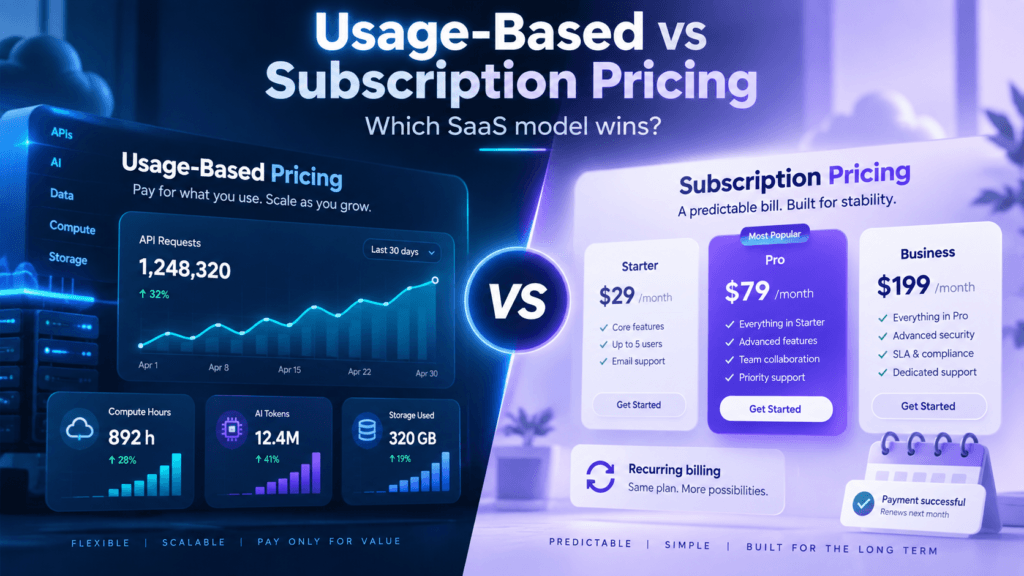
Choosing between usage-based pricing and subscription pricing is one of the most important monetization decisions a SaaS company can make. The pricing model affects customer acquisition, revenue predictability, margins, expansion revenue, and even how customers perceive the product’s value.
With subscription pricing, customers usually pay a recurring monthly or annual fee for access to a software product or plan. With usage-based SaaS pricing, the bill changes according to how much of the product a customer actually consumes. Neither approach is automatically better. The right choice depends on the product, cost structure, buyer expectations, and how closely usage reflects customer value.
Usage-Based Pricing vs Subscription Pricing at a Glance
The simplest distinction is this: subscription pricing charges mainly for continued access, while usage-based pricing charges mainly for consumption. SaaS companies can also combine both approaches through hybrid pricing.
| Factor | Usage-Based Pricing | Subscription Pricing |
|---|---|---|
| Customer pays for | Actual consumption | Recurring access |
| Monthly bill | Variable | Usually predictable |
| Entry cost | Often lower | Usually fixed |
| Revenue predictability | Lower | Higher |
| Expansion revenue | Grows with usage | Grows through upgrades, seats, or add-ons |
| Billing complexity | Higher | Lower |
| Best suited for | APIs, AI, cloud, data, infrastructure | Productivity, collaboration, traditional SaaS |
What Is Usage-Based Pricing?
Usage-based pricing is a pricing model in which a customer’s charges depend on how much of a product or service they consume. It is also called consumption-based pricing, pay-as-you-go pricing, pay-per-use pricing, or metered pricing.
The SaaS company first chooses a measurable value metric and then bills customers according to that metric. Common examples include API requests, AI tokens, messages sent, gigabytes stored, transactions processed, compute time, workflow executions, or automation tasks.
How Usage-Based SaaS Pricing Works
A typical usage-based SaaS pricing system follows four steps. First, the company chooses the unit it wants to meter. Second, the product measures each customer’s usage. Third, the company applies its pricing rules. Finally, the billing platform calculates the customer’s charge for the billing period.
Real implementations can be more sophisticated. Companies may use pure pay-as-you-go pricing, graduated pricing, volume pricing, prepaid credits, committed usage, included allowances, minimum commitments, or overage pricing.
Usage-Based Pricing Examples
Usage-based pricing is particularly common in API, cloud, automation, communications, and AI software. An AI platform may charge for input and output tokens. A communications API may charge for messages sent. A cloud storage product may charge for gigabytes stored, while an automation platform may charge for workflow executions or tasks completed.
The key is that the chosen unit should be understandable to customers and should ideally increase alongside the value they receive.
What Is Subscription Pricing?
Subscription pricing charges customers a recurring amount to continue accessing a product or service. Monthly and annual billing are the most common structures. Customers typically know what they will pay each billing period unless they change plans, add users, or purchase additional services.
Common Subscription Pricing Models
There is no single subscription pricing model. SaaS companies commonly use flat-rate subscriptions, tiered subscriptions, per-user pricing, feature-based plans, freemium offers, and hybrid subscriptions that combine a recurring fee with additional usage charges.
For example, a SaaS company might offer a Starter plan at $19 per month, a Pro plan at $49, and a Business plan at $99. Higher SaaS pricing tiers can include more users, features, storage, or support.
The Biggest Difference: Access vs Consumption
The easiest way to understand usage-based pricing vs subscription pricing is to ask what triggers additional revenue. With a subscription model, revenue usually increases when customers upgrade plans, add seats, purchase add-ons, or renew at a higher tier. With usage pricing, revenue can increase simply because existing customers consume more of the product.
Imagine two companies using the same API. One processes 20,000 requests per month while the other processes 2 million. Under a flat subscription, both could theoretically pay the same price. Under a usage-based model, the heavier customer naturally pays more because consumption is higher.
Advantages of Usage-Based Pricing for SaaS
Lower Barrier to Entry
Customers can often start small instead of committing to an expensive plan before they understand the product’s value. That can reduce friction during acquisition.
Customers Pay According to Consumption
Light users avoid paying for capacity they do not use. This can make the pricing proposition easier to justify and can improve perceived fairness.
Natural Expansion Revenue
A successful customer can generate more revenue without formally upgrading to a higher subscription tier. As product usage grows, spending can grow with it.
Better Fit for Variable Workloads
Cloud infrastructure, APIs, data platforms, and AI products can have enormous differences between light and heavy customers. Usage-based billing accommodates that variation better than a single flat fee.
Disadvantages of Usage-Based Pricing
Unpredictable Customer Bills
Customers may not know their exact bill until the billing period ends. This can create budgeting concerns, especially for finance teams managing many SaaS vendors.
Revenue Is Harder to Forecast
The SaaS company faces the same uncertainty. If customer consumption falls, revenue may fall even when the customer count is unchanged.
Billing Infrastructure Is More Complex
Usage pricing requires accurate metering, data storage, aggregation, pricing rules, invoice calculation, and dispute handling. A standard recurring subscription is much easier to administer.
Bill Shock Can Hurt Trust
A sudden spike in usage may produce an unexpectedly high invoice. Usage dashboards, alerts, spending caps, prepaid credits, and threshold notifications can reduce this risk.
Challenges in Implementing Usage-Based Pricing
One of the hardest decisions is choosing the correct metric. An AI writing platform could charge by words generated, tokens, documents, AI actions, compute time, or successful outputs. The technically easiest unit to meter is not always the unit customers understand best.
Another challenge is pricing transparency. Customers should be able to estimate what they are likely to pay. A pricing model that feels impossible to predict can increase purchase friction instead of reducing it.
Cost alignment also matters. If a SaaS company charges per user while its underlying AI or infrastructure costs grow with usage, heavy customers can become disproportionately expensive to serve.
Advantages of Subscription Pricing
Predictable Customer Costs
A customer paying $99 per month can budget approximately $1,188 per year before taxes or add-ons. That simplicity is valuable to many businesses.
Predictable Recurring Revenue
SaaS companies can forecast revenue more easily when customers are on recurring monthly or annual contracts.
Simple Buying Experience
Customers can compare clear SaaS pricing plans such as Starter, Professional, and Enterprise without estimating future consumption.
Simpler Billing Operations
Standard subscriptions require less complex metering and invoicing infrastructure, which reduces operational overhead.
Disadvantages of Subscription Pricing
Customers may pay for unused capacity, heavy users may be underpriced, and per-user pricing can discourage broader adoption. Fixed subscriptions can also become difficult for AI SaaS products when the cost of serving heavy users grows significantly with usage.
Usage-Based Pricing vs Subscription for AI SaaS
AI has made this pricing debate more important. Additional AI usage can directly create model inference costs, GPU costs, API charges, data-processing expenses, and storage costs. Two customers on the same fixed subscription can therefore have radically different cost-to-serve profiles.
Common AI SaaS pricing approaches now include token pricing, AI credits, generations, minutes, actions, compute units, base subscriptions plus usage, and included credits with paid overages.
What Is Hybrid SaaS Pricing?
Hybrid pricing combines a recurring subscription with usage-based charges. For example, a company might charge $49 per month including 10,000 actions, then bill additional actions at a metered rate.
This gives the SaaS business a predictable subscription floor while still allowing revenue to expand when customers consume more resources. Hybrid models can combine subscriptions, users, features, usage, overages, credits, and commitments.
When Should a SaaS Business Use Usage-Based Pricing?
Usage-based pricing is worth considering when customer consumption varies substantially, infrastructure cost rises with usage, usage closely correlates with customer value, customers prefer a low-commitment entry point, or the product is an API, AI platform, cloud service, or infrastructure tool.
The critical question is whether you can identify a measurable unit that customers understand and that reasonably represents the value they receive.
When Should a SaaS Business Use Subscription Pricing?
Subscription pricing may be preferable when customer usage is relatively predictable, access itself creates most of the value, buyers strongly prefer predictable budgets, costs do not increase dramatically with consumption, and product functionality can be clearly divided between plans.
When Does Hybrid Pricing Make More Sense?
Hybrid pricing is useful when neither pure model solves the entire problem. Consider an AI customer-support platform. The software may provide ongoing value through dashboards, analytics, integrations, team management, and workflow configuration, which can justify a base subscription. AI conversations then create variable compute costs that can be billed through credits or usage.
In that structure, the subscription monetizes access to the platform while usage pricing monetizes variable consumption.
How to Choose the Right SaaS Pricing Model
1. Identify What Creates Customer Value
Determine whether customers gain value primarily from users, transactions, messages, data, projects, automation, or AI output.
2. Understand What Creates Cost for Your Company
Cost-to-serve is especially important for infrastructure and AI SaaS. A pricing model should not encourage usage that destroys gross margins.
3. Evaluate How Predictable Usage Is
If customers cannot estimate consumption at all, pure usage pricing can make budgeting difficult.
4. Check Whether Usage Grows With Customer Success
The strongest usage metric is one that expands when customer value expands.
5. Decide How Important Revenue Predictability Is
A company seeking stable recurring revenue may want a subscription floor even if additional consumption is metered.
A Simple SaaS Pricing Evaluation Framework
Use the following framework as a starting point when comparing subscription, usage-based, and hybrid SaaS pricing models.
| Factor | Subscription | Usage-Based | Hybrid |
|---|---|---|---|
| Revenue predictability | High | Low to medium | High |
| Customer cost predictability | High | Low to medium | Medium to high |
| Value alignment | Medium | High | High |
| Supports variable usage | Low | High | High |
| Billing simplicity | High | Low | Medium |
| Expansion potential | Medium | High | High |
How to Reduce Bill Shock With Usage-Based Pricing
Companies considering usage-based pricing should build customer control into the pricing experience. Useful protections include usage dashboards, spending alerts, budget limits, prepaid credits, estimated monthly bills, threshold notifications, and hard spending caps.
If you are designing your own SaaS plans, you can also use the SaaS Pricing Calculator to test pricing, margins, and revenue scenarios. For AI products, the AI API Cost Calculator can help estimate model costs before you finalize a pricing structure.
Common SaaS Pricing Mistakes
Common mistakes include choosing a metric customers do not understand, creating too many pricing tiers, hiding important limits, ignoring heavy-user economics, making costs impossible to predict, and failing to revisit pricing as the product evolves.
Pricing should be treated as an ongoing strategic decision rather than a one-time launch task.
Usage-Based Pricing vs Subscription: Which Is Better?
Neither model wins in every situation. Choose subscription pricing when predictable access, predictable bills, and predictable recurring revenue matter most. Choose usage-based pricing when customer consumption varies significantly and usage closely reflects customer value. Consider hybrid pricing when you want the stability of recurring revenue while still monetizing variable consumption.
For many modern SaaS and AI products, the more useful question is not subscription or usage. It is how much of the product should be subscription-based and how much should be usage-based.
Final Verdict
Usage-based pricing vs subscription pricing is ultimately a question of value alignment. Subscription pricing remains powerful because it is simple, familiar, and predictable. Usage-based pricing can create a stronger connection between consumption and revenue, particularly for APIs, cloud products, and AI software.
For many SaaS businesses, a well-designed hybrid model offers the strongest balance: a predictable recurring subscription, a reasonable amount of included usage, and transparent charges when consumption grows beyond that allowance.
Frequently Asked Questions
What is the difference between usage-based pricing and subscription pricing?
Usage-based pricing charges customers according to how much of a product or service they consume. Subscription pricing usually charges a recurring monthly or annual amount for continued access to a product or plan.
Is usage-based pricing better than subscription pricing for SaaS?
Not universally. Usage pricing can work better when consumption varies significantly and usage closely reflects value. Subscription pricing is often better when predictable costs and simple purchasing are priorities.
What is usage-based pricing for SaaS?
Usage-based pricing for SaaS means charging according to a measurable consumption unit such as API calls, tokens, transactions, storage, automation tasks, or data processed.
What is a subscription-based pricing model?
A subscription-based pricing model charges customers at regular intervals, commonly monthly or annually, for continued access to software or services.
Can SaaS companies combine usage-based and subscription pricing?
Yes. A SaaS company can charge a recurring base subscription while including a usage allowance or billing additional consumption separately. This is commonly called hybrid pricing.
Is usage-based pricing good for AI SaaS?
It can be particularly suitable because AI infrastructure costs often increase with consumption. Tokens, credits, generations, compute units, and AI actions are common ways to connect usage with pricing.