
A SaaS startup budget can be tiny or enormous depending on what you are building, who is building it, and how quickly you want to reach the market. A founder using no-code tools and existing APIs can test an idea with a few hundred dollars, while a team building a secure enterprise platform may spend tens or hundreds of thousands before meaningful revenue arrives.
The important question is not “How much does SaaS cost?” in isolation. It is: what do you need to spend to validate demand, deliver the product reliably, acquire customers, and survive long enough to learn? This guide breaks a SaaS budget into practical cost categories and gives you sample budget scenarios you can adapt to your own business.
Quick answer: A lean founder-led SaaS can often validate an idea for under $5,000 if development is handled internally and paid acquisition is limited. A professionally built MVP can easily move into the $15,000–$75,000 range, while complex enterprise software may require substantially more.
Treat those numbers as planning examples, not universal price tags. Your real SaaS cost structure depends on product complexity, infrastructure, AI usage, compliance, talent, and sales motion.
SaaS Startup Budget at a Glance
The table below shows three simplified ways a new SaaS company might allocate early capital.
| Budget level | Typical approach | What it may cover |
|---|---|---|
| Ultra-lean: $500–$5,000 | Founder-built / no-code / existing APIs | Domain, hosting, software tools, basic design, small testing budget |
| Lean MVP: $5,000–$25,000 | Founder + freelancers or small technical team | MVP development, infrastructure, analytics, basic marketing, legal setup |
| Professional MVP: $25,000–$75,000+ | Agency or dedicated product team | Design, engineering, QA, security, onboarding, integrations, launch support |
| Enterprise-grade: $75,000+ | Specialized engineering and compliance | Complex architecture, security, compliance, integrations, support systems |
These are illustrative planning ranges. The same product idea can cost dramatically different amounts depending on whether you code it yourself, hire overseas freelancers, use a specialist SaaS agency, or build an internal team.
The 8 Main SaaS Startup Cost Categories
A good budget separates one-time startup expenses from recurring monthly costs. That makes it easier to understand how much cash you need to launch and how much runway you need after launch.
1. Product development
Development is usually the largest early cost if you cannot build the product yourself. This may include front-end development, back-end development, database architecture, API integrations, testing, authentication, payments, admin tools, and deployment.
The cheapest version of development is not always the cheapest long term. Poor architecture, missing analytics, and rushed code can create expensive rework later. The goal is to build the smallest version that proves the value proposition without creating avoidable technical debt.
2. UI and UX design
Design costs include user flows, wireframes, interface design, mobile responsiveness, onboarding, dashboard layouts, and usability testing. A SaaS product does not need to look expensive at launch, but it does need to be understandable.
Many early-stage products overspend on visual polish before they have proven demand. Prioritize clarity, speed, and successful task completion over decorative complexity.
3. Hosting and infrastructure
Your infrastructure budget may include cloud hosting, database services, storage, email delivery, logging, monitoring, backups, CDN usage, and third-party APIs. Early-stage infrastructure can be inexpensive, but costs can rise quickly if the product processes large volumes of data, media, AI requests, or real-time events.
4. AI and API costs
If your SaaS depends on language models, image generation, transcription, search APIs, data enrichment, or other metered services, usage becomes part of your cost of goods sold. This is especially important for AI SaaS because heavy users can become expensive to serve.
Before setting your own pricing, estimate model and API expenses with the AI API Cost Calculator. You can then test customer pricing scenarios with the AI SaaS Pricing Calculator.
5. Software and operational tools
Even a small SaaS company may pay for analytics, project management, customer support, CRM, email marketing, accounting, design, error monitoring, documentation, automation, and internal collaboration software.
The danger is subscription creep. Ten inexpensive tools can quietly become a meaningful monthly expense. Review every recurring tool quarterly and remove anything that is not helping product delivery, revenue, or customer support.
6. Legal, accounting and company setup
Depending on your country and customer base, you may need company registration, accounting, contracts, privacy documentation, terms of service, tax advice, intellectual-property agreements, and payment compliance.
Enterprise customers may also expect stronger legal and security documentation, which can increase costs as the company grows.
7. Marketing and customer acquisition
Your marketing budget can include content, SEO, paid ads, email software, communities, sponsorships, events, design, video, affiliate programs, and sales tools. Early founders should avoid assuming paid acquisition will solve weak product-market fit.
For many SaaS startups, founder-led outreach, SEO content, partnerships, communities, and product-led acquisition are more useful in the validation stage because they generate both customers and feedback.
8. Support and customer success
Customer support is often underestimated. As soon as real customers depend on the product, someone has to answer questions, troubleshoot issues, improve documentation, and help users reach value. Enterprise SaaS may also require onboarding, training, dedicated account management, or service-level commitments.
One-Time Costs vs Monthly SaaS Expenses
A useful SaaS startup budget should separate launch costs from ongoing operating expenses.
| One-time or irregular costs | Recurring monthly costs |
|---|---|
| Initial development | Cloud hosting |
| Brand and product design | APIs and AI usage |
| Legal setup | Email and communication tools |
| Initial integrations | Analytics and monitoring |
| Launch assets | Customer support software |
| Security or compliance work | CRM and sales tools |
| Initial content library | Marketing software |
This distinction matters because a startup can afford the launch and still fail because it underestimated the cost of staying alive for the next twelve months.
How Much Runway Should a SaaS Startup Budget For?
Runway is the number of months your company can continue operating before it runs out of cash. A simple formula is:
Runway = Cash available ÷ Monthly net burn
If you have $60,000 in cash and lose $5,000 per month after revenue, you have roughly 12 months of runway. If revenue grows and monthly burn falls, runway improves. If hiring or infrastructure costs increase, runway shrinks.
Why runway matters more than launch budget
Most SaaS products do not reach product-market fit immediately. You may need several pricing changes, onboarding experiments, positioning revisions, or product iterations before growth becomes repeatable. A budget that leaves no room for learning is fragile even if the first version of the product launches successfully.
Example: $5,000 Lean SaaS Startup Budget
A founder who can build most of the product internally might use a small budget like this:
| Expense | Example allocation |
|---|---|
| Domain, hosting and infrastructure | $500 |
| Design or templates | $400 |
| APIs and software tools | $600 |
| Legal/accounting setup | $800 |
| Content and launch assets | $700 |
| Customer acquisition tests | $1,000 |
| Emergency / iteration reserve | $1,000 |
This approach only works when founder labor is not being paid from the project budget and the product can be built without expensive external engineering.
Example: $25,000 SaaS MVP Budget
A more typical founder who needs outside technical help may allocate something closer to:
| Expense | Example allocation |
|---|---|
| Development | $12,000 |
| UI/UX design | $2,500 |
| Infrastructure and APIs | $1,500 |
| Legal and accounting | $1,500 |
| Analytics, support and software tools | $1,000 |
| Content, SEO and launch marketing | $3,000 |
| Customer acquisition tests | $1,500 |
| Contingency | $2,000 |
The contingency line is important. Development estimates are rarely perfect, and early customers will often reveal missing workflows or integrations you did not predict.
Example: $75,000 Professional SaaS Budget
A larger budget can support deeper engineering, a stronger launch, and more runway, but it should not be treated as permission to build everything before talking to customers.
| Expense | Example allocation |
|---|---|
| Engineering and QA | $35,000 |
| Product and UX design | $7,500 |
| Infrastructure, APIs and security | $5,000 |
| Legal, accounting and compliance | $4,000 |
| Marketing website and content | $5,000 |
| Sales and customer acquisition | $6,000 |
| Customer support and operations | $2,500 |
| Reserve / iteration runway | $10,000 |
Again, these numbers are planning examples. Your location, hiring model, product complexity, and market can move every line significantly.
How SaaS Cost Structure Changes as You Grow
Early-stage SaaS businesses often have a cost structure dominated by development. Once the product reaches the market, sales, marketing, support, cloud infrastructure, and customer-success costs become more important.
Pre-revenue stage
Most spending goes toward product creation, validation, tools, and initial marketing. The objective is learning, not scale.
Early revenue stage
Customer support, analytics, onboarding, sales tools, and acquisition become more important. The team begins measuring conversion, retention, expansion, and gross margin more carefully.
Growth stage
Headcount becomes a major cost. Sales, customer success, engineering, marketing, security, and operations expand. Infrastructure may also become a meaningful variable cost.
Enterprise stage
Enterprise SaaS may add compliance, security reviews, SLAs, professional services, implementation, and dedicated account management. Pricing should evolve with those costs rather than remaining stuck at an early self-service structure.
For a deeper look at packaging larger customers, see our guide to enterprise software pricing models.
How AI Changes a SaaS Startup Budget
AI can reduce some startup costs while increasing others. Founders can prototype faster, generate code, automate support, accelerate research, and produce content more efficiently. At the same time, AI products often introduce variable model costs that traditional SaaS companies did not have to manage.
AI can reduce labor cost
A small team can now produce prototypes, documentation, analysis, marketing assets, and support workflows faster than before. That can reduce the amount of capital required to test an idea.
AI can increase cost of goods sold
Every inference request, image generation, transcription, or external AI API call can create a direct cost. If your pricing does not account for heavy usage, your most active customers can become your least profitable.
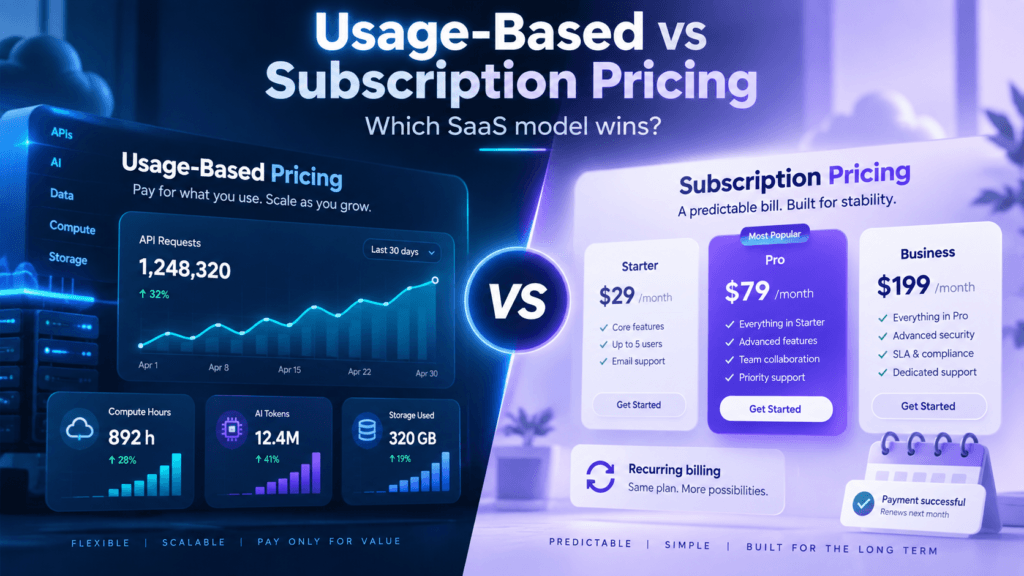
This is one reason many AI businesses are moving toward usage-based or hybrid pricing. Read our comparison of usage-based pricing vs subscription pricing before choosing a monetization model.
Where SaaS Founders Commonly Overspend
Building too many features before validation
The most expensive feature is one nobody needs. Early development should focus on the smallest workflow that proves customers care about the problem and are willing to pay for a solution.
Branding before product-market fit
A credible website and clean product design matter, but expensive branding projects rarely fix weak demand. Spend enough to look trustworthy, then invest more after the positioning is proven.
Buying too many software tools
Founders often subscribe to premium tools before they have a process that requires them. Start with the minimum stack and upgrade when manual work becomes the bottleneck.
Paid ads too early
Paid acquisition can accelerate a working funnel, but it can also accelerate losses. If onboarding, retention, and conversion are weak, more traffic only creates more expensive learning.
Hiring before the bottleneck is clear
Full-time hiring creates recurring burn. Use founders, contractors, automation, and focused specialists until you understand which roles will produce durable leverage.
Where You Should Not Cut Costs Too Aggressively
Security
Weak authentication, poor data handling, or missing backups can destroy trust quickly. Security requirements increase further if you sell to enterprises.
Monitoring and backups
You need to know when the product is broken and have a recovery path. These costs are small compared with the damage caused by lost customer data or extended downtime.
Customer support
Early support conversations are one of your best research channels. Do not automate every interaction before you understand what customers are struggling with.
Analytics
If you cannot see activation, retention, churn, and feature usage, it becomes difficult to know whether the product is improving.
How to Build Your Own SaaS Budget
Step 1: Define the validation milestone
Decide what success looks like before you spend. It may be ten paying customers, $1,000 MRR, a successful pilot, a certain activation rate, or a signed enterprise design partner.
Step 2: List required costs only
Separate “must-have to reach the milestone” from “nice to have.” The second list can wait.
Step 3: Estimate monthly burn
Include infrastructure, software, contractors, salaries, marketing, support, and any founder living expenses funded by the business.
Step 4: Add a contingency buffer
Plan for unexpected development, support, legal, or infrastructure costs. A budget with zero flexibility is usually unrealistic.
Step 5: Reforecast every month
Your budget should change as you learn. If customer acquisition is working, spend may shift toward growth. If churn is high, product and customer success may deserve more investment than marketing.
A Simple SaaS Startup Budget Formula
Total capital needed ≈ One-time build costs + (Monthly net burn × Desired runway) + Contingency reserve
For example, if your one-time build costs are $15,000, monthly net burn is $3,000, you want 12 months of runway, and you want a $5,000 reserve, the planning requirement would be approximately $56,000.
This formula is intentionally simple, but it forces you to think beyond the cost of launching.
Final Verdict
A strong SaaS startup budget is not about spending the least money possible. It is about spending enough to reach the next meaningful proof point without creating unnecessary burn.
Start lean, keep fixed costs low, measure variable costs carefully, and protect runway for iteration. If you are building AI SaaS, pay particular attention to API and inference expenses because they can fundamentally change your margins and pricing strategy.
The best budget is the one that gives you enough time to learn whether customers truly value the product—and enough flexibility to change direction when the evidence tells you to.
Frequently Asked Questions
How much money do you need to start a SaaS business?
It depends heavily on who builds the product and how complex it is. A founder-built or no-code validation project may cost under $5,000, while a professionally developed MVP can cost tens of thousands of dollars or more.
What are the biggest SaaS startup costs?
The largest early costs are usually development, design, infrastructure, APIs, software tools, legal setup, marketing, and customer support. For AI SaaS, model and API usage can also become a major variable cost.
How much runway should a SaaS startup have?
There is no universal number, but startups should budget enough runway to survive multiple product and go-to-market iterations. Twelve months is a useful planning scenario for many early-stage teams, though actual needs vary widely.
How do you calculate SaaS runway?
Divide cash available by monthly net burn. For example, $60,000 in cash with a $5,000 monthly net burn equals roughly 12 months of runway.
How does AI affect SaaS startup costs?
AI can lower development and operating costs through automation, but AI products may also create significant variable model and API expenses. Those costs should be included in both the startup budget and pricing model.