
Enterprise software pricing is rarely as simple as putting three plans on a public pricing page. Large customers buy differently: they need security reviews, procurement approval, implementation support, service-level commitments, flexible billing, and often a pricing structure that reflects both platform value and actual usage.
That is why enterprise software pricing models usually combine more than one pricing dimension. A company may charge a base platform fee, add per-user pricing, include usage allowances, negotiate annual commitments, and attach premium support or onboarding fees. The best model is the one that stays understandable to the buyer while still protecting margins and allowing revenue to grow with customer value.
Quick verdict: For most B2B SaaS companies selling to larger organizations, hybrid enterprise pricing is the strongest default. A recurring platform fee creates predictable revenue, while seats, usage, add-ons, or committed volume allow the account to expand naturally.
Pure per-seat pricing works well when value increases with team adoption. Pure usage-based pricing works better for infrastructure, APIs, AI, data, and communications products. Custom pricing makes sense when implementation, security, support, or contract requirements vary significantly by customer.
Enterprise Software Pricing Models at a Glance
The table below summarizes the seven enterprise pricing models we see most often in SaaS and software services.
| Pricing model | How it works | Best fit | Main risk |
|---|---|---|---|
| Tiered subscription | Customers choose a plan with defined features and limits. | Business software with clear customer segments | Poorly designed tiers can force awkward upgrades |
| Per-user / per-seat | Price scales with the number of users. | Collaboration, CRM, HR, productivity | Can discourage broad adoption |
| Usage-based | Customers pay according to consumption. | APIs, cloud, data, AI, communications | Revenue and bills can become unpredictable |
| Hybrid | Base subscription plus seats, usage, or overages. | Modern B2B and AI SaaS | More complex to explain and bill |
| Value-based | Price reflects business value or outcome potential. | Mission-critical or high-ROI software | Requires strong value measurement |
| Custom enterprise | Price is negotiated based on scope and contract terms. | Large or complex accounts | Slower sales cycles and less transparency |
| Platform + add-ons | Core platform fee plus optional modules and services. | Broad suites and multi-product SaaS | Can become difficult to understand |
Recent pricing guidance from Stripe and Paddle also reflects the growing importance of hybrid pricing, especially where SaaS companies need predictable recurring revenue but customer consumption varies significantly.
What Makes Enterprise SaaS Pricing Different?
Enterprise SaaS pricing is different from SMB pricing because the product is only one part of the commercial agreement. Large companies often evaluate procurement risk, integrations, security, compliance, implementation, data requirements, support, and contract terms alongside the software itself.
Finance, procurement, IT, security, legal, and department leaders may all influence the purchase.
Enterprise customers often expect negotiated pricing, volume discounts, and annual commitments.
Implementation, onboarding, SLAs, training, and premium support can become part of the package.
Heavy usage, data volume, integrations, AI compute, or support can materially change cost-to-serve.
This is why a single flat monthly price is often too crude for enterprise software. The pricing structure needs enough flexibility to reflect real account value without becoming so complicated that the buyer cannot understand it.
1. Tiered Subscription Pricing
Tiered pricing groups customers into predefined plans, usually based on features, limits, support levels, or customer size. A typical structure may include Starter, Professional, Business, and Enterprise plans.
When tiered enterprise pricing works best
Tiered pricing works well when customer segments have genuinely different needs. For example, a professional plan may include core automation while an enterprise plan adds SSO, advanced permissions, audit logs, dedicated support, custom retention policies, and stronger security controls.
Why SaaS pricing tiers can fail
The problem begins when tiers are created only to force customers upward. If an essential feature is locked behind a much more expensive plan without a clear value difference, buyers may feel the upgrade is artificial rather than useful. Good SaaS tiered pricing should create a natural upgrade path as customer complexity increases.
2. Per-User or Per-Seat Pricing
Per-user pricing charges according to the number of people who can access the product. It remains one of the most familiar enterprise SaaS pricing models because procurement teams can understand it quickly and forecast spending from headcount.
Best fit for seat-based pricing
This model is strongest when product value grows as more people participate. CRM systems, collaboration tools, HR platforms, project management software, and sales tools often fit this structure because adoption across the organization is part of the value proposition.
The adoption problem
Per-seat pricing can also work against product growth. A customer may deliberately limit licenses because every additional user increases cost. If the software becomes more valuable when more teams use it, charging for every seat can discourage the behavior you actually want.
3. Usage-Based Pricing
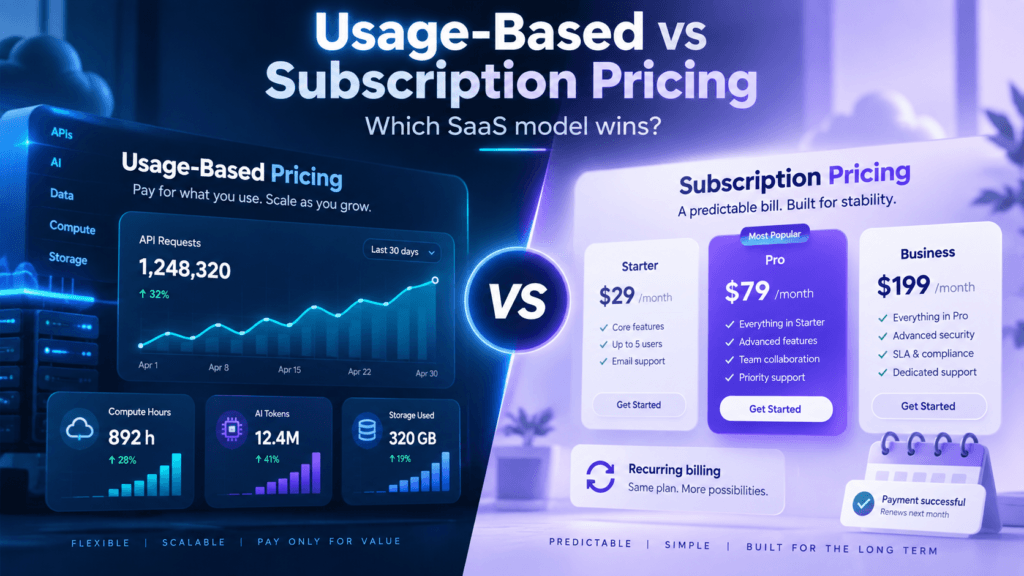
Usage-based enterprise software pricing charges customers according to a measurable consumption unit such as API calls, transactions, messages, data processed, storage, AI tokens, compute time, or workflow executions.
Why usage-based pricing works for enterprise SaaS
It can create excellent value alignment because light customers pay less while heavy customers naturally pay more. It is especially strong for products where operating cost also increases with customer consumption.
Where it becomes risky
Pure usage pricing can make budgets difficult to predict. Enterprise finance teams usually dislike unexpected invoices, so successful usage-based models often include committed spend, usage dashboards, alerts, annual allowances, or negotiated volume rates.
We cover this model in greater depth in our guide to usage-based pricing vs subscription pricing.
4. Hybrid Pricing
Hybrid pricing combines a recurring platform fee with another pricing dimension, such as users, usage, transactions, credits, storage, or overages. For many modern SaaS companies, it is the most practical enterprise pricing model.
Example hybrid SaaS pricing structure
An enterprise AI platform could charge $2,000 per month for platform access, security controls, team management, analytics, and support. The plan might include a monthly AI usage allowance, with additional tokens or actions billed separately once the allowance is exceeded.
Why hybrid pricing is attractive
The base fee creates predictable recurring revenue while the variable component allows revenue to grow with customer usage. This can be particularly useful when the platform has substantial fixed value but also carries variable infrastructure costs.
5. Value-Based Pricing
Value-based pricing starts with the economic value the software creates for the customer rather than simply adding a margin to your cost. A product that saves a company $2 million per year can often command a much higher price than a product with the same technical hosting cost but little measurable business impact.
Good candidates for value-based pricing
This approach is strongest for mission-critical software that directly affects revenue, cost savings, risk reduction, compliance, conversion, staffing efficiency, or operational throughput.
The challenge
Value has to be credible. If the customer cannot connect the product to a measurable business result, the pricing can feel arbitrary. Strong case studies, ROI analysis, benchmarks, and calculators make value-based enterprise pricing easier to defend.
If you need to quantify potential software returns, our AI ROI Calculator can help model savings, payback, and multi-year value.
6. Custom or Negotiated Enterprise Pricing
Custom enterprise pricing means there is no single public price for every large customer. The final quote depends on factors such as user count, usage, modules, implementation scope, support, contract length, data volume, compliance requirements, or expected growth.
Why companies use custom pricing
Large accounts can be too different for a single package. One customer may require 5,000 users and standard support, while another needs only 500 users but demands complex integrations, custom data residency, a strict SLA, and dedicated implementation resources.
When Contact Sales becomes a problem
Custom pricing should not mean total opacity. Enterprise buyers still want to understand the pricing logic before entering a long sales process. Publishing starting prices, value metrics, package differences, or example ranges can improve trust without eliminating negotiation.
7. Platform Fee Plus Add-Ons
This model charges a core platform fee and then sells additional modules, capabilities, or services separately. It is common in broad enterprise software suites where different departments need different functionality.
Typical enterprise add-ons
Add-ons may include advanced analytics, AI capabilities, premium integrations, extra storage, data enrichment, compliance features, training, onboarding, dedicated support, sandbox environments, or additional business units.
Keep packaging understandable
The danger is creating a pricing system where every useful capability becomes another charge. The buyer should still be able to understand what the core platform does, what is included, and why an add-on costs more.
How Enterprise Software Pricing Is Usually Structured
Enterprise software pricing often contains several layers. Understanding these components makes it easier to compare proposals and design a pricing strategy that scales.
Base platform fee
A recurring charge for access to the core software, administration, standard features, and baseline support.
Seats or user licenses
An additional charge based on users, active users, administrators, agents, employees, or another role relevant to the product.
Usage or consumption
Charges based on transactions, compute, API requests, storage, AI tokens, messages, workflows, or another measurable value metric.
Minimum commitment
Enterprise agreements often include an annual minimum spend or committed volume. The customer receives predictable pricing or discounts in exchange for committing to a certain level of spend.
Implementation and onboarding
Complex deployments may include one-time fees for migration, configuration, integrations, training, or professional services.
Premium support and SLA
Customers may pay more for faster response times, dedicated customer success, 24/7 support, uptime commitments, or financially backed service-level agreements.
Enterprise SaaS Pricing Examples
The following examples are simplified, but they show how different enterprise pricing models can be combined.
| Product type | Possible pricing structure | Why it fits |
|---|---|---|
| Enterprise CRM | $120 per user/month + enterprise support | Value scales with team adoption |
| AI customer support platform | $1,500 platform fee + AI conversations | Fixed platform value plus variable compute cost |
| Data warehouse | Annual commitment + consumption | Customer usage varies significantly |
| Security SaaS | Tier based on employees/endpoints + premium modules | Account size and security scope drive value |
| Marketing automation | Base subscription + contacts + add-ons | Customer database size creates a scalable metric |
These are illustrative structures, not recommended price points. Actual enterprise software pricing depends on customer value, competitive positioning, cost structure, product maturity, and sales strategy.
Enterprise SaaS Pricing vs SMB Pricing
SMB SaaS pricing usually prioritizes simplicity and self-service. Enterprise pricing has to accommodate complexity.
| Area | SMB SaaS | Enterprise SaaS |
|---|---|---|
| Buying motion | Self-service or light-touch sales | Sales-led, procurement-heavy |
| Pricing | Public and standardized | Often negotiated or customized |
| Contract | Monthly or standard annual terms | Annual or multi-year agreement |
| Security | Standard controls | Detailed reviews, SSO, audit, compliance |
| Support | Standard support | Dedicated success, SLA, premium support |
| Implementation | Usually self-serve | May require onboarding and services |
How to Choose the Right Enterprise Pricing Model
The best SaaS pricing strategy is not the model that produces the highest price on paper. It is the model that matches customer value, supports a natural expansion path, and remains economically sustainable as accounts grow.
1. Identify the real value metric
Ask what grows when the customer gets more value. It may be users, transactions, revenue processed, data volume, workflows, AI actions, locations, or another measurable outcome.
2. Understand your SaaS cost structure
Separate fixed costs from variable costs. If a customer’s usage significantly increases infrastructure, AI, support, or data-processing expense, your pricing should account for it.
3. Match the model to how customers budget
Pricing is easier to approve when the metric maps to something the customer already understands. Per-seat pricing can align with headcount budgets, while transaction or usage pricing can align with operational volume.
4. Design a natural expansion path
Customers should be able to grow from one level of spend to another because they receive more value, not because the pricing architecture creates artificial restrictions.
5. Protect predictability for both sides
Customers want budgeting confidence; SaaS companies want revenue predictability. Minimum commitments, included usage, caps, thresholds, and hybrid models can help balance those needs.
A Practical Enterprise Pricing Decision Matrix
| If your product… | Start by testing… |
|---|---|
| Gets more valuable as more employees use it | Per-seat or tiered pricing |
| Has variable infrastructure cost | Usage-based or hybrid pricing |
| Creates a measurable financial outcome | Value-based or outcome-linked pricing |
| Has substantial platform value plus variable usage | Hybrid pricing |
| Requires different implementation for every customer | Custom enterprise pricing |
| Has many optional modules | Platform + add-ons |
How to Price Software as a Service for Enterprise Customers
If you are deciding how to price software as a service, avoid starting with competitor price copying. Competitor benchmarks are useful, but they cannot tell you what your own customers value or what your product costs to deliver.
Start with customer segmentation
Define who the enterprise customer is. A 200-person company and a 50,000-person company should not automatically be treated as the same segment simply because both ask for an enterprise plan.
Estimate willingness to pay and ROI
Use customer interviews, sales calls, win/loss data, ROI calculations, and pricing experiments to understand where the product creates enough value to justify a higher contract.
Model margins under realistic usage
Test what happens if an account uses significantly more AI, support, bandwidth, data, or integrations than expected. Enterprise deals can look attractive at signing and become unprofitable later if heavy usage is not priced correctly.
Keep the commercial story simple
Even sophisticated enterprise pricing should have a clear explanation: what is the base value, what makes the price grow, and what the customer receives at each level.
You can model plan economics with our AI SaaS Pricing Calculator. If AI or model usage is part of your cost base, use the AI API Cost Calculator to estimate underlying API expenses before setting customer prices.
Enterprise Pricing Mistakes to Avoid
Hiding every pricing signal
Some enterprise products need custom quotes, but giving buyers no idea how pricing works can create unnecessary friction. Even a starting figure, value metric, or example structure can help qualify buyers.
Charging for the wrong metric
A metric that is convenient to bill is not automatically a good value metric. If customers have to reduce product usage to control cost, your model may discourage the very behavior that makes the software valuable.
Over-discounting multi-year deals
Long contracts improve retention and predictability, but excessive discounts can lock in weak economics for years. Discounting should reflect the value of commitment, not replace sound pricing.
Ignoring implementation cost
Enterprise onboarding can consume significant engineering, support, and customer-success resources. Include those costs in the commercial model rather than treating them as free.
Making the proposal impossible to understand
Complexity is sometimes necessary, confusion is not. A buyer should be able to explain the pricing logic internally without needing your sales representative in every meeting.
Should Enterprise SaaS Publish Prices?
There is no universal rule. A standardized product with predictable implementation can often publish enterprise pricing or at least starting prices. A highly customized platform may need a sales-led quote.
A practical middle ground is to publish the pricing architecture: the base model, what drives additional cost, which features are enterprise-only, and whether volume commitments or custom contracts are available. This creates transparency while preserving flexibility.
Final Verdict
The strongest enterprise software pricing models are built around value, expansion, and economic sustainability. Tiered and per-seat models remain useful for traditional business software. Usage-based pricing is powerful for infrastructure and variable-consumption products. Custom pricing helps when account requirements vary substantially.
For many modern B2B and AI SaaS businesses, however, hybrid pricing offers the best overall balance. A recurring platform fee establishes predictable value, while seats, usage, modules, or overages allow pricing to scale as the customer grows.
The goal is not to create the most complicated pricing system. It is to create a model that customers can understand, sales teams can defend, finance teams can forecast, and the business can sustain.
Frequently Asked Questions
What are enterprise software pricing models?
Enterprise software pricing models are the structures used to charge larger organizations for software. Common models include tiered subscriptions, per-seat pricing, usage-based pricing, hybrid pricing, value-based pricing, custom negotiated contracts, and platform-plus-add-on pricing.
What is the best enterprise SaaS pricing model?
There is no universal best model. Per-seat pricing works well when value scales with users, usage-based pricing fits products with variable consumption, and hybrid pricing is often effective when a SaaS product has both fixed platform value and variable usage.
Why do enterprise SaaS companies use custom pricing?
Enterprise customers can differ significantly in users, implementation, integrations, security, support, data volume, and contract requirements. Custom pricing allows the vendor to reflect those differences in the commercial agreement.
Should enterprise software pricing be public?
It depends on how standardized the product and implementation are. Even when exact enterprise quotes are negotiated, publishing pricing logic, starting prices, or the main value metric can make the buying process clearer.
What is hybrid enterprise SaaS pricing?
Hybrid pricing combines a recurring base subscription with a variable component such as users, API calls, AI usage, transactions, storage, or overages. It can provide predictable baseline revenue while allowing accounts to expand with usage.
Featured photo by dlxmedia.hu on Unsplash.