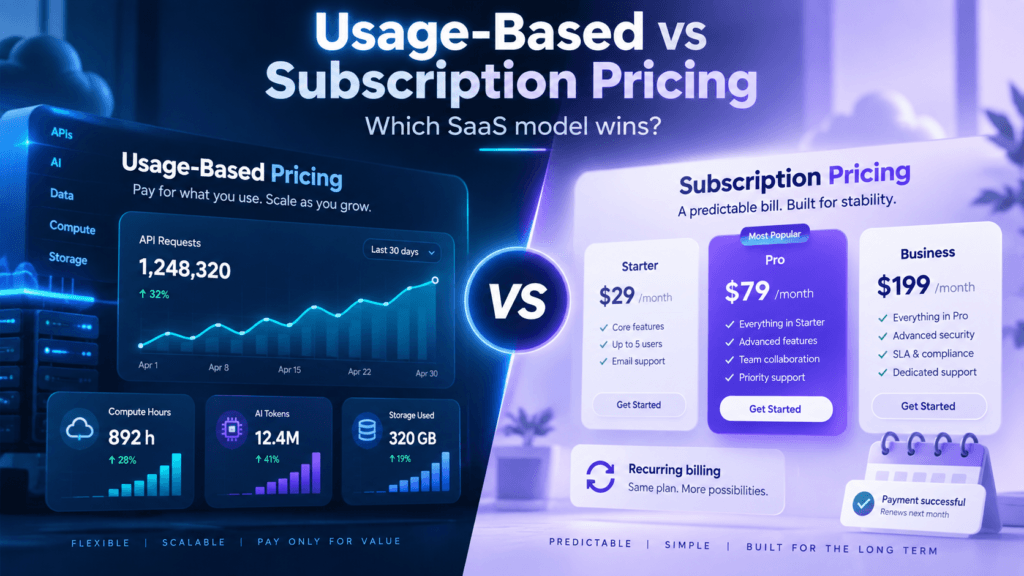

Software pricing strategies determine far more than the number printed on a pricing page. They shape which customers buy, how quickly revenue expands, whether margins survive heavy usage, how easy the product is to sell, and whether customers feel the price grows in proportion to the value they receive. For SaaS companies in particular, software pricing is tightly connected to packaging, billing, product architecture, sales motion, customer success, and long-term retention. A weak pricing strategy can make a strong product difficult to monetize, while a well-designed pricing structure can improve conversion, expansion revenue, and profitability without increasing acquisition spend. This guide explains the major software pricing models, the difference between pricing strategy and pricing model, how to choose a value metric, how to price software products at different stages, and how to avoid the common mistakes that lead to underpricing, over-discounting, and customer confusion.
What Is a Software Pricing Strategy?
A software pricing strategy is the commercial system used to decide what customers pay, what they receive at each price point, how price scales as customer value or usage grows, and when customers should move to a higher plan, contract, or service level. It includes the pricing model, the value metric, packaging rules, discount policy, billing frequency, trial structure, free-plan decisions, and the way enterprise contracts are handled. The strongest software pricing strategies begin with customer value rather than internal cost alone. Cost matters because the business must maintain healthy margins, but customers do not buy software because it costs the vendor money to build. They buy because the software saves time, reduces risk, increases revenue, improves productivity, automates work, or creates another measurable outcome. Pricing works best when the structure makes that value easy to understand and allows revenue to grow as customer value grows.
Pricing strategy vs pricing model
The pricing strategy is the broader commercial logic, while the pricing model is the mechanism used to charge the customer. Subscription, per-user, usage-based, flat-rate, tiered, freemium, hybrid, and perpetual licensing are pricing models. The strategy decides why a company chooses one of those models, how it packages the offer, which customer segment each plan serves, how much price should increase between tiers, and how discounts are controlled. Two SaaS businesses can both use per-user pricing and still have very different strategies because one may target small teams with low monthly plans while the other targets regulated enterprises with minimum commitments, annual contracts, onboarding fees, and negotiated discounts. Treating the model as the entire strategy is a common mistake because it ignores packaging, segmentation, willingness to pay, value metrics, and expansion logic.
10 Common Software Pricing Models
1. Flat-rate pricing
Flat-rate pricing charges one recurring amount for a defined package of software, often regardless of team size or usage within reasonable limits. It is attractive because buyers can understand the price immediately, finance teams can forecast cost easily, and the vendor can keep billing operations simple. Flat-rate pricing works best when customer usage and cost-to-serve do not vary dramatically across accounts and when the product creates broad value that is difficult to express through a single measurable unit. The weakness is that heavy users can consume far more resources than light users while paying the same amount, which can hurt margins or leave expansion revenue untapped. Flat-rate pricing can also make segmentation difficult because a small customer and a large customer may receive very different economic value from the same plan. For early-stage products, however, one clear flat price can be useful while the company is still learning how customers use the software.
2. Tiered pricing
Tiered pricing offers several plans with progressively greater features, limits, users, support levels, or usage allowances. This is one of the most common SaaS pricing methods because it lets different customer segments self-select into a package that matches their needs and budget. A typical structure might include Starter, Pro, Business, and Enterprise plans, with clear upgrade triggers between each tier. The commercial advantage is expansion: as a customer grows, needs more automation, adds users, requires stronger security, or reaches a usage limit, the product has a natural path to higher revenue. The challenge is packaging discipline. Too many tiers increase decision complexity, while arbitrary feature gates can make customers feel manipulated. A strong tiered software pricing strategy gives each plan a clear customer, a clear value proposition, and a clear reason to upgrade. Our SaaS pricing ladder guide explains how those upgrade paths should be designed.
3. Per-user pricing
Per-user pricing, also called per-seat pricing, charges according to the number of people who have access to the software. It is especially common in collaboration, CRM, productivity, project-management, and workflow products because team size is easy to measure and often correlates with customer value. The biggest strength is simplicity: a company with 20 users can quickly estimate what it will pay, and the vendor can forecast expansion when teams add employees. The weakness is that per-user pricing can discourage broad adoption. Customers may limit seats, share accounts, or keep occasional users outside the platform because every additional person increases cost. It also becomes less suitable when AI agents, automated workflows, or APIs create significant value without a human user attached to each unit of activity. Per-user pricing works best when individual access is genuinely tied to value rather than used only because competitors already charge by seat.
4. Usage-based pricing
Usage-based pricing charges customers according to consumption, such as API calls, AI tokens, transactions, messages, storage, compute time, workflow executions, or another measurable unit. This model can align revenue closely with customer value because customers who use the product more usually pay more, while light users can start with lower cost. It is especially relevant for AI SaaS, cloud infrastructure, developer platforms, data products, and communications software where delivery costs also scale with consumption. The trade-off is predictability. Customers may worry about bill shock, finance teams may find budgeting harder, and the vendor must build reliable metering, rating, alerts, and billing infrastructure. A successful usage-based strategy needs a value metric customers understand, transparent dashboards, spending controls, and clear overage rules. See our detailed comparison of usage-based pricing vs subscription pricing for the operational and revenue trade-offs.
5. Freemium pricing
Freemium pricing gives customers a permanently free version of the product and monetizes a portion of users through paid upgrades. The model can reduce acquisition friction, increase product awareness, create referral loops, and allow users to experience value before making a purchase decision. It works especially well when free users create distribution through invitations, shared files, templates, collaboration links, public content, or network effects. However, freemium can become expensive when support, infrastructure, and onboarding costs are high or when the free plan attracts users who are unlikely to match the ideal customer profile. The free tier also needs deliberate limits. If free users receive enough value indefinitely, conversion may remain weak; if the plan is too restricted, it becomes a disguised trial rather than a useful product. A strong freemium strategy identifies a specific paid trigger such as collaboration, advanced features, increased usage, storage, exports, or business controls.
6. Value-based pricing
Value-based pricing sets the price according to the economic value the software creates for the customer rather than simply adding a margin to the vendor’s cost. This approach is powerful in B2B software because the same product can be worth dramatically different amounts depending on customer size, revenue, risk, or operational impact. If a platform saves an enterprise hundreds of thousands of dollars per year, pricing it solely according to hosting cost leaves substantial value uncaptured. Value-based pricing therefore requires strong customer research, segmentation, willingness-to-pay analysis, and evidence of business outcomes. The difficult part is measurement: customer value may be qualitative, uncertain, or distributed across several departments. In practice, many SaaS businesses use value-based thinking to set price levels while still charging through a measurable model such as seats, usage, transactions, or tiers. The goal is not to bill a vague concept called value, but to anchor the commercial structure to what the customer actually gains.
7. Cost-plus pricing
Cost-plus pricing calculates the cost of delivering the software and adds a target margin. It is easy to understand and can protect gross margin when infrastructure, support, licensing, or third-party costs are significant. The method is especially useful as a financial floor because every SaaS company should know the minimum price required to serve customers profitably. The weakness is that cost-plus pricing ignores willingness to pay and customer value. Software often has high development costs but relatively low marginal delivery cost, so a price based only on cost can become artificially low. The opposite problem can occur in AI products where variable inference cost is meaningful: a flat value-based price without cost controls can attract heavy users who destroy margins. A mature software pricing strategy therefore uses cost data as a constraint while allowing value, segment, competition, and willingness to pay to determine the commercial ceiling.
8. Penetration pricing
Penetration pricing starts with a relatively low price to accelerate adoption, win market share, reduce switching resistance, or create a large installed base. It can be effective for startups entering competitive categories where customers need a strong reason to try a new vendor. The danger is that early pricing teaches the market what the product is worth and can attract price-sensitive customers who react strongly when rates increase. A low launch price can also create poor unit economics if support, onboarding, or infrastructure costs are higher than expected. Penetration pricing should therefore have a clear strategic purpose and an exit plan. Founders should decide in advance whether early customers will be grandfathered, moved gradually to new pricing, or kept on a legacy plan. If the company later needs to reprice, our guide to SaaS price increases explains how to communicate the change without creating unnecessary churn.
9. Skimming pricing
Skimming pricing launches at a relatively high price and targets customers with the strongest willingness to pay before expanding toward broader segments. This strategy can work for specialized enterprise software, innovative AI capabilities, regulated solutions, or products that solve a high-cost problem with limited direct competition. High initial pricing can fund implementation, customer success, security, and product development while signaling a premium market position. The risk is that the company may limit adoption too early, invite lower-priced competitors, or overestimate how differentiated the product really is. Skimming is strongest when the initial target customer has urgent pain, a meaningful budget, and a clear economic reason to pay a premium. As the category matures, the company can introduce smaller plans, self-service tiers, or lower-cost packages without necessarily reducing the value of the enterprise offer.
10. Hybrid pricing
Hybrid pricing combines two or more models, such as a base subscription plus usage charges, per-user pricing with usage allowances, or tiered plans with paid overages. This structure has become especially important in AI SaaS because companies want predictable recurring revenue while still protecting margins when customers generate expensive usage. A hybrid model might charge $99 per month for platform access, include a fixed number of AI credits, and then bill additional consumption beyond the allowance. The benefit is flexibility: the vendor can create a predictable revenue floor while allowing revenue to expand as customers consume more. The drawback is complexity. Customers must understand both the recurring price and the variable component, and billing systems must handle entitlements, usage, proration, and overages accurately. Hybrid pricing works best when each component has a clear purpose and the total cost remains understandable.
How to Choose the Right Software Pricing Strategy
The best software pricing strategy starts with four questions: who is the customer, what outcome do they value, what measurable unit grows as that value grows, and what does it cost the business to serve them. These questions prevent the company from copying competitor pricing without understanding whether the competitor has the same product economics or customer segments. A good value metric should be easy for customers to understand, difficult to game, measurable by the product, and positively correlated with value. If seats grow when value grows, per-user pricing may fit. If transactions, storage, tokens, or automation runs grow with customer success, usage-based or hybrid pricing may be stronger. If value comes from the complete platform and usage is relatively uniform, tiered or flat-rate pricing can be simpler. The objective is not to select the most fashionable model, but to build a structure that supports customer adoption, expansion, healthy margins, and clear buying decisions.
How to Price a Software Product Step by Step
Start by defining the ideal customer profile and the specific problem the product solves. Next, interview customers and prospects to understand alternatives, business impact, budget expectations, and how they describe value in their own words. Then map the cost structure, including infrastructure, support, AI or API expense, payment processing, onboarding, and any third-party services. Use this information to test several pricing architectures rather than debating one number. Compare flat rate, tiers, per-user, usage-based, and hybrid structures against real customer scenarios. Model what a small, medium, and large account would pay and compare that price with the value delivered and the cost to serve. Finally, test the pricing with sales conversations, conversion data, expansion behavior, and customer feedback. Pricing is not a one-time launch task; it should be reviewed as the product, market, and customer base evolve.
Software Pricing Methods Founders Should Avoid Using Alone
Competitor matching, gut feel, and cost-plus formulas are useful inputs but weak standalone pricing methods. Competitor research helps you understand market expectations, but competitors may serve different segments, package differently, or be underpriced themselves. Gut instinct can be useful when there is almost no data, yet it should quickly be replaced by customer evidence. Cost-plus protects margins but does not reveal willingness to pay. Founders should also avoid choosing a price simply because it creates a clean-looking pricing table. The right commercial structure may be less symmetrical if customer economics demand it. The strongest process combines customer research, willingness-to-pay evidence, product usage, sales feedback, margin analysis, competitive context, and observed upgrade behavior. Pricing becomes more accurate when multiple sources point in the same direction rather than when one spreadsheet appears mathematically precise.
How Software Pricing Changes by Company Stage
Early-stage software companies usually benefit from simplicity because they are still learning which customers receive the most value and which features matter. One or two clear plans can generate cleaner feedback than a complex five-tier pricing page. As product-market fit strengthens, segmentation becomes clearer and the company can introduce tiered packaging, usage limits, annual contracts, or higher-value plans. During the growth stage, pricing should support expansion revenue and sales efficiency, while finance needs stronger forecasting and discount governance. Enterprise expansion introduces requirements such as minimum commitments, custom contracts, procurement, implementation, service-level agreements, security features, and negotiated discounts. Mature companies should regularly audit pricing because the original model can drift away from the current product. A pricing structure built for a small startup may become inefficient once the software serves multiple segments, includes AI costs, and handles substantially larger customers.
Common Software Pricing Mistakes
The most damaging software pricing mistakes usually come from misalignment rather than from choosing a number that is slightly too high or too low. Common problems include pricing on a metric customers do not understand, creating too many plans, forcing customers upward through arbitrary feature gates, allowing discounts without governance, ignoring heavy-user cost, hiding important overage rules, and leaving old pricing untouched for years after the product changes. Another mistake is optimizing only for new-customer conversion. A lower price may increase signups while weakening lifetime value, gross margin, or expansion potential. Pricing should be evaluated across the full customer lifecycle: acquisition, activation, retention, expansion, support, and renewal. The company should also watch for evidence that sales teams routinely discount, customers cluster in one tier, or large accounts create unusually low margins. Those signals often indicate that the pricing architecture needs attention.
How to Measure Whether Your Pricing Strategy Works
Pricing performance should be measured using a combination of conversion, retention, expansion, and profitability metrics rather than one headline number. Track trial-to-paid or visitor-to-paid conversion, average revenue per account, gross margin, logo churn, gross revenue retention, net revenue retention, upgrade rate, downgrade rate, discount rate, CAC payback, and the distribution of customers across plans. If the highest-value customers routinely choose a low tier, packaging may be weak. If customers hit usage limits and churn instead of upgrading, the upgrade path may feel punitive. If sales discounts almost every deal, list prices may not match willingness to pay or the sales team may lack confidence in value. Pricing data should be segmented by customer size, acquisition channel, geography, and use case because aggregate averages can hide important differences. The goal is to understand how the pricing system behaves, not simply whether monthly recurring revenue increased.
Final Verdict
There is no single best software pricing strategy for every product. Flat-rate pricing prioritizes simplicity, tiered pricing supports segmentation, per-user pricing works when people are the value unit, usage-based pricing aligns revenue with consumption, freemium can accelerate product-led acquisition, and hybrid pricing combines predictability with scalable expansion. The correct choice depends on customer value, cost-to-serve, product usage, willingness to pay, and the commercial motion. Founders should begin with a simple structure they can explain clearly, collect evidence from real customers, and refine pricing as the business learns. The strongest pricing systems make it obvious who each plan is for, what causes the price to increase, and why the customer receives more value as they pay more. If those answers are unclear, the pricing page is usually reflecting a deeper strategy problem rather than a copywriting problem.
Frequently Asked Questions
What is the best software pricing strategy?
The best software pricing strategy is the one that aligns price with customer value while maintaining healthy margins and an understandable buying experience. For products where value grows with team size, per-user pricing may work well. For APIs, AI tools, cloud products, and infrastructure, usage-based or hybrid pricing often fits better. Tiered pricing is useful when different customer segments need different levels of features, limits, or support. The decision should be based on how customers receive value, how your costs behave, and how easily the pricing model can scale as the account grows. Copying the most common model in your market can be a useful benchmark, but it should not replace customer research and unit-economics analysis.
What are the main software pricing models?
The main software pricing models include flat-rate, tiered, per-user, usage-based, freemium, value-based, cost-plus, penetration, skimming, and hybrid pricing. SaaS companies often combine several of these approaches rather than using one pure model. For example, a product may have tiered subscription plans, charge per user inside each plan, include an allowance of usage, and bill overages once the allowance is exceeded. The labels are less important than the underlying logic. A company should understand what customers are paying for, which metric scales with value, what each plan includes, and how the pricing structure supports both customer adoption and the vendor’s economics.
How do you price a new software product?
Begin by identifying the target customer and the economic value created by the product. Research alternatives, current spending, customer budgets, and willingness to pay. Then calculate delivery costs so the business understands the minimum sustainable price. Test several pricing models against realistic customer scenarios and evaluate how the price changes for small, medium, and large accounts. Early-stage companies should keep packaging simple because excessive tiers can hide what the market is actually telling them. Once real customers begin using the product, study conversion, retention, usage, expansion, discounts, and support cost. Those signals provide stronger pricing evidence than a launch spreadsheet created before the company had meaningful customer data.
Is value-based pricing better than cost-plus pricing for software?
Value-based pricing is generally more useful for setting the commercial opportunity because software customers pay for outcomes rather than for the vendor’s internal cost structure. However, cost-plus analysis remains important as a financial safeguard. The strongest approach uses both. Customer value and willingness to pay help determine how much the market may accept, while cost data establishes the margin floor the business cannot sustainably go below. This balance matters even more in AI SaaS, cloud software, and data products because variable infrastructure costs can rise significantly with usage. A product can create high customer value and still become unprofitable if heavy users consume expensive resources under a poorly designed flat price.
How often should software pricing be reviewed?
Software pricing should be reviewed whenever the product, customer base, competitive environment, or cost structure changes materially, and most SaaS companies benefit from a formal review at least annually. A review does not mean prices must increase every year. It means the company should examine plan distribution, conversion, churn, expansion, discounting, margins, competitor positioning, usage patterns, and customer feedback to determine whether the current model still fits. Pricing often becomes outdated gradually because features accumulate, new customer segments appear, AI or infrastructure costs change, and sales teams develop workarounds. Regular review prevents the commercial model from drifting too far away from the value the product now delivers.
What is the difference between software pricing strategy and software pricing method?
A software pricing strategy is the complete commercial logic behind pricing, while a pricing method is one technique used to establish or calculate price. Value-based pricing, cost-plus pricing, competitor-based pricing, and willingness-to-pay research are examples of methods that help determine price levels. Per-user, tiered, usage-based, and flat-rate are pricing models that determine how customers are charged. A strong pricing strategy combines these pieces with segmentation, packaging, discounts, billing terms, free trials, enterprise rules, and expansion logic. Treating any one method or model as the complete strategy usually creates gaps because customers experience the whole commercial system rather than one isolated pricing decision.
Should SaaS pricing be monthly or annual?
Offering both monthly and annual billing is common because the two options serve different customer preferences. Monthly billing lowers commitment and can improve initial conversion, while annual billing improves cash flow, revenue visibility, and often retention. Many SaaS companies encourage annual commitments through a discount, but the discount should be deliberate rather than automatic. The business should compare the economic value of lower churn and upfront cash with the revenue given up through the discount. Enterprise customers may prefer annual or multi-year contracts for procurement and budgeting reasons, while smaller self-service buyers may value flexibility. Billing frequency is therefore part of the pricing strategy, not simply a checkout setting.
How do discounts affect software pricing strategy?
Discounts can support annual commitments, volume purchases, strategic accounts, and competitive deals, but uncontrolled discounting can undermine the entire pricing architecture. If sales teams routinely discount by large amounts, customers learn that list prices are negotiable and the company loses confidence in its own value. Discounts should have clear approval rules, defined reasons, expiration dates, and measurable trade-offs such as longer contract terms or larger commitments. The business should also track discount rate by segment and salesperson because patterns often reveal whether the problem is pricing, positioning, sales execution, or packaging. Our SaaS pricing discounts guide explains how to structure those rules more systematically.