SaaS price increases are one of the highest-leverage and highest-risk decisions a recurring-revenue company can make. Raising prices can improve revenue, margins, positioning, and customer economics without acquiring a single new account. It can also create churn, anger loyal customers, and damage trust if the change feels arbitrary or poorly communicated.
The best SaaS pricing changes are not based on “we have not raised prices in a while.” They are based on evidence that customer value, product capability, market positioning, service cost, or packaging has changed enough to justify a new commercial structure.
Quick answer: A successful SaaS price increase starts with segmentation, customer value, and unit economics. Decide who is affected, how much their price changes, whether existing customers receive a transition period, and how the change will be communicated before touching the pricing page.
Do not optimize only for short-term ARPU. Measure the combined effect on expansion, downgrade behavior, churn, new-customer conversion, support load, and long-term trust.
Why SaaS Companies Raise Prices
The product creates more value
A SaaS product may become significantly more capable through new workflows, automation, integrations, analytics, security, AI features, or service improvements. If customers receive more value than when the original price was set, pricing may need to catch up.
Costs have increased
Cloud infrastructure, AI inference, support, compliance, data, payment processing, and customer-success costs can change the economics of a product. A price that worked for a simpler product may not support the current cost structure.
The company is underpriced
Early startups often price conservatively because they are trying to win initial customers and learn. As positioning becomes stronger and the product proves business value, those early prices can become disconnected from willingness to pay.
The pricing metric no longer fits
Sometimes the problem is not the number; it is the model. A company may move from flat-rate pricing to seats, usage, credits, transactions, or a hybrid structure because the old model no longer aligns price with customer value.
Packaging has become too complex
A pricing change can simplify plans, remove outdated tiers, consolidate add-ons, or create a clearer enterprise package rather than simply increasing every price by the same percentage.
What Is a SaaS Annual Price Increase?
A SaaS annual price increase is a recurring or periodic adjustment to subscription pricing, often introduced at renewal. Some companies build contractual increases into enterprise agreements, while others review public pricing periodically and announce changes when necessary.
An annual increase is not automatically justified simply because a year has passed. Customers will evaluate whether the product, service, inflationary environment, usage, or business value supports the new price.
What Is the Average SaaS Price Increase?
There is no reliable universal average SaaS price increase that every company should copy. The appropriate change depends on segment, contract value, product maturity, market alternatives, customer ROI, historical pricing, and how much value has changed.
A 5% increase can be aggressive for a highly commoditized tool with many alternatives, while a larger restructuring may be reasonable for a product that was materially underpriced or has changed its value metric. Benchmarking competitors is useful, but blindly matching an “average” can produce the wrong decision.
How to Calculate a SaaS Price Increase
Price increase % = (New price − Old price) ÷ Old price × 100
If a plan moves from $100 to $120 per month, the increase is 20%. The more important calculation, however, is the revenue outcome after churn and downgrades.
Model the net revenue impact
Suppose 1,000 customers pay $100 per month, creating $100,000 MRR. A move to $120 could theoretically increase MRR to $120,000, but not if the pricing change causes enough customers to cancel or downgrade.
Model multiple scenarios: low churn, expected churn, high churn, plan downgrades, and reduced new-customer conversion. Pricing decisions should be based on the net effect rather than the headline increase.
When Should a SaaS Company Raise Prices?
When customer value has clearly increased
If customers are receiving more measurable value, a pricing review is easier to justify. This is especially true when the product replaces additional tools, saves more labor, improves revenue, or reduces operational risk.
When willingness-to-pay evidence is stronger
Sales conversations, win/loss data, pricing research, customer interviews, expansion patterns, and discount behavior can reveal that the market accepts a higher price than the company currently charges.
When gross margin needs correction
If heavy users or infrastructure costs are compressing margins, the company may need a pricing model that reflects actual consumption. This is common in AI and data-heavy products.
When the company is repositioning
A product moving from a lightweight tool to a mission-critical platform may need packaging and pricing that reflect the new customer segment and buying process.
When You Should Not Raise SaaS Prices
A price increase will not fix weak retention, poor product-market fit, declining product quality, or support problems. If customers are already questioning the value, a higher price can accelerate churn.
Likewise, avoid using pricing as a substitute for cost discipline. If unnecessary internal costs are the problem, customers should not automatically absorb them.
Should Existing Customers Be Grandfathered?
Grandfathering means allowing existing customers to keep their old price permanently or for a defined period. It can reduce immediate churn and reward early customers, but permanent grandfathering can create long-term pricing complexity.
Permanent grandfathering
This maximizes goodwill but can leave a large part of the customer base on outdated economics for years.
Temporary grandfathering
Customers keep the old price for a transition period, such as until the next renewal or for several months. This gives customers time to budget while eventually moving the base to the new model.
Feature-based grandfathering
The old plan may remain available to existing customers, while new capabilities or limits sit inside the updated plan. This can preserve trust without freezing the entire commercial model.
How to Communicate a SaaS Price Increase
Give customers enough notice
Customers need time to adjust budgets, seek approval, evaluate alternatives, or discuss the change internally. Enterprise accounts may require significantly more planning than self-service consumers.
Explain what is changing
State the old price, new price, effective date, affected plan, and whether the billing cycle changes. Avoid forcing customers to calculate the impact themselves.
Connect price to value without overclaiming
Explain meaningful product, service, security, support, or capability improvements. Do not pad the announcement with every minor feature shipped since the last pricing change.
Make transition options clear
If customers can renew early, switch to annual billing, choose another tier, reduce seats, or discuss enterprise terms, explain those options directly.
Prepare customer-facing teams
Sales, support, customer success, and account management should have the same explanation, objection guidance, and escalation path.
SaaS Price Increase Communication Template
Subject: An update to your [Product] plan
Starting [date], your [plan name] subscription will change from [old price] to [new price]. This update reflects [brief, specific reason tied to value, service or product investment].
Your current price will remain unchanged until [transition date]. You do not need to take action unless you want to review your plan, billing cycle or usage. [Link/contact option].
The exact wording should match the relationship and product. Enterprise accounts often deserve direct account-manager outreach rather than only a generic email.
Price Increase vs Packaging Change
A company does not always need to increase the same plan. Sometimes the better strategy is to redesign packaging so customers select a tier that matches their value and usage more accurately.
Examples of packaging changes
You might introduce a new premium tier, move usage-heavy features into an add-on, include credits inside plans, separate enterprise security, or shift from one flat package to clearer tiers.
For broader architecture options, read our guide to enterprise software pricing models.
Price Increases for Usage-Based SaaS
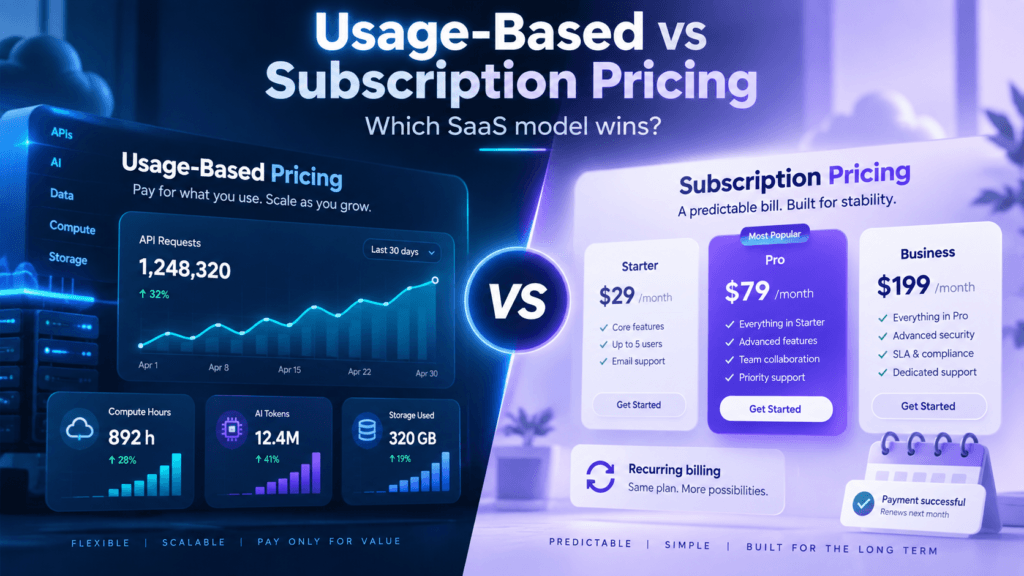
Usage-based pricing can change through the unit price, included allowance, minimum commitment, volume discounts, or overage structure. A small change in unit economics can have a large impact on heavy users.
Model customer-level outcomes before changing the rate. The customers most affected may also be the customers generating the most expansion revenue.
Our guide to usage-based pricing vs subscription pricing explains how variable pricing changes customer and revenue predictability.
How AI Changes SaaS Price Increases
AI can make historical flat-rate pricing difficult because product costs may increase materially with usage. Companies may respond by adding credits, usage limits, fair-use policies, paid overages, or higher-priced AI tiers.
Do not hide usage economics
If customers experience a major change because AI usage is expensive, explain the new structure clearly. Confusing credit systems can create more frustration than a transparent price.
How to Reduce Churn After a Price Increase
Segment customers by risk
High-value customers, low-adoption customers, price-sensitive customers, and highly engaged customers may respond differently. Do not assume one communication path fits everyone.
Improve adoption before the increase
A customer receiving strong value is less likely to churn because of a reasonable increase. Use the transition period to improve onboarding, adoption, and account health.
Offer the right downgrade path
A customer who cannot absorb the higher price may prefer a smaller plan to cancelling entirely. A well-designed pricing ladder can preserve the relationship.
Track reasons, not just churn rate
Separate cancellations caused by price from cancellations caused by product, budget cuts, company closure, low usage, or competitive switching.
Metrics to Watch After a SaaS Price Increase
| Metric | Why it matters |
|---|---|
| Gross revenue retention | Shows revenue lost from churn and contraction |
| Net revenue retention | Shows whether expansion offsets losses |
| Logo churn | Tracks customer cancellations |
| Downgrade rate | Shows movement into lower plans |
| New conversion rate | Reveals impact on acquisition |
| Discount rate | Shows whether sales is giving back the increase |
| Support volume | Indicates confusion and customer reaction |
SaaS Price Increase Checklist
Do we know why the price should change?
Have we tested churn and downgrade scenarios?
Do existing customers have clear timing?
Can every customer-facing team explain the change?
Final Verdict
SaaS price increases work best when they are treated as a business-model decision rather than a billing update. The company should understand customer value, willingness to pay, cost-to-serve, competitive position, and churn risk before deciding how much to change.
There is no universal average increase that replaces this work. Segment the customer base, model the economics, communicate clearly, and measure the result after launch. A well-designed increase can strengthen both revenue and positioning; a careless one can turn a pricing opportunity into a retention problem.
Frequently Asked Questions
What is a SaaS price increase?
A SaaS price increase is a change that raises the amount customers pay for a subscription, seat, usage unit, plan, add-on, or recurring contract.
What is a normal SaaS annual price increase?
There is no universal normal percentage. The appropriate increase depends on customer value, market alternatives, product changes, cost structure, segment and historical pricing.
How do you calculate a SaaS price increase percentage?
Subtract the old price from the new price, divide by the old price, and multiply by 100.
How often should SaaS companies raise prices?
There is no required schedule. Pricing should be reviewed regularly, but changed when evidence supports a new price or model rather than simply because a calendar year has passed.
Should existing SaaS customers be grandfathered?
It depends on the economics and customer relationship. Permanent grandfathering maximizes goodwill but can create outdated pricing; temporary grandfathering often provides a practical transition.
How much notice should customers get before a price increase?
Give enough notice for the customer to understand the change and adjust budgeting or approvals. Enterprise accounts often require more time than self-service customers.
Will raising SaaS prices increase churn?
It can. The impact depends on value perception, competitive alternatives, customer adoption, size of the increase, communication, and available downgrade options.
What is the best way to announce a SaaS price increase?
Be direct about the old price, new price, effective date, reason, transition rules and available options. Avoid vague messaging that makes customers search for the real impact.
Should a SaaS price increase apply to monthly and annual customers?
It can, but contract terms and renewal dates matter. Annual customers are commonly moved to new pricing at renewal rather than mid-contract.
Can SaaS companies raise prices by changing packaging instead?
Yes. New tiers, usage allowances, add-ons, feature packaging, and enterprise plans can improve monetization without applying the same percentage increase to every customer.
How should AI SaaS companies handle price increases?
AI SaaS should model variable inference and API costs, then consider credits, usage tiers, overages, hybrid pricing or plan changes that keep margins sustainable while remaining understandable to customers.
What metrics should be monitored after a price increase?
Track churn, downgrades, gross and net revenue retention, new-customer conversion, discounting, support volume and account-level expansion.