
A SaaS pricing ladder is the structured path customers move through as their needs, usage, team size, or willingness to pay increases. Instead of treating pricing as a single number, a pricing ladder creates deliberate steps from entry-level access to higher-value plans.
Good price laddering makes the buying decision easier because customers can see where they fit today and what would justify paying more later. Poor price laddering creates confusing tiers, artificial feature gates, awkward jumps in price, and upgrade paths that feel like punishment rather than added value.
Quick answer: A strong SaaS pricing ladder gives each tier a clear customer, clear value, and clear reason to upgrade. The gap between plans should reflect a meaningful increase in value—not simply more features for the sake of differentiation.
The most effective ladder usually combines packaging, usage, seats, features, support, or limits in a way that customers can understand in seconds.
What Is a Pricing Ladder?
A pricing ladder is a sequence of progressively higher-priced offers. In SaaS, each step usually represents more value, capability, capacity, support, or business impact.
A simple ladder might look like Free → Starter → Pro → Business → Enterprise. The important question is not the names. It is whether each step serves a distinct segment and creates a natural upgrade trigger.
Price Laddering vs Tiered Pricing
Tiered pricing describes the existence of multiple plans. Price laddering focuses on the logic connecting those plans. It asks why a customer would move from one tier to the next and whether the value increase feels proportional to the price increase.
| Concept | Main focus |
|---|---|
| Tiered pricing | How plans are packaged |
| Pricing ladder | How customers progress through plans |
| Value metric | What causes price to scale |
| Packaging | What is included in each plan |
Why SaaS Companies Need a Pricing Ladder
It captures different willingness to pay
A solo user and a 500-person company should not necessarily pay the same amount. A pricing ladder allows the business to serve multiple segments without forcing every customer into one package.
It creates expansion revenue
If the product becomes more valuable as customers grow, the pricing structure should create a logical way for revenue to grow with them.
It reduces buying friction
Customers can choose the plan closest to their needs instead of negotiating every purchase.
It improves positioning
The ladder communicates who the product is for. A free tier signals accessibility, while a strong enterprise tier signals readiness for complex customers.
The 5 Building Blocks of a SaaS Pricing Ladder
1. Customer segment
Each tier should correspond to a real type of customer or use case. Examples include individual users, small teams, growing businesses, larger organizations, and enterprise buyers.
2. Value metric
The value metric is what naturally increases as the customer gets more value: seats, usage, transactions, contacts, storage, projects, locations, API calls, or another measurable unit.
3. Feature packaging
Features should be grouped according to customer needs, not distributed randomly just to create differences between plans.
4. Limits
Usage, storage, automation, history, team size, or reporting limits can create upgrade triggers, but the limits should feel connected to value.
5. Support and service level
Higher tiers may include onboarding, priority support, dedicated customer success, stronger SLAs, or implementation services.
How Many Pricing Tiers Should SaaS Have?
There is no universal answer, but too many plans increase decision complexity. Many SaaS companies use three or four primary public plans because it is enough to distinguish segments without overwhelming buyers.
Three-tier pricing model
A three-tier model often works because it creates a simple entry, middle, and premium choice. The middle tier can act as the default for the majority of customers.
Four-tier pricing model
Four tiers can work when the business serves both self-service and larger organizations. For example: Free, Pro, Business, Enterprise.
How to Design a 3-Tier SaaS Pricing Model
| Tier | Typical customer | Primary purpose |
|---|---|---|
| Starter | Individuals or small teams | Reduce entry friction |
| Pro | Growing teams | Capture the main use case |
| Business | Larger or more complex teams | Monetize advanced needs |
The biggest mistake is making Starter intentionally unusable so customers are forced into Pro. A weak entry tier can reduce conversion instead of increasing upgrades.
How to Choose the Right Upgrade Trigger
Seat growth
Per-user or team-size thresholds work when collaboration is central to product value.
Usage growth
Usage triggers work for APIs, AI, cloud, messaging, storage, and automation products.
Feature maturity
Advanced reporting, permissions, integrations, security, or workflow automation can justify higher tiers when more sophisticated customers genuinely need them.
Business complexity
Multiple workspaces, SSO, audit logs, custom roles, data residency, and dedicated support often belong in higher tiers because they correlate with organizational complexity.
How Big Should the Price Gaps Be?
The gap between plans should match the change in value. A $19 plan followed by a $399 plan creates a very different buying experience from $19 → $49 → $99.
There is no universal multiplier. The right gap depends on customer segments, willingness to pay, product economics, and how different the plans actually are.
Avoid arbitrary jumps
If the next tier costs 3x more but gives only one small feature, customers may feel forced rather than persuaded. Price gaps should be explainable through value.
How to Name SaaS Pricing Tiers
Plan names should help buyers identify where they belong. Clear names usually outperform clever names if the creative naming makes the hierarchy difficult to understand.
Common SaaS plan names
Free, Starter, Basic, Pro, Professional, Business, Growth, Scale, and Enterprise are common because customers immediately understand the order.
When custom names make sense
Industry-specific products can use names tied to customer maturity or workflow, but the order must still be obvious.
How to Use a Free Plan in the Pricing Ladder
A free tier can reduce acquisition friction and create product-led growth, but only if free users have a path to paid value. If the free plan satisfies every important need indefinitely, the business may build usage without monetization.
Good free-tier upgrade triggers
Team collaboration, increased usage, premium exports, more history, automation, advanced AI, storage, integrations, or professional features can all create natural upgrade moments.
How Usage-Based Pricing Fits Into a Pricing Ladder
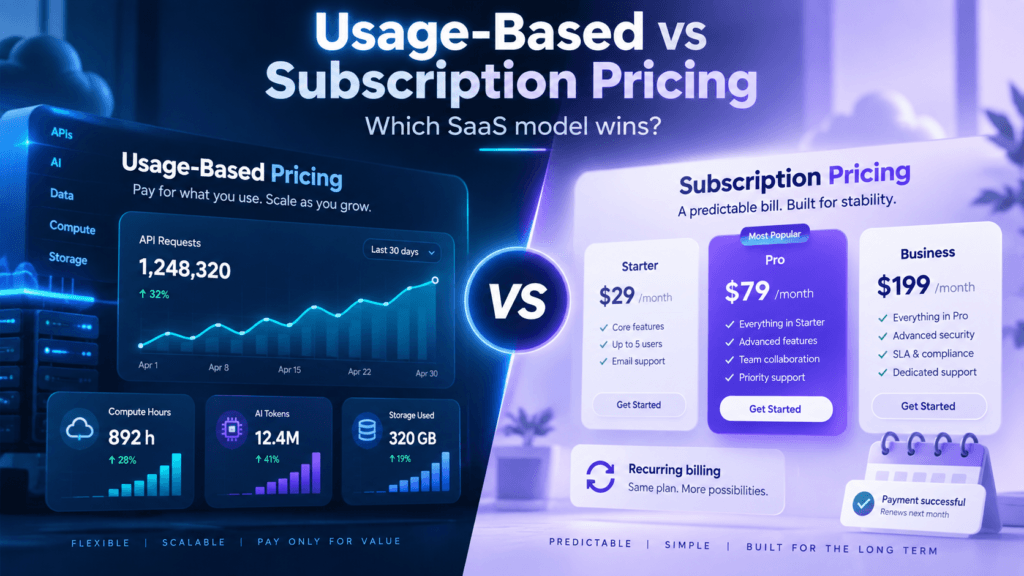
Usage-based pricing does not eliminate tiers. A SaaS company can combine plan levels with included usage and paid overages.
For example, Pro may include 20,000 monthly actions while Business includes 100,000 and a lower overage rate. This creates both a tier ladder and a usage curve.
See our guide to usage-based pricing vs subscription pricing for a deeper comparison.
How Enterprise Fits Into the Pricing Ladder
Enterprise should not simply be “Pro with contact sales.” Larger organizations often require different buying, security, support, contract, and implementation structures.
Enterprise upgrade triggers
SSO, audit controls, custom contracts, SLAs, implementation, data residency, advanced permissions, larger scale, procurement, and dedicated support can justify an enterprise tier.
Our enterprise software pricing models guide covers these structures in more detail.
How to Test a SaaS Pricing Ladder
Watch plan distribution
If almost everyone chooses the cheapest tier, higher plans may not communicate enough value. If almost nobody chooses the entry tier, it may not serve a real segment.
Track upgrade reasons
Understand what causes customers to move up: users, features, usage, security, integrations, support, or another need.
Track downgrade reasons
Downgrades reveal whether customers are over-packaged or whether a higher tier failed to deliver expected value.
Review conversion by segment
A pricing ladder can work well for small teams and poorly for enterprise buyers. Analyze behavior by customer type rather than only aggregate conversion.
Common Pricing Ladder Mistakes
Too many tiers
More choice can reduce clarity. Add a plan only when it serves a distinct customer need.
Artificial feature gates
Customers dislike being forced upward for a feature that feels fundamental to the core product.
No upgrade logic
If the product cannot explain why someone should move from Starter to Pro, the ladder is only a price list.
Ignoring cost-to-serve
Higher tiers should not create expensive support, AI, infrastructure, or services without sufficient revenue.
Pricing for competitors instead of customers
Competitor pages provide context, but copying another company’s tiers can fail if your value metric and customer segments are different.
Pricing Ladder Example
| Plan | Price | Designed for | Upgrade trigger |
|---|---|---|---|
| Free | $0 | Individual trial and light use | Needs collaboration or more usage |
| Pro | $29 | Professionals and small teams | Needs advanced automation |
| Business | $99 | Growing teams | Needs scale, permissions or security |
| Enterprise | Custom | Large organizations | Needs procurement, SLA and custom controls |
This is only an illustration. Real pricing should be based on customer research, willingness to pay, product economics, and segment needs.
How Pricing Ladders Support Price Increases
A good ladder gives customers alternatives when pricing changes. Instead of forcing every account to absorb the same increase, customers can move to a smaller plan, a usage-based structure, or a higher-value package.
Read our guide to SaaS price increases for how to manage pricing changes without unnecessary churn.
A SaaS Pricing Ladder Checklist
Does each tier serve a clear customer?
Is the next tier meaningfully more valuable?
Is there a natural reason to upgrade?
Does revenue scale with cost-to-serve?
Final Verdict
A strong SaaS pricing ladder turns pricing into a growth system. Customers should be able to start at a level that fits their current needs and move upward as they receive more value, use more capacity, or become more complex.
Keep the tiers understandable, make upgrade triggers natural, avoid artificial restrictions, and test the ladder using real customer behavior. Price laddering works best when every step makes sense from both the customer’s perspective and the company’s economics.
Frequently Asked Questions
What is a pricing ladder?
A pricing ladder is a sequence of progressively higher-priced offers designed to match increasing customer needs, value, usage, or willingness to pay.
What is price laddering in SaaS?
Price laddering is the process of structuring SaaS plans so customers can move from lower to higher tiers as their needs and value increase.
How many SaaS pricing tiers should there be?
There is no fixed number, but three or four public tiers are common because they balance customer choice with simplicity.
What is a 3-tier pricing model?
A three-tier pricing model typically offers an entry plan, a core or professional plan, and a higher-value business or premium plan.
What should trigger a SaaS upgrade?
Natural triggers include more users, higher usage, advanced features, stronger security, more automation, additional storage, premium support, or increased organizational complexity.
How should SaaS pricing tiers be named?
Use names that make the order clear, such as Starter, Pro, Business and Enterprise. Creative names are fine only if buyers can immediately understand the hierarchy.
Should SaaS have a free tier?
A free tier can support product-led growth when it gives users enough value to adopt the product while preserving clear reasons to upgrade.
How big should the price difference be between tiers?
The difference should reflect the additional value and segment willingness to pay. There is no universal percentage or multiplier.
Can usage-based pricing be part of a pricing ladder?
Yes. Plans can include different usage allowances, overage rates, or commitment levels while still maintaining a clear tier structure.
What is the biggest pricing ladder mistake?
One of the biggest mistakes is creating tiers without a natural upgrade reason. Customers should understand why the next plan is more valuable.
How do you know if a pricing ladder is working?
Track plan selection, upgrades, downgrades, conversion, churn, expansion revenue, discounting, and the reasons customers move between tiers.