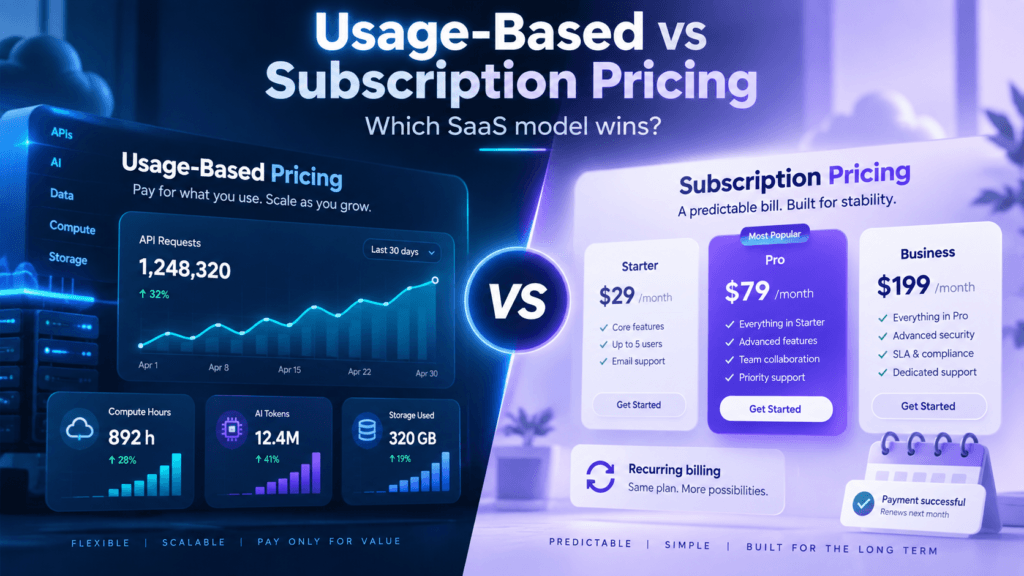

SaaS volume pricing charges customers differently as their usage, seats, transactions, storage, contacts, or another measurable quantity increases. The basic idea is that larger customers receive a lower effective unit price while the SaaS company earns more total revenue from the account.
Volume pricing can improve expansion and make larger commitments more attractive, but it must be designed carefully. Poor thresholds can create strange price cliffs, margin problems, and incentives for customers to game usage.
Quick answer: SaaS volume pricing works best when customers naturally buy more of a measurable unit and when serving additional volume becomes economically efficient. Use clear thresholds, protect margin, and avoid price jumps that make a customer pay more for using slightly less.
What Is SaaS Volume Pricing?
Volume pricing is a pricing method where the unit price changes based on the total quantity purchased or consumed. In SaaS, that quantity might be users, API calls, messages, transactions, contacts, storage, licenses, or another value metric.
Simple example
A product might charge $1.00 per unit for the first usage band, $0.80 at higher volume, and $0.60 for enterprise-scale usage. The customer spends more overall, but the effective cost per unit falls.
Volume Pricing vs Tiered Pricing
The terms are often confused. In volume pricing, the final quantity can determine the price applied to all units. In graduated or tiered pricing, different portions of usage are charged at different rates.
| Model | How it works | Main benefit |
|---|---|---|
| Volume pricing | One rate based on total quantity band | Simple discount logic |
| Graduated pricing | Each usage band has its own rate | Smoother economics |
| Plan tiers | Different packages and features | Customer segmentation |
| Usage-based pricing | Bill varies with consumption | Value alignment |
How Volume Pricing Works in SaaS
Per-seat volume pricing
A collaboration tool may reduce the effective per-user price when a company purchases 50, 100, or 500 seats.
API volume pricing
An API business can charge a lower rate per request as monthly consumption rises, especially when large customers commit to predictable usage.
Transaction volume pricing
Payments, messaging, data processing, and workflow platforms may reduce the unit price as transaction count increases.
Storage volume pricing
Cloud or data products can use decreasing rates per GB or TB as customer storage grows.
Volume Pricing Example
| Monthly volume | Unit price | Example total |
|---|---|---|
| 1–1,000 units | $1.00 | $1,000 at 1,000 units |
| 1,001–5,000 | $0.80 | $4,000 at 5,000 units |
| 5,001–20,000 | $0.60 | $12,000 at 20,000 units |
This is only a simplified example. Real pricing should be tested for margin, willingness to pay, and customer behavior.
Benefits of SaaS Volume Pricing
Encourages larger commitments
Customers can justify moving more usage onto the platform when the effective rate improves at scale.
Supports enterprise expansion
Large accounts often expect economics that recognize the size of their commitment.
Can improve retention
A customer receiving favorable economics at higher volume may have more incentive to consolidate usage with one vendor.
Aligns price with scale
When the vendor’s marginal cost falls as volume grows, volume discounts can share part of that efficiency with customers.
Risks of Volume Pricing
Price cliffs
A poorly designed threshold can make 1,001 units cheaper than 1,000 units in an illogical way. Customers may delay or manipulate usage around the breakpoint.
Margin erosion
Large customers can become unprofitable if discounts grow faster than delivery efficiency.
Complex sales negotiation
Enterprise buyers may treat every volume band as a starting point for additional discounting.
Customer confusion
Too many bands and exceptions make pricing difficult to forecast and compare.
How to Set Volume Pricing Tiers
1. Analyze real usage distribution
Use customer data to understand natural usage clusters before choosing thresholds.
2. Calculate contribution margin
Know the variable cost associated with each unit so discounts do not create negative economics.
3. Define the behavior you want
Thresholds should encourage meaningful expansion, annual commitments, platform consolidation, or another valuable behavior.
4. Keep the bands understandable
Three or four major bands are usually easier to communicate than a long table of tiny increments.
5. Test customer outcomes at every breakpoint
Calculate what happens immediately below and above each threshold. Make sure the pricing remains rational.
Volume Pricing vs Usage-Based Pricing
Volume pricing can be part of a usage-based model, but the two are not identical. Usage-based pricing means the bill varies with consumption. Volume pricing determines how the per-unit rate changes as that consumption increases.
For the broader trade-offs, read our usage-based pricing vs subscription pricing guide.
Volume Pricing vs SaaS Pricing Ladder
A SaaS pricing ladder focuses on moving customers between packages. Volume pricing can sit inside those packages as one of the upgrade or expansion mechanisms.
For example, Pro and Business plans may each include different usage allowances while enterprise contracts use custom volume bands.
When Volume Pricing Works Best
It works best when the unit is easy to measure, customers naturally need more as they grow, and the product cost per additional unit is predictable.
Strong use cases
APIs, communications, data processing, storage, transactions, automation runs, seats, and other measurable software units are common candidates.
When Not to Use Volume Pricing
Avoid it when usage is not connected to value, when unit economics are highly unstable, or when customers cannot predict their likely volume. In those cases, a subscription or hybrid model may be easier to buy.
Volume Discounts and Annual Contracts
Volume discounts are often combined with annual commitments. The customer receives better economics in exchange for predictable spend, while the vendor improves revenue visibility.
The discount should reflect the commercial value of the commitment rather than becoming an automatic concession. Our SaaS price increase guide also explains how pricing changes interact with customer contracts.
How AI SaaS Can Use Volume Pricing
AI products can create decreasing per-unit rates for tokens, generations, inference calls, or credits, but they must protect infrastructure margin. Heavy usage should not be rewarded with discounts that exceed the cost efficiencies created at scale.
You can estimate model costs with our AI API Cost Calculator.
A SaaS Volume Pricing Checklist
Is the unit easy to understand?
Does every band remain profitable?
Do breakpoints match real usage?
Does the model reward valuable expansion?
Final Verdict
SaaS volume pricing can be a strong expansion model when customers receive more value as they buy or consume more. The key is to make the discount structure economically rational and easy to understand.
Use real usage data, test every threshold, protect contribution margin, and make sure bigger commitments create better economics for both the customer and the SaaS company.
Frequently Asked Questions
What is SaaS volume pricing?
It is a pricing method where the effective unit price changes as the customer’s quantity, usage, seats, or another measurable unit increases.
What is the difference between volume pricing and tiered pricing?
Volume pricing typically applies a rate based on total quantity, while graduated tiered pricing charges different portions of usage at different rates.
Is volume pricing the same as volume discounting?
They are closely related. Volume pricing builds lower unit rates into defined quantity bands, while volume discounts may also be negotiated contractually.
What SaaS products use volume pricing?
APIs, cloud services, messaging, storage, transactions, automation, seats, and data products are common examples.
How do you calculate volume pricing?
Define quantity bands and the unit rate for each band, then calculate the customer’s total according to the model selected.
What is a pricing cliff?
It is a breakpoint where a small change in volume causes an unexpectedly large change in total price or effective unit cost.
How many volume pricing tiers should SaaS have?
There is no fixed number, but a small number of meaningful bands is easier to understand and manage.
Can volume pricing be combined with subscriptions?
Yes. A base subscription can include usage, with different rates or overages at higher volume.
Does volume pricing work for enterprise SaaS?
Yes. Large customers often negotiate volume-based economics tied to seats, usage, transactions, or annual commitments.
How do you prevent margin loss with volume discounts?
Model variable cost, support cost, infrastructure cost, and expected usage before setting each discount level.
Should AI SaaS offer volume discounts?
It can, but only when the lower unit rate remains sustainable after model and infrastructure costs.