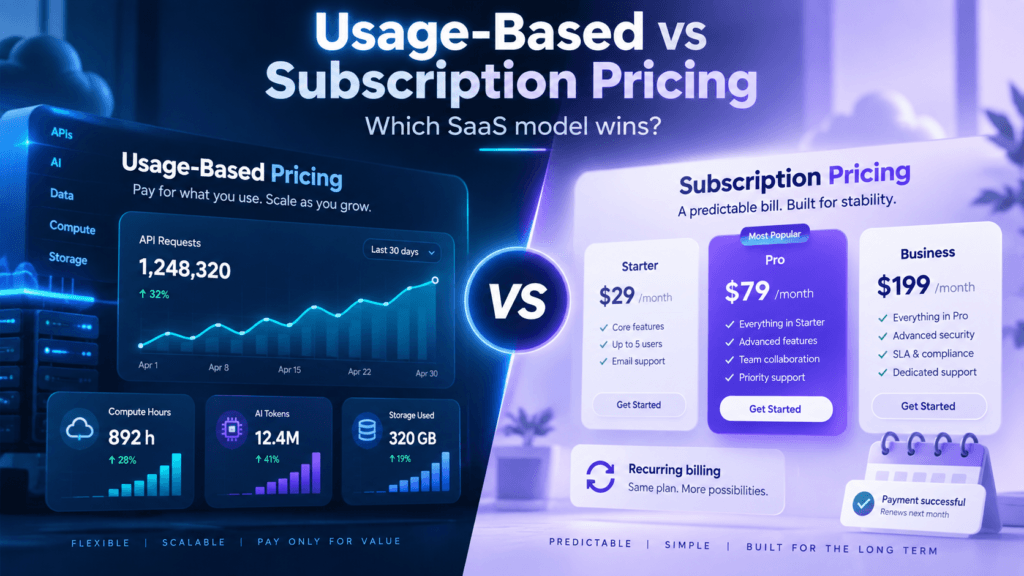
Subscription pricing examples are more useful when you study the structure behind the price instead of copying a number from another SaaS company. The same recurring-revenue business can use a flat subscription for individual users, per-seat pricing for teams, usage allowances for infrastructure, credits for AI, and custom contracts for enterprise accounts. Recent 2026 pricing research from billing providers and vendor pages shows how mature SaaS products increasingly combine models rather than relying on one mechanism forever. The examples below focus on the billing logic used by recognizable products such as Dropbox, Calendly, Kit, Kinsta, Slack, Notion, Figma and other software businesses. Exact prices change, so the important lesson is the shape of the offer: what the customer pays for, how the subscription expands, where variable charges appear, and which buyer segment each model is designed to serve.
1. Dropbox: Flat Consumer Subscription to Per-Seat Teams
Dropbox is a useful subscription pricing example because the commercial model changes as the buyer changes. Individual users can purchase storage-oriented plans that behave largely like flat recurring subscriptions, while team plans move toward per-user pricing with shared storage, administration, and business controls. That transition makes strategic sense because the value metric changes from personal storage capacity to organizational collaboration and team access. The lesson for founders is that one product does not need one pricing model across every segment. A consumer or solo-professional offer can remain simple while the B2B version introduces seats, shared capacity, stronger administration, and enterprise terms. When a company serves both individuals and organizations, pricing should reflect the different buying logic instead of forcing both audiences into the same package. This is a good example of evolving subscription architecture without creating an entirely separate product.
2. Calendly: Freemium Plus Per-Seat Subscription Tiers
Calendly illustrates a classic product-led subscription model: a useful free tier reduces acquisition friction, paid plans add capabilities for professional users and teams, and enterprise buyers move into a more sales-assisted relationship. The recurring paid plans are structured around seats and feature depth, which works because scheduling value expands when more employees, routing rules, integrations, and administrative controls are involved. The free product also performs an acquisition function because every scheduling link exposes new people to the product. The founder lesson is that freemium works best when the free experience delivers a real outcome while paid tiers unlock capabilities customers naturally need as their usage becomes more professional. The annual billing option also supports longer commitment without removing monthly flexibility. This is a strong pattern for SaaS products where users can reach value independently before a larger team or organization becomes involved.
3. Kit: Subscription Pricing Tied to Audience Size
Kit, previously known as ConvertKit, demonstrates a subscription structure where price scales with a customer value metric: subscriber count. Creators with larger email lists generally receive more economic value from marketing software and also create greater sending and data requirements, so audience size provides a relatively intuitive way to scale the bill. The product can combine subscriber bands with different feature packages, giving customers both a usage dimension and a capability dimension. The lesson is that founders do not always need to force expansion through artificial feature gates. If one measurable metric naturally increases as the customer becomes more successful, pricing can scale around that metric while still offering plan-level differences for advanced functionality. The key is ensuring that the metric remains understandable and fair; customers should feel that they are paying more because their own business has grown, not because the vendor selected an arbitrary billing unit.
4. Kinsta: Subscription Allowances With Overage Protection
Kinsta is a strong infrastructure-oriented example because the subscription provides a predictable baseline while usage limits and overages protect the vendor when customers consume more resources. Hosting businesses have real variable costs tied to traffic, bandwidth, storage, compute, and the number of sites, so an unlimited flat plan can expose the company to margin risk. A subscription with included capacity gives the customer a stable expected bill in normal months and lets the vendor charge more when usage moves materially beyond the package. This pattern is valuable for SaaS founders with variable infrastructure costs because it avoids the extremes of pure flat pricing and pure metered billing. Customers get predictability for expected usage, while the company preserves the ability to monetize spikes. The pricing page should make allowances, overage rates, and monitoring tools clear so the customer can understand when and why the bill might change.
5. Slack: Per-Seat Subscription With Tiered Business Value
Slack represents one of the most familiar B2B subscription patterns: recurring per-seat pricing combined with plan tiers that add administration, security, compliance, and enterprise capabilities. Seats make sense because the product becomes more valuable as more employees collaborate inside the workspace, while higher tiers address the requirements of larger and more regulated organizations. A particularly important lesson from seat-based software is that fairness policies can matter almost as much as the listed price. Customers worry about paying for inactive users, departed employees, or licenses that are not creating value. A transparent policy for inactive seats, prorating, or account changes can reduce procurement resistance and improve trust. For founders, the lesson is that per-seat subscription pricing is not only about multiplying users by a rate. The billing rules around seat changes, annual commitments, inactive users, and enterprise controls shape the customer experience and can materially affect retention.
6. Notion: Per-Seat SaaS With an AI Usage Layer
Notion is a useful modern example of how subscription models evolve as AI becomes part of the product. The core collaborative workspace can be sold through recurring per-user tiers because seats represent team adoption, while AI capabilities introduce a different cost and value dimension that can be handled through higher plans, credits, or usage-oriented add-ons. This creates a hybrid pricing architecture even though the customer still thinks of the product as a subscription. The founder lesson is that new product capabilities do not always fit the original value metric. If an AI feature creates substantial variable cost, forcing all usage into a flat seat price can distort margins and lead to cross-subsidization between light and heavy users. A hybrid approach can preserve the simplicity of the core subscription while allowing expensive or high-value AI activity to scale separately. The challenge is explaining the second billing dimension without making the overall price feel unpredictable.
7. Figma: Role-Based Seats Instead of One Seat Price
Figma demonstrates a refinement of per-seat subscription pricing by recognizing that different user roles can receive different levels of value. A designer who creates and edits core product work may justify a higher-value seat than a stakeholder who mainly reviews, comments, or collaborates. Role-based seats can improve adoption because the company does not have to charge every participant the same amount, which reduces the incentive to exclude occasional users. The lesson for SaaS founders is that a single seat price can be too blunt when product usage varies substantially by role. Instead of abandoning per-user pricing entirely, the business can create seat classes tied to the actual capabilities or value each role receives. This can support broader organizational adoption while preserving monetization of power users. Role-based pricing does add billing complexity, so the definitions must be clear enough that administrators can assign the right licenses without constant disputes or manual support.
8. AI SaaS: Credit-Based Subscription Pricing
Many AI products use subscription plans that include recurring credit balances rather than exposing raw model tokens, compute seconds, or API costs. Credits allow the company to combine several AI actions under one customer-facing unit and can absorb changes in underlying model economics more cleanly than a fixed unlimited plan. A user may receive a monthly allowance of credits, spend them on different features, and upgrade or purchase additional capacity when usage grows. The model is especially useful when the product offers multiple models or workflows with different costs. The danger is opacity: customers need to understand roughly how many useful outcomes their credits will produce. Good credit subscriptions provide examples, visible balances, alerts, and straightforward rules around expiration or rollover. The founder lesson is to use credits to simplify complexity, not to obscure it. If customers cannot estimate value, the abstract currency can become a source of frustration.
9. Usage-Based SaaS: Subscription-Like Relationship Without a Fixed Bill
Some software businesses create a recurring customer relationship while billing primarily according to actual consumption. API, communications, voice, payments, and infrastructure products are common examples because customer usage can vary by orders of magnitude. The customer may have an account and recurring monthly billing cycle, but the invoice changes based on minutes, requests, messages, transactions, or compute. This structure aligns price closely with activity and lowers the entry barrier for small customers, but it can weaken budget predictability. Mature usage-based businesses often add minimum commitments, included allowances, volume discounts, or spend alerts to make the relationship more subscription-like for larger accounts. The lesson is that recurring revenue does not require a perfectly fixed bill. What matters is that the billing metric is understandable, the customer receives recurring value, and the company provides enough cost visibility that growing usage feels like success rather than a financial surprise.
10. Hybrid Enterprise Subscriptions
Complex enterprise software often combines a base subscription, user or usage metrics, modules, professional services, and negotiated commitments in one contract. This hybrid structure exists because large organizations vary dramatically in scale, security requirements, integrations, implementation effort, and support expectations. A public pricing page may show simpler self-service plans while enterprise contracts use an internal framework that captures these additional value drivers. The lesson is that custom enterprise pricing should still be systematic. The company should define what the base platform fee represents, how users or usage are calculated, which modules are optional, what services are one-time, and what discounts require approval. Without internal rules, hybrid enterprise pricing becomes inconsistent and difficult to renew. Our enterprise software pricing models guide covers how to build a repeatable structure around complex accounts.
What These Subscription Pricing Examples Have in Common
The strongest examples use a billing metric that tracks customer value and then add complexity only when the product or segment requires it. Dropbox changes structure between individuals and teams, Kit scales with subscriber growth, Slack and Figma monetize organizational adoption through seats, Kinsta protects infrastructure economics with allowances and overages, and modern AI products add credits or usage layers when variable compute becomes important. A 2026 billing-industry review of major SaaS products similarly groups most real-world subscription pricing into flat-rate, tiered, per-seat, usage-based, credit-based, and hybrid models. Rather than copying one vendor, founders should identify which pattern resembles their own value creation and cost structure. Use competitor examples to understand market conventions, then validate the model with customer interviews, usage data, willingness-to-pay research, and margin analysis before finalizing the price.
Final Verdict
Subscription pricing examples are most valuable as strategic patterns, not templates to copy word for word. The exact price of a SaaS plan can change frequently, but the underlying structure reveals how the company thinks about customer value, expansion, and cost. Products with clear individual value can use simple subscriptions, team software can use seats, infrastructure can combine allowances with overages, AI can use credits, and enterprise SaaS can layer several components into negotiated annual contracts. The best model for your product is the one customers can understand and that lets revenue scale naturally as they receive more value. Study successful companies to identify patterns, then build the commercial logic around your own customer behavior instead of assuming that a famous SaaS pricing page will transfer directly to a different market.
Frequently Asked Questions
What are good subscription pricing examples?
Useful examples include flat recurring subscriptions for simple consumer software, per-seat subscriptions for collaboration tools, subscriber- or contact-based pricing for marketing platforms, usage-inclusive plans for infrastructure, credit subscriptions for AI, and hybrid enterprise contracts. Real products such as Dropbox, Calendly, Kit, Kinsta, Slack, Notion and Figma illustrate different versions of these models. The most useful lesson is the value metric and upgrade logic rather than the exact price, which can change over time.
Which subscription pricing model is most common in SaaS?
Tiered and per-user subscriptions are extremely common in B2B SaaS, while flat-rate subscriptions remain common for simpler or consumer-oriented products. Usage, credit and hybrid models are increasingly important in AI, infrastructure and API software. A recent 2026 billing-industry analysis similarly identifies flat-rate, tiered, per-seat, usage-based, credit-based and hybrid structures as the dominant patterns across SaaS and AI products.
Why do SaaS companies offer annual subscriptions?
Annual subscriptions improve cash flow and revenue visibility and can reduce the number of cancellation decisions customers make during the year. Companies often offer a lower effective monthly rate in exchange for that longer commitment. The discount should be based on the economics of retention and upfront cash rather than copied automatically from competitors. Annual billing is especially common in B2B and enterprise SaaS because procurement and implementation already involve longer planning cycles.
What is an example of hybrid subscription pricing?
A hybrid subscription can charge a fixed monthly or annual platform fee that includes a usage allowance, then bill additional consumption beyond the allowance. Another version charges per user for the core collaboration product and adds credits or usage charges for AI capabilities. Hybrid models are useful when the product creates recurring platform value but also has variable costs or value that grow with consumption.
What is an example of value-based subscription pricing?
Value-based pricing often appears through the choice of metric rather than as a standalone billing label. A marketing platform may price according to contacts because a larger audience can generate more business value, while a payments product may charge according to transactions because revenue processed is closely connected to customer outcomes. The goal is to select a measurable unit that increases as customer value increases, then package the subscription around that relationship.
Should a startup copy a large SaaS company’s pricing?
No. Large SaaS companies often have mature segmentation, enterprise contracts, multiple product modules, established brand value, and billing infrastructure that an early startup does not need. Startups usually benefit from a simpler model that generates clean learning about willingness to pay and usage. Study large companies to understand patterns, but build the initial price around your own customer segment, cost structure, and value metric.
How often do subscription prices change?
There is no fixed schedule. Companies may change prices when product value, packaging, customer segments, infrastructure costs, or competitive positioning changes. Some updates change the list price, while others change included features, usage allowances, billing terms, or plan names. That is why current vendor pages should be checked when exact prices matter, while structural pricing examples remain useful even when the specific numbers move.
Where can I compare subscription pricing models?
Start with our subscription pricing models guide for the major structures, then use our SaaS pricing examples and SaaS pricing models guides to compare how seats, usage, tiers, credits, freemium and hybrid pricing behave across different software categories.