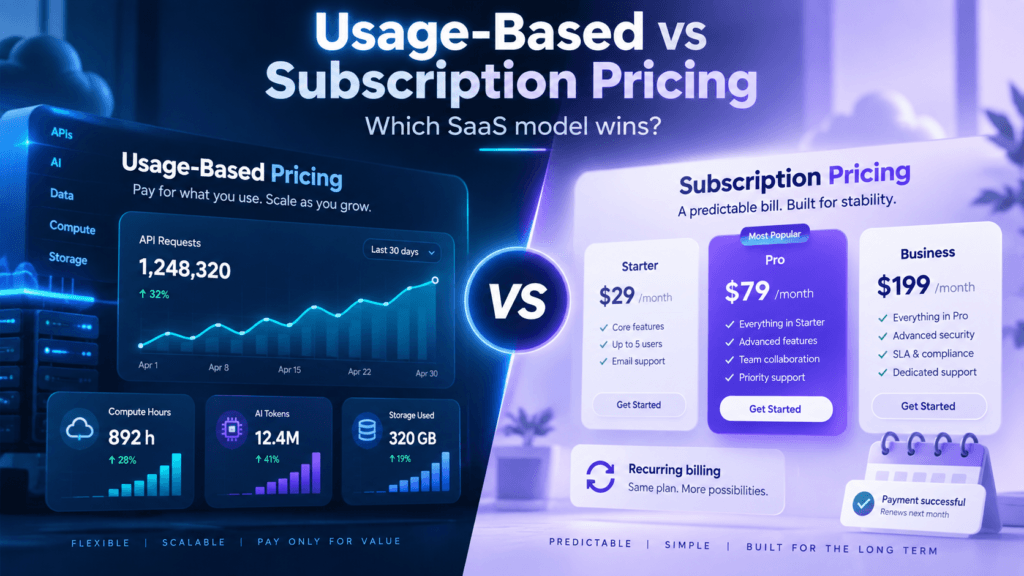

Subscription pricing models are the foundation of recurring-revenue SaaS because they turn ongoing software access into predictable monthly or annual payments. The term sounds simple, but subscription pricing can be structured in many different ways: one flat recurring fee, several tiers, a per-user subscription, a freemium plan, credits, usage allowances, or a hybrid subscription that combines a fixed base with variable charges. The correct structure depends on what customers value, how usage changes over time, how expensive the product is to deliver, and how much predictability buyers need. A good subscription pricing model gives customers a clear reason to remain subscribed and creates a logical path for revenue to expand as their needs grow. This guide compares the major subscription-based pricing models used by SaaS companies, explains their advantages and disadvantages, and shows how to choose the structure that best fits your product economics and customer behavior.
What Is a Subscription Pricing Model?
A subscription pricing model charges customers a recurring fee for continued access to a product or service, usually monthly, quarterly, annually, or through a multi-year contract. In SaaS, the recurring payment typically includes cloud access, maintenance, product updates, support, and continued use of the software rather than ownership of a perpetual license. Subscription pricing is broader than a single billing method because the recurring charge can still depend on seats, features, usage, credits, transactions, or customer segment. A company can therefore have a subscription business while using several monetization models at the same time. The core economic advantage is revenue predictability: recurring contracts make it easier to forecast cash flow and customer lifetime value. The core challenge is retention because customers continuously evaluate whether the product is still worth the ongoing payment. A strong subscription model must therefore create recurring value, not merely recurring invoices.
1. Flat-Rate Subscription Pricing
Flat-rate subscription pricing charges one recurring amount for a defined package, regardless of customer size or usage within reasonable limits. This is the simplest subscription pricing model because customers know exactly what they will pay and the vendor can keep checkout, billing, and communication straightforward. It works best for focused SaaS products where usage patterns do not vary dramatically and where the company values simplicity as part of the buying experience. The weakness is limited monetization flexibility. A small customer and a large customer may receive very different levels of value while paying the same amount, and heavy users can create margin pressure when support or infrastructure costs rise with consumption. Flat-rate subscriptions are often attractive during the early stage of a product because they reduce the number of pricing variables the company must learn. As the customer base matures, tiers, seats, or usage components can be introduced when real segmentation becomes visible.
2. Tiered Subscription Pricing
Tiered subscription pricing offers several recurring plans with increasing features, limits, users, support, or usage allowances. It is one of the most common SaaS subscription models because it allows customers to choose a package that fits their current needs while creating a natural upgrade path as the account becomes more sophisticated. A typical structure might include Starter, Professional, Business, and Enterprise. The key is ensuring that each tier maps to a real customer segment rather than creating arbitrary differences simply to justify higher prices. Good tiers can improve conversion by helping customers identify where they belong, while poor tiers increase decision friction and make buyers compare long lists of nearly identical features. Tiered pricing also gives the company a framework for expansion revenue when customers need more automation, security, collaboration, analytics, or scale. Our SaaS pricing ladder guide explains how to design those upgrade steps.
3. Per-User Subscription Pricing
Per-user subscription pricing charges a recurring amount for each person, seat, agent, or active user who accesses the software. It is especially common in CRM, collaboration, productivity, sales, project management, and workflow products because team size is easy to understand and often correlates with value. Customers can forecast the bill by multiplying the seat price by the number of users, and SaaS companies gain expansion revenue as customers hire more employees or roll the product out across departments. The downside is adoption friction. A customer may intentionally limit users or share accounts because each new seat increases spending. This can be strategically harmful when wider adoption would make the product more valuable and more deeply embedded in the organization. Per-user subscriptions also become less suitable when AI agents or automated workflows generate substantial value without a corresponding human user. The model should be chosen because seats represent value, not simply because competitors charge by seat.
4. Freemium Subscription Pricing
Freemium subscription pricing provides a permanent free version of the product and offers recurring paid plans when users need additional capability, usage, storage, collaboration, or business controls. It is popular in product-led SaaS because users can experience the product before committing and can spread it organically through shared files, invitations, templates, or network effects. The free tier becomes part of the acquisition engine, but it also creates costs that must be managed. A large free user base can consume infrastructure and support without contributing revenue, and a plan that is too generous may reduce conversion. The best freemium models give free users a meaningful outcome while preserving clear upgrade triggers for professional or higher-volume use. Paid subscription value can include more history, advanced AI, team access, integrations, exports, automation, or security. Freemium should therefore be evaluated as a full business model rather than simply a marketing tactic.
5. Usage-Inclusive Subscription Pricing
Usage-inclusive subscriptions charge a fixed recurring fee that contains a defined allowance of a variable resource, such as API calls, AI generations, storage, messages, automation runs, or data processing. This structure gives customers more predictability than pure usage pricing while still protecting the vendor from unlimited heavy consumption. Different tiers can include different allowances, and customers can be asked to upgrade when they consistently reach their limit. The model works well when the product has meaningful variable costs but buyers prefer a predictable monthly bill. The challenge is selecting allowance levels. If the included amount is too low, normal users feel constantly constrained; if it is too high, heavy users can create margin pressure without generating additional revenue. Use product usage distributions to define sensible bands rather than guessing. Usage-inclusive subscriptions can later be extended with overages or credits if customers need more flexibility than a hard upgrade threshold provides.
6. Credit-Based Subscription Pricing
Credit-based subscription pricing gives customers a recurring balance of credits that can be spent across different product actions. It is increasingly common in AI SaaS because one product may offer text generation, image creation, research, video, transcription, or other features with different underlying compute costs. Credits create one customer-facing currency instead of exposing raw tokens or model-specific costs. The advantage is packaging flexibility: the company can change the credit cost of different actions as product economics evolve while maintaining recognizable subscription plans. The weakness is opacity. Customers may struggle to understand what 5,000 credits actually means for their workflow, which can create hesitation or frustration when balances disappear faster than expected. A good credit subscription provides concrete usage examples, visible balances, alerts, rollover rules, and straightforward upgrade options. Credits should make complex usage easier to understand rather than acting as a way to hide unpredictable consumption.
7. Hybrid Subscription Plus Usage Pricing
A hybrid subscription combines a recurring base fee with a variable component such as usage, overages, transactions, AI credits, storage, or outcomes. This structure has become increasingly important because it balances recurring revenue predictability with monetization that scales as customer consumption increases. The base subscription can represent platform access, administration, integrations, support, and included usage, while the variable element protects margin and captures expansion beyond the allowance. Hybrid pricing is particularly useful for AI, API, cloud, data, and infrastructure products where heavy users can cost materially more to serve. The trade-off is complexity. Buyers need to understand both the fixed and variable portions of the bill, and the vendor needs reliable metering and billing systems. The model works best when the variable unit is transparent and when customers have dashboards, alerts, and estimates that reduce the risk of bill shock. Our usage vs subscription guide explores this balance.
8. Minimum-Commitment Subscription Pricing
Minimum-commitment subscriptions are common in B2B and enterprise SaaS where customers agree to a minimum monthly or annual spend in exchange for access, service levels, or better unit economics. The commitment can cover seats, usage, platform access, or a combination of these elements. For the vendor, minimums improve revenue visibility and reduce the risk that a large account consumes substantial implementation or support resources while generating very little recurring revenue. For the customer, a commitment can unlock volume discounts, dedicated support, enterprise features, or negotiated terms. The risk is selling a commitment that is larger than the customer’s realistic usage, which can create dissatisfaction at renewal. Account teams should therefore model expected adoption and design commitments around credible growth. A healthy enterprise subscription creates a commercial floor without forcing customers to prepay for large amounts of value they are unlikely to use.
9. Module-Based Subscription Pricing
Module-based subscriptions charge customers for distinct product suites or functional areas rather than one all-inclusive package. A platform may have a core subscription and optional modules for analytics, marketing, finance, AI, security, or additional workflows. This can improve value alignment when customer needs differ significantly and when each module delivers a clear independent outcome. It also creates expansion revenue because customers can add functionality over time without moving the entire organization to a more expensive plan. The downside is packaging complexity. Too many modules can make the product feel fragmented and can turn the buying process into a long configuration exercise. Customers may also resent paying separately for features they assumed were part of the core platform. Module-based pricing works best when the modules represent genuinely distinct use cases or cost structures and when the company clearly explains which foundational capabilities are included in the base subscription.
10. Enterprise Custom Subscription Pricing
Enterprise subscription pricing uses recurring contracts that are customized according to company size, users, usage, security, implementation, support, integrations, service levels, and procurement requirements. The subscription may include a platform fee, minimum annual commitment, per-user component, modules, usage allowances, and professional services. Custom pricing is appropriate when large accounts vary too much for one public plan to represent their economics accurately. However, custom should not mean arbitrary. The company needs internal pricing rules, minimums, discount thresholds, and a consistent value metric so sales teams can quote different customers in a defensible way. Enterprise subscriptions often use annual or multi-year agreements because implementation and procurement costs are higher and because buyers need budget predictability. Our enterprise software pricing models guide explains how to structure these contracts while protecting repeatability and margin.
How to Choose the Right Subscription Pricing Model
Choose the model by starting with how customers receive value and how your costs behave. If value scales with team adoption, a per-user subscription may be appropriate. If customers differ mainly by sophistication, tiered or feature-based subscriptions can work better. If usage creates meaningful variable cost, include allowances, credits, overages, or a hybrid structure. If the product serves highly variable enterprise accounts, a minimum commitment or custom subscription may be necessary. Then evaluate customer budgeting preferences, sales motion, billing complexity, and expansion potential. Self-service products generally benefit from simpler public pricing, while enterprise sales can support more configurable commercial terms. Finally, model the economics for several customer types before launch. The right subscription model should be easy enough to explain, predictable enough to buy, and flexible enough to let revenue increase when customers receive more value.
Monthly vs Annual Subscription Pricing
Monthly subscriptions reduce commitment and make it easier for customers to begin, which can improve conversion for self-service products. Annual subscriptions create more predictable revenue and cash flow and can reduce the number of cancellation decisions customers make during the year. Many SaaS companies offer both and use an annual discount to encourage longer commitments. The discount should be based on the economic value of upfront cash and improved retention rather than copied automatically from competitors. Make the billing language explicit: if the page shows a monthly equivalent but requires annual payment, say so beside the price. Enterprise customers often prefer annual or multi-year agreements because budgets, procurement, implementation, and security reviews already involve substantial commitment. Subscription pricing works best when the billing frequency matches the customer’s buying process and when annual discounts do not unnecessarily sacrifice revenue from accounts that would have committed anyway.
Final Verdict
There is no single best subscription pricing model for every SaaS product. Flat-rate subscriptions maximize simplicity, tiered subscriptions support segmentation, per-user subscriptions scale with team size, freemium supports product-led acquisition, credit and usage-inclusive subscriptions manage variable consumption, and hybrid or enterprise subscriptions handle more complex economics. The correct structure should connect recurring customer value with recurring revenue while preserving a buying experience customers can understand. Start with the simplest model that fits your value metric, then add complexity only when usage, segmentation, or enterprise requirements justify it. A successful subscription model is not simply a way to collect recurring payments; it is a commercial architecture that gives customers a reason to remain, expand, and feel that increased spending corresponds to increased value.
Frequently Asked Questions
What are the main subscription pricing models?
The main subscription pricing models include flat-rate, tiered, per-user, freemium, usage-inclusive, credit-based, hybrid, minimum-commitment, module-based, and enterprise custom subscriptions. Many SaaS companies combine several approaches. For example, a company can sell tiered subscription plans, price each tier per user, include an allowance of usage, and apply overage charges beyond the allowance. The right combination depends on value, cost, customer segment, and buying behavior.
What is the difference between subscription pricing and SaaS pricing?
Subscription pricing describes recurring billing, while SaaS pricing is the broader commercial system used by software-as-a-service companies. SaaS pricing can include subscriptions, usage, credits, seats, tiers, enterprise minimums, and other structures. Most SaaS businesses use subscriptions in some form because customers pay for ongoing access, but the subscription itself can be calculated in many different ways. SaaS pricing also includes packaging, discounts, free trials, annual billing, enterprise terms, and expansion rules.
Which subscription pricing model is best for SaaS?
The best model is the one that aligns with the way customers receive value while maintaining understandable billing and sustainable margins. Per-user subscriptions work when each user creates value, tiered subscriptions work when customer needs vary by maturity, and usage-inclusive or hybrid subscriptions work when consumption and cost vary. Early-stage SaaS often benefits from simpler pricing until enough usage data exists to justify more complex models.
Is monthly or annual subscription pricing better?
Monthly pricing improves flexibility and can reduce the barrier to purchase, while annual pricing improves cash flow, revenue predictability, and often retention. Offering both allows customers to choose. The annual discount should be deliberate and based on the value of commitment rather than an automatic industry convention. Enterprise products often default to annual contracts because implementation and procurement already require longer planning cycles.
How should subscription prices increase over time?
Subscription prices should be reviewed when product value, customer segments, costs, or market positioning change materially. Increases can be applied to new customers, existing customers at renewal, or through new packaging rather than one universal percentage. Existing customers may need notice or a transition period. The company should model churn, downgrades, expansion, and conversion before changing prices and measure the actual impact afterward.
Can subscription pricing include usage charges?
Yes. Hybrid subscriptions commonly include a recurring platform fee or plan with a defined amount of usage and then charge overages beyond the allowance. This is useful for AI, API, cloud, communications, and data products because the subscription creates predictable recurring revenue while the usage component protects margins and captures heavy-user expansion. Clear dashboards and alerts are important so customers can predict the variable portion of their bill.
What makes a subscription pricing model fail?
Subscription models fail when recurring payment is disconnected from recurring value, when customers cannot predict the bill, when tiers do not match real segments, or when the value metric penalizes adoption. Other common problems include excessive discounting, opaque credits, hidden overages, and keeping prices unchanged while costs or product value change significantly. Retention is the ultimate test: if customers do not continue receiving meaningful value, recurring billing alone will not create a healthy subscription business.
How many subscription plans should a SaaS company offer?
Three or four public plans are common, but the right number depends on customer segmentation. Each plan should represent a meaningful customer profile, level of usage, or degree of sophistication. More plans create more choice but also more comparison effort. A company should add a tier only when it serves a distinct need and creates a clear upgrade path. Enterprise can be separated from self-service plans when commercial requirements are materially different.