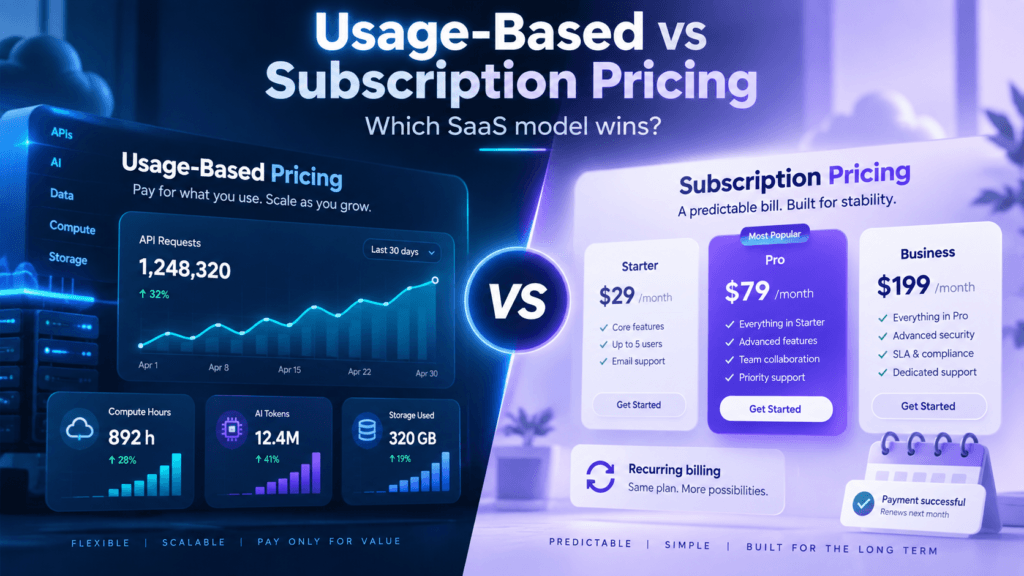

SaaS pricing models decide how a software company turns product value into recurring revenue. The model you choose influences conversion, expansion revenue, churn, gross margin, customer expectations, billing complexity, and even the way the product is built. A simple per-user plan may work perfectly for collaboration software, while an AI platform with highly variable compute costs may need usage-based or hybrid pricing to stay profitable. The most important principle is that pricing should scale with the value customers receive without becoming difficult to understand or budget. This guide compares the major SaaS pricing models used in 2026, explains the pros and cons of each approach, shows where different models fit best, and gives a practical framework for choosing a model based on customer value, cost-to-serve, sales motion, and product maturity.
What Is a SaaS Pricing Model?
A SaaS pricing model is the mechanism a software company uses to calculate what customers owe for continued access to the product. It may charge for users, features, transactions, storage, API calls, AI tokens, outcomes, a recurring package, or a combination of several variables. The model is different from the broader software pricing strategy, which also includes packaging, discounts, billing terms, trials, enterprise contracts, and positioning. A strong SaaS pricing model should satisfy three requirements at the same time: customers should understand it, revenue should increase as customer value grows, and the vendor should preserve healthy economics as usage expands. When those conditions are not aligned, customers either feel overcharged, the company leaves money on the table, or the billing model becomes too complex to sell and operate efficiently.
12 SaaS Pricing Models Compared
1. Flat-rate pricing
Flat-rate pricing charges every customer the same recurring amount for a defined package of software. It is one of the easiest SaaS pricing models to explain because buyers can see the price immediately and finance teams can predict their software spend without modeling usage. The model is most suitable when customers receive roughly similar value and when the vendor’s cost-to-serve does not vary dramatically from one account to another. The downside is limited expansion revenue because a large customer may pay the same amount as a much smaller one. Heavy users can also become unprofitable if infrastructure, AI, support, or data costs increase with usage. Flat-rate pricing is often useful for early-stage SaaS companies that want simplicity while learning how customers use the product, but many companies later introduce tiers, seats, or usage once meaningful segments appear.
2. Tiered pricing
Tiered pricing organizes the product into multiple plans, usually with increasing features, limits, support, users, or usage allowances. It is popular because different customer segments can self-select into a package that matches their needs, while the vendor creates a natural path to expansion revenue. A well-designed pricing ladder might move from Starter to Pro to Business to Enterprise, with each tier serving a clearly different customer profile. The risk is complexity: too many plans slow decisions, and arbitrary feature gates can make the pricing feel manipulative. The best tiered SaaS pricing models use a clear value metric and upgrade triggers that emerge naturally as customers grow. Our SaaS pricing ladder guide explains how to structure those steps so customers understand why the next plan costs more.
3. Per-user pricing
Per-user or per-seat pricing charges according to the number of people who have access to the software. This model remains common in CRM, project management, productivity, collaboration, and business software because team size is easy to count and often correlates with the amount of value created. It also supports predictable expansion because revenue increases as customers add employees. The weakness is that per-user pricing can discourage adoption across the organization. Customers may restrict seats, share accounts, or keep occasional users outside the product simply to control cost. The model also becomes less attractive when automated workflows or AI agents create significant value without corresponding human seats. Per-user pricing works best when each additional user receives direct product value and when collaboration across more users increases the customer’s willingness to pay.
4. Usage-based pricing
Usage-based pricing charges according to actual consumption, such as API calls, transactions, messages, storage, compute time, workflow executions, or AI tokens. This model can create excellent alignment because customers who use the product more generally pay more, while smaller users can start cheaply. It is particularly relevant for AI SaaS, developer platforms, cloud infrastructure, data services, and communications software where cost-to-serve also rises with consumption. The main challenge is predictability. Customers may worry about unexpectedly high bills, and the SaaS company must invest in accurate metering, usage dashboards, alerts, rating logic, and transparent invoicing. Usage-based pricing is strongest when the usage unit is easy to understand and closely tied to value. For a deeper comparison, see our guide to usage-based pricing vs subscription pricing.
5. Freemium pricing
Freemium gives users permanent access to a limited free version of the product and monetizes them when they need more features, capacity, collaboration, security, or support. It can lower acquisition friction and create powerful product-led growth because users experience value before paying. Freemium works best when free usage also creates distribution through shared content, invitations, templates, collaboration links, or network effects. The danger is attracting large numbers of low-intent users who generate infrastructure and support cost without converting. A free plan also needs a meaningful upgrade trigger; if free users can achieve every important outcome indefinitely, the company may build engagement without revenue. Freemium is therefore not simply a marketing decision. It is a full pricing and product strategy that must balance acquisition, conversion, cost, and long-term retention.
6. Subscription pricing
Subscription pricing charges a recurring monthly or annual fee for continued access to software. It is the foundation of most SaaS businesses because it creates predictable recurring revenue and lets customers spread cost over time rather than purchasing a perpetual license upfront. Subscription pricing can exist alongside several other models: a company may sell subscriptions per user, by tier, by usage allowance, or with a hybrid structure. The main strategic decisions include billing frequency, contract length, annual discounts, plan packaging, renewal rules, and upgrade logic. Subscription pricing works best when customers receive continuous value and have an ongoing reason to keep the product. If the value is mainly one-time, recurring billing can feel artificial and may create churn. Our upcoming subscription cluster separates the model, strategy, and real-world pricing examples in more detail.
7. Feature-based pricing
Feature-based pricing places advanced capabilities into progressively more expensive plans. It is commonly combined with tiered pricing and works well when customer sophistication increases alongside feature needs. Smaller customers may only need basic workflows, while larger companies require automation, analytics, permissions, integrations, governance, or security features. The challenge is deciding which features should be gated. If a feature feels essential to the basic product, forcing customers into a much higher tier can create frustration and weaken conversion. The strongest feature-based pricing aligns packages with genuine segment needs rather than scattering features randomly to justify plan differences. Companies should also monitor whether feature gates remain relevant as the product evolves because yesterday’s premium capability can become today’s market expectation.
8. Volume pricing
Volume pricing changes the effective unit price as customers purchase or consume more. Larger commitments may receive a lower per-unit rate, while total revenue still rises with scale. This model is common in API products, messaging, data platforms, transactions, storage, and enterprise software where customers can forecast meaningful volumes. It can reward commitment and make large accounts more competitive, but the discount curve must be designed carefully. If unit prices fall too quickly, the vendor can give away margin precisely when usage and support requirements increase. Volume pricing also differs from tiered pricing because the calculation can apply to units rather than packaged feature plans. Our detailed SaaS volume pricing guide explains graduated tiers, block pricing, commitments, and the economic trade-offs.
9. Credit-based pricing
Credit-based pricing is increasingly common in AI SaaS because it converts several expensive activities into a single consumable unit. Instead of showing customers the raw cost of tokens, model calls, images, audio minutes, or workflow steps, the product gives each action a credit cost and sells bundles of credits inside subscription plans. The advantage is flexibility because multiple features can share one billing system. The drawback is opacity: customers may struggle to understand how many real outcomes a credit balance will produce, especially if different actions consume credits at different rates. A strong credit model needs clear examples, visible balances, spending estimates, and predictable renewal rules. Credits should simplify complex usage rather than hide cost behind an arbitrary internal currency.
10. Outcome-based pricing
Outcome-based pricing charges according to a measurable result rather than access or activity. Examples might include a resolved support ticket, a qualified lead, a recovered payment, or another verifiable business outcome. The model can create powerful value alignment because customers pay when the software delivers something useful, but it is operationally difficult. The vendor must define the outcome precisely, verify that the software caused or contributed to it, handle disputes, and prevent gaming. Outcome pricing is especially relevant as AI systems automate tasks that were previously priced by human seats. However, it should only be used when the outcome is measurable, auditable, and sufficiently connected to customer value. If attribution is ambiguous, a hybrid model may provide a safer structure.
11. Enterprise custom pricing
Enterprise custom pricing replaces a public fixed price with a negotiated contract based on customer size, usage, security requirements, implementation, support, procurement complexity, and expected value. It is common when accounts vary dramatically and when the vendor provides capabilities such as SSO, audit logs, data residency, SLAs, dedicated customer success, onboarding, or custom integrations. The advantage is flexibility and the ability to capture more value from complex customers. The disadvantage is lower transparency, longer sales cycles, and greater dependence on discount governance. Enterprise pricing should not simply mean hiding the price. The company needs a clear internal pricing architecture so sales teams can explain why one account pays more than another. Our enterprise software pricing models guide covers this in depth.
12. Hybrid pricing
Hybrid pricing combines multiple models, such as a base subscription plus usage charges, tiered plans with per-user components, or a fixed platform fee with credits and overages. It is increasingly common because modern SaaS products often need both predictable recurring revenue and variable monetization. AI software is a clear example: the company may want a subscription floor to cover platform value while also charging for expensive inference or generation activity. Hybrid models can produce strong economics, but they are harder to communicate and operate. Customers need to understand what is fixed, what can vary, and how to estimate the total bill. The best hybrid pricing models use each component for a specific reason and avoid stacking so many variables that customers need a spreadsheet before they can buy.
How to Choose the Right SaaS Pricing Model
The right model begins with the value metric: the unit that grows when customer value grows. If more users create more value, per-seat pricing may be logical. If transactions, storage, AI output, or API calls scale with value, usage-based pricing may fit. If customer sophistication changes more than usage, tiered feature packaging may work better. The second consideration is cost-to-serve. Products with significant variable costs need protection against heavy usage, while low-marginal-cost products have more flexibility. The third factor is the sales motion. Self-service products need simpler, more transparent pricing, while enterprise sales can support negotiated structures. Finally, model the customer experience. A mathematically elegant pricing system can still fail if buyers cannot predict what they will pay or understand why the bill increases.
Which SaaS Pricing Model Is Best for B2B?
B2B SaaS often benefits from tiered, per-user, usage-based, or hybrid pricing because business customers vary widely in team size, complexity, and economic value. The best choice depends on how the product creates value. Collaboration software may naturally scale by seats, while an API platform may scale by requests or transactions. Enterprise products often combine public tiers for smaller customers with custom contracts for large organizations. B2B founders should pay particular attention to expansion revenue because the ability to monetize growing customer value can materially affect net revenue retention. The wrong value metric can cap upside or discourage adoption. Our dedicated B2B SaaS pricing models article goes deeper into the selection process for sales-led and product-led B2B businesses.
Final Verdict
No SaaS pricing model is universally best. The strongest model is the one customers understand, the company can operate reliably, and revenue can scale with the value delivered. Flat-rate pricing maximizes simplicity, tiered pricing supports segmentation, per-user pricing works when people drive value, usage-based pricing aligns revenue with consumption, freemium reduces acquisition friction, and hybrid pricing balances predictability with expansion. The decision should be based on customer research, product usage, willingness to pay, cost structure, and sales motion rather than on whichever model is currently fashionable. Pricing should also evolve as the SaaS business matures. A simple launch model can become more sophisticated once the company has enough evidence to understand customer segments and value metrics with confidence.
Frequently Asked Questions
What are the most common SaaS pricing models?
The most common SaaS pricing models include flat-rate, tiered, per-user, usage-based, freemium, feature-based, volume, enterprise custom, credit-based, outcome-based, and hybrid pricing. Many companies use a combination rather than one pure model. For example, a SaaS company can offer tiered subscription plans, charge per user inside each plan, include usage allowances, and apply paid overages beyond the allowance. The important question is not how many model labels apply, but whether the pricing structure is understandable and whether revenue grows in a logical way as the customer receives more value.
What is the best SaaS pricing model for startups?
Early-stage SaaS startups usually benefit from simplicity because they are still learning customer segments and willingness to pay. A flat-rate plan or a small number of clear tiers can make it easier to gather pricing feedback and understand usage. Complex usage-based or hybrid systems should only be introduced when the business has evidence that the extra complexity improves value alignment or protects margins. Startups should avoid building elaborate pricing architecture before they know which customers stay, expand, and create the strongest economics. The model can become more sophisticated once real data reveals the value metric and natural upgrade triggers.
Is usage-based pricing better than per-user pricing?
Neither is automatically better. Usage-based pricing is stronger when consumption closely reflects value and cost, while per-user pricing is stronger when each additional user directly benefits from the product. Usage pricing can improve value alignment and expansion but creates billing unpredictability. Per-user pricing is simple and forecastable but can discourage wider adoption and becomes less suitable when automated systems create value without human seats. The best choice comes from customer behavior rather than industry fashion. If customers naturally think in users, seats may work. If they naturally think in transactions, data, tokens, or activity, usage may be more intuitive.
How many SaaS pricing tiers should a company offer?
There is no fixed number, but three or four public tiers are common because they allow meaningful segmentation without overwhelming customers. A typical structure might include Starter, Pro, Business, and Enterprise. The number should be based on real customer groups rather than an arbitrary design preference. If two plans serve almost the same customer and differ only through minor feature gates, they may not both be necessary. If one plan is trying to serve individual users and large enterprises at the same time, additional segmentation may be justified. Every tier should have a clear customer profile and a clear upgrade trigger.
Can a SaaS product combine subscription and usage pricing?
Yes. A hybrid model can charge a recurring subscription for platform access and then add usage charges beyond an included allowance. This is increasingly common for AI, API, data, and infrastructure software because the subscription creates predictable recurring revenue while usage charges protect margins and capture expansion. The key is transparency. Customers need to understand what the base fee includes, how usage is measured, what happens when they exceed limits, and how they can monitor spend. A hybrid model should simplify the economics rather than create a confusing bill with multiple unrelated variables.
How often should SaaS pricing models be reviewed?
A SaaS pricing model should be reviewed whenever customer behavior, the product, costs, or market positioning changes materially, and most companies benefit from at least an annual pricing review. A review does not mean prices must change every year. It means examining plan distribution, conversion, expansion, churn, discounts, margins, usage, and customer feedback to determine whether the current model still fits. Pricing can become outdated as new features are added, AI costs change, enterprise customers appear, and sales teams develop discount workarounds. Regular review prevents the monetization system from drifting away from the value the product now delivers.