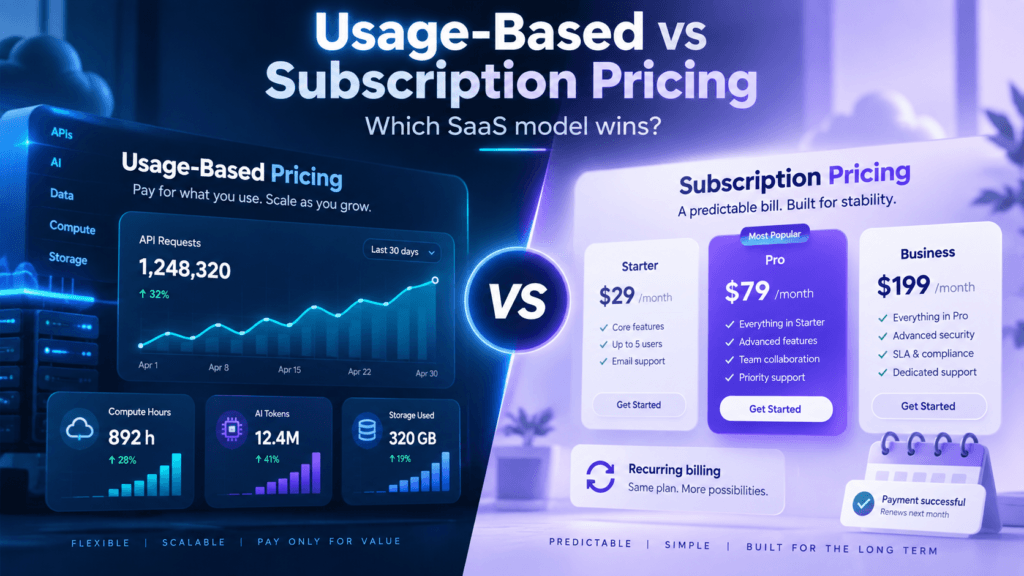

A strong subscription pricing strategy connects recurring customer value with recurring revenue. The strategy goes beyond deciding whether a plan costs $20, $50 or $500 per month. It defines who each plan is for, what metric controls the price, how monthly and annual billing are presented, which capabilities belong in each package, what triggers an upgrade, how discounts are governed, and how pricing changes as the product matures. Subscription businesses succeed only when customers continue to believe the product is worth the recurring payment, so retention must be built into the pricing logic from the beginning. An aggressive price that improves first-month revenue but creates churn is not a strong strategy, and a low price that attracts many users but leaves no room for expansion can create equally poor economics. This guide provides a practical framework for designing, testing and optimizing subscription-based pricing for SaaS and software products.
Define the Recurring Value Before the Recurring Price
The first strategic question is why the customer should continue paying month after month or year after year. Subscription pricing works best when the product creates ongoing value through continuous workflows, updated data, collaboration, automation, storage, security, support, or repeated outcomes. If the customer receives most of the value once and rarely returns, recurring billing can feel artificial and churn will be difficult to control. Map the recurring jobs the product performs and identify which outcomes become more valuable over time. This helps determine whether the price should scale with users, usage, data, transactions, features, or another metric. It also clarifies what belongs in the core subscription versus an add-on or one-time service. The strongest subscription strategy starts with a durable value loop: customers keep using the product because the problem keeps existing, and the pricing structure lets the company capture a fair share of that continuing value.
Choose a Subscription Value Metric
The value metric determines how a subscription grows as the customer becomes more successful. Common metrics include seats, active users, contacts, projects, locations, messages, transactions, storage, API calls, AI credits, and revenue processed. The metric should be easy for customers to understand and should increase when they receive more value rather than when they simply create more internal cost. A product can also combine a primary subscription metric with secondary limits. For example, a plan may be priced per user but include an allowance of AI credits or automation runs. Before finalizing the metric, model several customer types and ask whether a small account, growing customer, and enterprise buyer all see a sensible relationship between price and value. If customers consistently complain that growth is being punished, the metric may be misaligned. If large accounts receive dramatically more value without paying more, the business may be leaving expansion revenue uncaptured.
Design Plans Around Customer Maturity
Subscription plans should represent real differences in customer needs. An entry plan can serve individuals or small teams that need the core workflow, a professional plan can add automation and integrations, a business plan can add administration and analytics, and enterprise can address security, compliance, service levels, procurement and support. This approach is stronger than randomly distributing features across three columns. Each plan should have a clear target customer and a natural upgrade trigger. If customers have to study a long comparison table to understand the difference, packaging is probably too complicated. If nearly everyone chooses the cheapest tier, higher plans may not communicate enough incremental value. If nearly everyone chooses the highest public tier, the middle packaging may be weak. Use plan selection, feature usage, sales calls and customer interviews to refine segmentation over time. Our SaaS pricing ladder provides a deeper framework for creating those transitions.
Set the Entry Price to Support Adoption and Economics
The entry subscription price should make sense for the lowest-value attractive customer, not for every possible user. If the price is too high, the product may require a sales conversation before buyers are ready; if it is too low, the company may attract customers who consume support and infrastructure without generating enough revenue. Consider the cost of acquisition, onboarding, support, payment processing and infrastructure alongside willingness to pay. A low entry price can be useful for product-led growth when onboarding is inexpensive and expansion is strong, but it is less attractive when each customer requires implementation or human support. For freemium products, the free tier effectively becomes the entry price and must be evaluated using the same economic logic. The company should know what percentage of free or low-tier users need to convert or expand for the acquisition model to remain sustainable. Entry pricing is therefore both a conversion decision and a customer-quality decision.
Use Annual Billing as a Strategic Commitment Tool
Annual billing can strengthen subscription economics by improving cash flow, reducing renewal frequency, and creating longer customer commitment. Many SaaS companies offer a lower effective monthly rate for annual payment, but the discount should be calculated rather than copied. Estimate the expected difference in churn between monthly and annual customers, the value of receiving cash earlier, payment-processing savings, and the revenue sacrificed by the discount. For some products, a modest annual incentive may be enough; for others, stronger discounts are justified because monthly churn is materially higher. Enterprise subscriptions may not require a public percentage discount because annual contracts are already the standard buying structure and can be negotiated around volume or term length. Whatever approach you use, present billing clearly. Customers should know whether a displayed monthly number is charged monthly or is merely the monthly equivalent of an annual invoice. Transparency protects trust and reduces checkout abandonment.
Create Upgrade Triggers That Feel Like Progress
Subscription expansion works best when customers upgrade because their own success creates a new need. More employees may require additional seats, a growing customer list may require a higher contact tier, increased automation may require more workflow capacity, and larger organizations may need advanced permissions, SSO, audit logs or premium support. These are natural upgrade triggers because the customer can see why the higher plan is more valuable. Artificial limits create a different emotional response. If a customer is forced to upgrade for a basic capability that should logically belong in the product, the price increase can feel like a penalty. Review which limits customers hit before upgrading and which limits cause churn or support complaints. The goal is to create a pricing ladder where each step corresponds to a meaningful improvement in scale, capability or service. That relationship supports both expansion revenue and customer satisfaction because higher spending is connected to higher realized value.
Decide When Usage Should Sit Outside the Subscription
Pure subscriptions are attractive because they create predictable revenue and predictable customer bills, but they can become risky when product costs vary significantly with consumption. AI inference, cloud compute, data transfer, messages, API calls and storage can all create substantial variable costs. A subscription strategy can handle this through included allowances, hard limits, paid overages, credits or a hybrid model. The correct choice depends on how predictable usage is and how closely usage reflects customer value. If most customers consume similar amounts, a generous allowance inside the plan may preserve simplicity. If consumption varies by orders of magnitude, variable pricing is usually safer. Customers should receive tools to monitor usage and avoid surprise bills. Our usage-based pricing vs subscription guide and AI API Cost Calculator can help evaluate the trade-off between predictability and margin protection.
Govern Subscription Discounts
Discounts should support a strategic objective such as longer commitment, larger volume, prepaid usage, competitive displacement or a defined promotional campaign. They should not become the default response to sales resistance. Create rules for who can approve discounts, how much can be offered, how long the discount lasts and what the customer provides in return. A subscription discount that never expires can become a permanent reduction in lifetime value and can complicate future price increases. Track discounts by segment and salesperson because patterns often reveal whether the list price, packaging or sales positioning is the real problem. At renewal, revisit whether the original reason for the discount still exists. Our SaaS pricing discounts guide explains annual, volume and enterprise discount structures in more depth. Pricing integrity matters because customers compare not only the price they pay but also the fairness of how different customers are treated.
Build Downgrade Paths Into the Strategy
A subscription strategy should not assume that every customer either upgrades or cancels. Customers can experience budget cuts, lower usage, seasonal changes, team reductions or temporary shifts in need. A sensible downgrade path can preserve the relationship and reduce avoidable churn. The smaller plan should still provide meaningful value while reflecting the customer’s reduced scale or requirements. If downgrade options are hidden or intentionally painful, customers may cancel entirely and reconsider the product later through a competitor. Track downgrade reasons separately from churn because contraction can reveal packaging issues that are easier to fix than product failure. Customers repeatedly moving down from one tier may indicate that the higher plan was oversold or contains benefits that are not sustaining value after purchase. A healthy subscription model supports movement in both directions and focuses on long-term customer value rather than forcing every account to remain at the highest historical spend.
Test Subscription Pricing With Cohort Economics
Pricing tests should be evaluated over time rather than only at checkout. A new plan may improve conversion but attract customers with lower retention, weaker expansion or higher support needs. Compare cohorts on average revenue per account, gross margin, churn, gross revenue retention, net revenue retention, annual-plan adoption, discount rate and expansion behavior. If the company is changing prices for new customers, keep enough data to compare the old and new cohorts over several billing cycles. For usage-heavy products, also compare the distribution of consumption and the percentage of customers who reach limits or overages. Qualitative feedback matters alongside metrics: sales objections, cancellation reasons and support questions can reveal confusion that aggregate revenue does not show. The goal is to optimize lifetime economics and customer fit, not simply the percentage of visitors who purchase on the first day.
Review Subscription Pricing Before It Becomes Legacy Debt
Subscription pricing should evolve as the product becomes more valuable, customer segments change, AI capabilities appear, costs move and sales teams learn which accounts are willing to pay more. A formal annual review is a useful discipline, but material product or market changes can justify a review sooner. Examine plan distribution, usage, discounts, grandfathered customers, margins, competitive positioning and retention. Pricing changes do not always require a straightforward increase. The company may simplify packaging, retire an old tier, introduce a usage component, create a new enterprise plan, change annual discounts or adjust the value metric. Existing customers may need migration rules or a transition period. Our SaaS price increases guide explains how to manage these changes without unnecessary churn. Regular review prevents the subscription model from drifting years behind the product it is supposed to monetize.
Final Verdict
A successful subscription pricing strategy makes recurring revenue feel like the natural result of recurring customer value. The company should know why customers continue using the product, what metric grows as value grows, how plans correspond to customer maturity, what triggers upgrades, and how usage costs are controlled. Monthly and annual billing, discounts, downgrades, enterprise contracts and pricing tests are not separate decisions; they are parts of one commercial system. Start with a clear value metric and simple packaging, then add complexity only when customer behavior and product economics justify it. Measure the strategy using retention, expansion and margin alongside conversion. A strong subscription model gives customers predictable value today and a logical path to pay more tomorrow as their needs, usage or organization grows.
Frequently Asked Questions
What is a subscription pricing strategy?
A subscription pricing strategy is the complete commercial plan for recurring billing. It defines the value metric, price points, plans, monthly and annual options, free or trial access, usage allowances, discounts, upgrade and downgrade rules, enterprise terms and the process for reviewing prices. The objective is to create predictable recurring revenue while keeping the relationship between customer value and customer spend clear enough to support retention and expansion.
How do you create a subscription pricing strategy?
Begin with the recurring customer problem and identify the value created when the product solves it repeatedly. Choose a value metric that scales with that value, segment customers by needs and willingness to pay, design a small number of plans, model cost-to-serve and test monthly versus annual billing. Then validate the structure through sales conversations, conversion, usage, churn and expansion data. Pricing should be refined as real customer behavior becomes available.
What is the best subscription pricing strategy for SaaS?
The best strategy depends on the product. Per-user subscriptions work well when human adoption drives value, tiers work when customers differ mainly by sophistication, and hybrid subscriptions work when variable usage or AI costs are important. Product-led SaaS may benefit from a free tier or low-friction monthly plan, while enterprise SaaS may require annual commitments and custom terms. The best model is the one that customers understand and that preserves healthy economics as accounts grow.
How should subscription tiers be priced?
Tier prices should reflect meaningful differences in customer value rather than an arbitrary mathematical multiplier. Model the outcomes, usage, features, support and organizational complexity associated with each segment, then test whether the price gap feels justified. Higher tiers should have natural upgrade triggers and should not depend on withholding basic functionality. Customer research and observed plan selection provide better guidance than simply copying competitor tier ratios.
Should subscription pricing include a free plan?
A free plan can be effective when the product is inexpensive to serve, users can reach value without human onboarding, and free usage creates distribution or a clear path to paid adoption. It is less attractive when infrastructure or support costs are high or when the free plan attracts users who rarely fit the ideal customer profile. The free tier should produce a meaningful outcome while preserving logical reasons to pay for greater scale or professional capabilities.
What is a good annual subscription discount?
There is no universal best percentage. Calculate the value of upfront cash, lower renewal frequency and expected retention improvement, then compare those benefits with the revenue given up through the discount. The right discount also depends on market expectations and customer segment. Enterprise contracts may use negotiated term or volume economics rather than a public annual percentage. Whatever the number, clearly explain the billing commitment to customers.
How do you reduce subscription churn with pricing?
Use plans that match customer needs, keep billing predictable, provide visible usage controls, create fair upgrade and downgrade paths, and avoid forcing customers into oversized packages. Pricing should allow customers to reduce spend when their needs decline rather than making cancellation the only option. Analyze churn reasons separately from product dissatisfaction because some cancellations are really pricing or packaging problems that can be addressed through better plan design.
When should subscription pricing be changed?
Review pricing when customer value, product capabilities, cost-to-serve, segmentation, competitive positioning or buying behavior changes materially. A formal annual review is useful, but companies should not wait for the calendar if AI costs or product value have changed substantially. Any pricing change should be modeled for conversion, churn, downgrades and expansion and communicated clearly to existing customers with appropriate notice or transition rules.