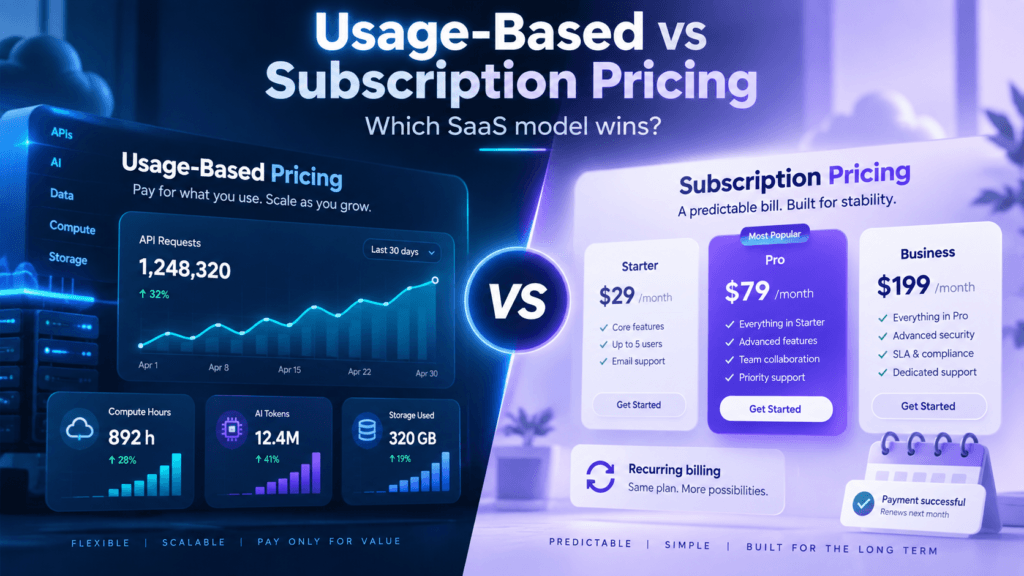

Usage-based pricing for SaaS charges customers according to what they actually consume rather than forcing every account into the same fixed subscription. In practice, the bill can scale with API calls, AI tokens, messages, transactions, storage, compute, workflow runs, data processed, credits or another measurable unit. The model has become especially important in AI, cloud, developer tools, infrastructure and automation because customer usage can vary dramatically and variable delivery costs can rise with consumption. Done well, usage-based SaaS pricing lowers the barrier to entry, aligns price with realized value and creates natural expansion revenue as customers use more. Done poorly, it produces bill shock, unpredictable revenue, confusing invoices and customer anxiety. This guide explains how to choose the right usage metric, structure the offer, set tiers and commitments, protect margin, meter consumption accurately and migrate from subscription pricing without creating unnecessary churn.
What Usage-Based Pricing Means in SaaS
Usage-based pricing, also called consumption-based or pay-as-you-go pricing, means the customer pays according to a measurable activity or resource. The most important principle is that the billable unit should feel connected to customer value. API requests make sense for developer platforms, transactions can work for payments, messages can work for communications software, and AI credits or tokens can reflect model usage when explained clearly. The metric should not be selected only because engineering can measure it easily. Customers need to understand what the unit means, how much they are likely to consume and what happens when usage increases. Stripe’s current usage-based pricing guidance emphasizes choosing a value metric first, then packaging the offer and planning the migration carefully. A technically precise metric that customers cannot forecast can create more friction than a simpler proxy that tracks value closely enough.
Choose a Usage Metric That Tracks Value
The strongest usage metric grows when the customer receives more value and does not punish healthy product adoption. Start by listing the activities that customers associate with successful outcomes: completed workflows, API calls, messages delivered, records processed, storage used, AI generations, compute consumed or transactions completed. Then compare each metric on four dimensions: customer understanding, correlation with value, predictability and cost alignment. A metric can be excellent for the vendor but poor for the customer if it creates a bill that is impossible to estimate. Likewise, a customer-friendly metric can damage margin if heavy usage creates significant variable cost that the price does not capture. The ideal unit sits close enough to the customer outcome that more usage feels like progress. If customers need a calculator to understand the metric, provide one and show realistic examples so finance teams can budget before the first invoice arrives.
Pure Pay-As-You-Go vs Included Usage
Pure pay-as-you-go billing charges from the first unit of usage and creates a very low entry barrier because customers do not need to commit to a large subscription. This works well for APIs, infrastructure and developer products where users want to experiment before scaling. The downside is weaker revenue predictability and greater bill volatility. Included-usage pricing adds a recurring subscription or platform fee that contains a defined allowance, then charges overages beyond that amount. This hybrid structure can create a more stable revenue floor while still allowing expansion as consumption grows. Chargebee’s current billing examples highlight included usage with overages as a way to combine predictable base revenue with automatic expansion. The right choice depends on customer budgeting preferences, cost-to-serve and how quickly usage can change. For many SaaS businesses, a base subscription plus included usage is easier to sell than a completely variable invoice.
Use Volume Tiers Without Creating Confusion
Volume pricing lowers the effective unit rate as consumption increases, which can make large customers more comfortable committing to higher usage. The structure can use graduated tiers, block pricing, all-units rates or negotiated enterprise commitments. The important point is that total spend should still rise as customer value increases even when the unit price declines. A discount curve that becomes too steep can create margin problems exactly when infrastructure and support demands are highest. Model several usage levels and calculate revenue, gross margin and customer effective rate at each point. Then test whether the transitions are intuitive. Customers should not discover that using one extra unit causes an unexpectedly large invoice jump. Our SaaS volume pricing guide explains graduated and commitment-based structures in more detail. Usage tiers should reward scale while preserving a predictable relationship between customer consumption and total contract value.
Minimum Commitments Improve Predictability
Enterprise usage-based SaaS often uses minimum annual commitments because a completely variable bill can be difficult for both the vendor and the buyer to forecast. The customer commits to a minimum level of spend or consumption and may receive better unit economics in exchange. The vendor gains a revenue floor, while the customer gains budget visibility and often a lower effective rate. The commitment should be based on realistic expected usage rather than on an aggressive sales target. If customers repeatedly consume far less than the contracted amount, renewals become difficult because unused commitment feels like wasted budget. Usage forecasting, historical consumption and implementation plans should all inform the minimum. A healthy commitment leaves room for growth while remaining attainable. Enterprise contracts can also include rollover, true-up or ramp periods when adoption is expected to increase gradually after implementation.
Prevent Bill Shock With Customer Controls
Bill shock is one of the biggest risks in usage-based pricing because a successful product can unexpectedly become expensive when customer activity spikes. Strong usage-based SaaS products therefore give customers visibility and control before the invoice closes. Provide real-time or near-real-time dashboards, budget alerts, threshold notifications, usage forecasts, spending caps, credit balances and clear overage rates. Finance teams should be able to see not only current usage but also projected month-end spend. When a customer crosses an important threshold, notify both the account administrator and relevant business owner rather than waiting for the invoice. This is especially important for AI and cloud products where automated workloads can scale quickly without a human actively watching every request. Good usage controls turn variable pricing from a source of anxiety into a manageable operating expense and reduce disputes after billing.
Protect Gross Margin in AI and Cloud SaaS
AI and infrastructure products often adopt usage-based pricing because their own costs scale with consumption. Model inference, API fees, compute, data transfer and storage can create meaningful variable expenses, so an unlimited flat subscription may become dangerous when power users consume far more than the average account. Pricing should not be based only on cost, but cost-to-serve establishes the margin boundary the company cannot ignore. Model light, typical and heavy users under the proposed rate and calculate contribution margin at each level. If heavy usage becomes less profitable, consider higher unit rates, included allowances, model-specific credit weights, minimum commitments or premium tiers. Our AI API Cost Calculator can help estimate variable model expenses before allowances are set. The objective is to align customer value and vendor economics so that increased product adoption improves the business rather than compressing margin.
Build Reliable Metering Before You Scale
Usage-based pricing depends on accurate metering. The billing system must record events, deduplicate them, aggregate consumption, apply pricing rules, handle late events, enforce limits and generate invoices that finance teams can defend. Small inaccuracies may be tolerable in product analytics but become serious when they affect customer charges. Decide which system is the source of truth for usage, how events are timestamped, what happens when data arrives late and how customers can audit their own consumption. Finance also needs a process for credits, disputes, refunds and contract exceptions. The more complex the pricing model, the more important it is to separate product telemetry from billing-grade data. Before launching usage pricing broadly, run shadow billing against historical usage and compare calculated invoices with expected customer behavior. This reveals edge cases before they become real revenue and trust problems.
How to Migrate From Subscription to Usage-Based Pricing
Moving an installed customer base from fixed subscriptions to variable billing should be sequenced carefully. Stripe’s current guidance recommends starting with new customers, then allowing opt-in migration, moving segment by segment and handling the highest-risk accounts with special care before any hard cutoff. That approach is sensible because existing customers built budgets and expectations around the old model. Start by modeling how the new pricing would affect different customer groups. Some accounts may save money, while heavy users may see a meaningful increase. Communicate the reason for the change in terms of fairness, scalability or alignment with value rather than simply announcing a new billing mechanism. Provide calculators, examples and transition periods. The migration is successful only when customers understand how to predict the new bill and when the company can operate the metering, invoicing and support process reliably.
When Usage-Based Pricing Is the Wrong Choice
Usage-based pricing is not automatically better than subscription pricing. It can be a poor fit when customers value access rather than consumption, when usage is difficult to measure, when customers require fixed budgets or when the chosen metric does not correspond to customer outcomes. Productivity and collaboration products often work well with seats or tiers because customers value persistent access and team capability more than individual actions. A highly variable invoice can also slow enterprise procurement even when the underlying model is economically fair. If usage differs only slightly among customers, a fixed subscription with sensible limits may create a better buying experience. Our usage-based pricing vs subscription comparison can help decide whether the added complexity is justified. Pricing should solve a real value-alignment problem, not follow an industry trend.
Final Verdict
Usage-based pricing for SaaS works best when the billable unit is understandable, closely tied to customer value and supported by reliable metering and spend controls. It can lower entry friction, improve monetization of heavy users and create natural expansion revenue, especially in AI, APIs, cloud, data and automation. The model becomes dangerous when customers cannot predict bills, when the metric feels arbitrary or when billing infrastructure cannot support accurate usage records. Start with the value metric, model customer and margin scenarios, choose between pure usage and a hybrid subscription, add volume or commitments carefully and give customers visibility before invoices arrive. Usage-based SaaS pricing should make growing product usage feel like a positive business outcome for both sides rather than a surprise charge.
Frequently Asked Questions
What is usage-based pricing for SaaS?
Usage-based pricing charges customers according to how much of the software or service they consume. Common billable units include API calls, AI tokens, messages, transactions, storage, compute, data processed and workflow executions. The model can be pure pay-as-you-go or combined with a recurring subscription, included allowance and overage charges.
What is the best usage metric for SaaS?
The best metric is one customers understand and that increases as they receive more value. It should also be measurable, reasonably predictable and compatible with the company’s cost structure. A technically convenient metric is not enough if customers cannot connect it to an outcome. Test several metrics against real customer scenarios before choosing one.
Is usage-based pricing better than subscription pricing?
Neither is universally better. Usage pricing is stronger when consumption varies widely and value scales with activity. Subscription pricing is stronger when customers value ongoing access and need highly predictable budgets. Many modern SaaS products use a hybrid model that combines a recurring base fee with included usage and overages.
How do SaaS companies prevent bill shock?
Provide dashboards, real-time usage visibility, budget alerts, threshold notifications, spending caps, forecasts and transparent overage rates. Customers should know what is driving the bill before the billing period ends. This is especially important for automated AI and cloud workloads that can scale quickly without constant human attention.
How do enterprise usage commitments work?
The customer commits to a minimum annual or monthly spend and usually receives better unit economics in exchange. The vendor gains revenue predictability and the buyer gains budget visibility. Commitments should be based on realistic expected usage, with ramp periods or rollover rules when adoption is expected to grow gradually.
What are the biggest challenges with usage-based pricing?
The biggest challenges are choosing the right metric, forecasting revenue, preventing customer bill shock, building billing-grade metering, handling overages and maintaining accurate invoices. Migration from fixed subscriptions can also create churn if existing customers are not given clear communication and transition options. See our usage-based pricing challenges guide for a deeper implementation checklist.