
Annual vs monthly SaaS pricing is not only a checkout design choice. It changes customer commitment, cash flow, churn risk, revenue recognition, discount economics and the way buyers evaluate product fit. Monthly billing lowers the barrier to entry because customers can test the software with less commitment and preserve cash, while annual billing gives the SaaS company more predictable revenue and reduces the number of renewal decisions customers make during the year. The difficult part is choosing an annual discount that creates enough incentive without giving away revenue unnecessarily. A 2026 dataset covering 560 SaaS plans across 207 products found a median annual-billing discount of 20%, with most business-software categories clustering in roughly the mid-teens to mid-twenties range. That benchmark is useful context, but the right discount still depends on your churn, cash flow, customer segment and whether usage already drives expansion.
How Annual and Monthly SaaS Billing Differ
Monthly billing gives customers flexibility and usually charges the full monthly list rate, while annual billing asks for a twelve-month commitment and often offers a lower effective monthly price. The commercial trade is straightforward: the customer gives up flexibility and usually prepays more cash, while the vendor gives up some unit revenue in exchange for commitment, improved cash flow and lower renewal frequency. The two options can also attract different customers. Buyers who are still testing product fit often prefer monthly plans, while customers with established usage and clear internal approval are more comfortable moving to annual billing. That means the annual toggle is partly a segmentation tool. If almost every new customer chooses annual immediately, the discount may be too aggressive or the monthly option may be priced as a deterrent. If almost nobody chooses annual, the incentive may be too weak or customers may not trust the product enough to commit.
What Is a Typical Annual SaaS Discount?
Market benchmarks can help establish a starting hypothesis, but they should not replace your own economics. CompareEdge’s 2026 annual-billing dataset reported a median discount of 20% across 560 plans and found many business-software categories clustered between roughly 16% and 25%. Paddle has also historically described annual SaaS discounts in the 15% to 20% range as common. These figures do not mean every SaaS company should copy 20%. A usage-heavy product that already expands with contacts, transactions or consumption may need less term discounting because customer spend can grow without a longer commitment. A highly competitive self-service product may need a stronger incentive to move customers from monthly to annual. The right question is not what percentage looks normal on a pricing page. It is what commitment is worth to your business after accounting for churn, cash flow, acquisition cost and customer behavior.
Calculate the Annual Billing Breakeven Point
Buyers and vendors can both evaluate annual pricing using a simple breakeven calculation. If the annual plan is 20% cheaper than paying month to month, the customer effectively pays for about 9.6 months of the monthly rate to receive twelve months of access, so annual becomes economically attractive when the customer expects to stay for roughly ten months or longer. CompareEdge’s 2026 analysis uses the same principle and reports month 10 as the typical breakeven point at a 20% discount. This math is useful because it shows why annual billing is not automatically better for every buyer. A new startup testing an unfamiliar tool may value flexibility more than the savings, while an established customer with stable usage is more likely to benefit from annual commitment. SaaS companies should present the savings clearly but should avoid implying that annual is always the rational choice regardless of uncertainty.
Why Annual Billing Improves SaaS Cash Flow
Annual prepayment brings cash into the business earlier, which can be valuable for companies funding product development, sales and customer acquisition. The accounting treatment is different from cash collection: receiving a full year of payment upfront does not mean the entire amount should be counted as one month of recurring revenue. Paddle’s SaaS accounting guidance explains that annual contract revenue is recognized across the service period, and monthly recurring revenue should normalize the annual subscription across twelve months. This distinction matters because annual billing can make bank balances look stronger without changing the underlying monthly revenue recognition. Finance teams should separate bookings, billings, cash and recognized revenue when evaluating the impact of annual plans. The real economic benefit comes from liquidity, lower collection risk, greater commitment and potentially better retention rather than from artificially inflating MRR in the month the payment arrives.
When Monthly Pricing Is Better for Customers
Monthly pricing is usually the better option when product fit is uncertain, the customer expects headcount or usage to change quickly, cash flow is constrained or the software is being evaluated for a short-term project. The flexibility creates a lower-risk purchase and can increase conversion among buyers who would hesitate to commit for a full year. This is especially important for early-stage SaaS, new categories and products with fast-changing feature sets because customers may not yet know whether the tool will remain essential. Monthly billing also reduces buyer resentment when a product disappoints because cancellation does not leave a large unused prepaid balance. The downside for the vendor is higher churn exposure and more frequent payment events. A strong SaaS pricing strategy often keeps monthly available as the low-commitment path while using annual billing to reward customers who already have confidence in the product.
When Annual Pricing Is Better for SaaS Companies
Annual pricing becomes particularly attractive when the product has demonstrated retention, onboarding costs are meaningful, customer success invests heavily in implementation or the sales process itself is expensive. A one-year commitment gives the vendor more time to recover acquisition cost and deliver value before the customer reaches another cancellation decision. It can also reduce the noise created by seasonal usage because customers remain contracted even when short-term activity falls. Enterprise and mid-market SaaS often default to annual contracts for exactly these reasons: procurement, implementation and security reviews already involve enough effort that month-to-month billing would not match the buying process. However, annual contracts should not become a substitute for retention. A company that relies on lock-in because customers would otherwise leave is creating future renewal risk. The best annual customers stay because the product is valuable, not because cancellation is administratively difficult.
How to Set the Annual Discount
Start with the economic value of commitment rather than a convention. Estimate how much annual customers reduce churn compared with monthly customers, the value of receiving cash earlier, the savings from fewer payment events and the effect on customer acquisition payback. Then compare those benefits with the revenue surrendered through the discount. If the company gives away 20% but annual customers do not retain materially better and cash is not a constraint, the discount may be too generous. If monthly churn is high and annual contracts dramatically improve lifetime value, a stronger incentive can be justified. Segment the analysis by customer type because enterprise, SMB and consumer SaaS may respond differently. Also consider non-price incentives such as premium onboarding, additional usage, priority support or bonus features. Our SaaS pricing discounts guide explains how to structure incentives without weakening pricing integrity.
How to Present Annual vs Monthly on the Pricing Page
The pricing page should make the billing commitment unmistakable. If the annual plan displays a lower monthly equivalent, state clearly that the customer is billed annually rather than placing that information in small text below the card. Show the actual savings in a way buyers can verify, such as save 20% annually or save $240 per year, and keep plan features identical unless there is a deliberate reason to create annual-only benefits. The monthly option should remain a real choice rather than a punishment. Extremely large gaps can make the monthly rate look artificial and may reduce trust. Your pricing-page design should also explain cancellation and refund policies because annual customers are taking more financial risk. See our SaaS pricing page best practices guide for conversion-focused layout, comparison and FAQ recommendations.
Annual Pricing for Usage-Based SaaS
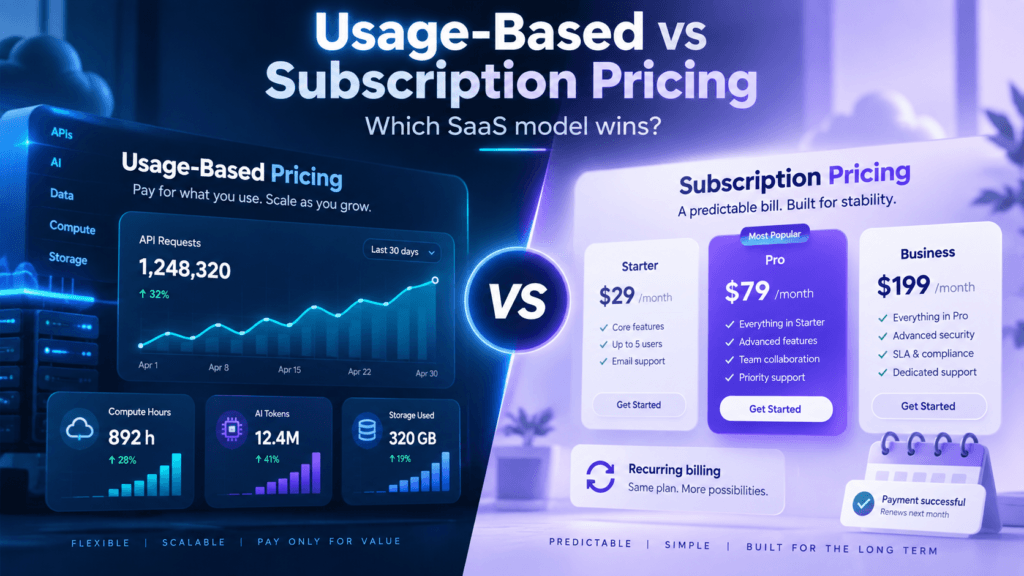
Usage-based businesses need to separate contract commitment from consumption. A customer can sign an annual agreement while still receiving monthly variable invoices based on usage, or it can commit to a minimum annual spend in exchange for better unit rates. This structure is common when pure annual prepayment would be difficult because actual usage is uncertain. The vendor gains some revenue floor, while the customer preserves flexibility within the commitment. Usage-heavy SaaS may also offer smaller annual discounts because revenue already expands as consumption grows. Instead of reducing the subscription price substantially, the company can negotiate volume commitments, prepaid credits or lower overage rates. The right design depends on whether the customer values cash-flow predictability, lower unit economics or maximum flexibility. Our usage-based pricing for SaaS guide explains commitments and included usage in more detail.
Metrics to Compare Annual and Monthly Customers
Do not judge the billing model only by the percentage of customers choosing annual. Compare monthly and annual cohorts on conversion, average revenue per account, churn, gross revenue retention, net revenue retention, refunds, expansion, payment failures, customer acquisition payback and support load. Normalize annual contracts correctly when calculating MRR so that upfront cash does not distort recurring revenue analysis. Also compare how quickly annual customers activate and whether they use the product more deeply than monthly accounts. If annual customers convert at a lower rate but retain much longer, the trade may still be attractive. If annual discounts produce lower MRR without improving retention or expansion, the incentive should be reconsidered. Pricing decisions become clearer when cohort economics show whether commitment genuinely improves customer lifetime value rather than simply shifting the timing of cash collection.
Final Verdict
Annual vs monthly SaaS pricing is a trade between flexibility and commitment. Monthly plans reduce purchase risk and can improve initial conversion, while annual plans improve cash flow, revenue visibility and often retention. A 20% annual discount is a useful 2026 market reference, but it should be treated as a benchmark rather than a rule. Model what the longer commitment is actually worth to your business, calculate the customer breakeven point, make billing terms transparent and compare the lifetime economics of monthly and annual cohorts. For many SaaS companies, the strongest structure is to offer both: monthly for customers who are still proving fit and annual for customers who already know the product belongs in their workflow. The discount should reward confidence and commitment without making the monthly option feel intentionally unreasonable.
Frequently Asked Questions
What is a typical annual SaaS discount?
A 2026 dataset covering 560 SaaS plans found a median annual-billing discount of 20%, with many business software categories clustering in the mid-teens to mid-twenties. That is a useful market reference, not a required percentage. The right discount depends on churn, cash flow, customer segment and how much value the vendor receives from a longer commitment.
Is annual or monthly SaaS pricing better?
Monthly is better when the customer is testing product fit, expects rapid change or values flexibility. Annual is better when usage is stable, the customer expects to stay and the discount creates meaningful savings. For the SaaS company, annual billing usually improves cash flow and revenue predictability, but the discount must still produce healthy lifetime economics.
When does an annual SaaS plan break even?
At a 20% annual discount, the customer effectively pays about 9.6 months of the monthly rate for twelve months of access, so annual becomes cheaper at roughly month 10. The exact breakeven depends on the discount. Buyers should also consider refund policies and the risk that they stop using the product before the paid term ends.
Should startups offer annual pricing?
Yes, but startups should avoid forcing every new customer into a long commitment before product fit is proven. Monthly billing helps lower acquisition friction, while annual billing can be offered to customers who already understand the value. As retention becomes more predictable, the company can optimize the annual incentive using real cohort data.
How should annual subscriptions be counted in MRR?
Annual contract value should be normalized across twelve months when calculating monthly recurring revenue. Receiving the full payment upfront increases cash, but it does not mean the entire annual amount is recurring revenue for that month. Finance teams should distinguish bookings, billings, cash collection and recognized revenue to avoid misleading growth metrics.
Do usage-based SaaS products need annual billing?
They can use annual commitments without fixing the entire invoice. A common structure is a minimum annual spend with monthly usage billing or prepaid credits. This gives the vendor a revenue floor while allowing customer consumption to vary. Usage-based companies may use volume incentives rather than relying only on a large annual subscription discount.