
SaaS pricing examples are useful because pricing frameworks become easier to understand when you can see how different business models translate customer value into a bill. The mistake founders make is copying the visible price without understanding the commercial logic underneath it. A per-user collaboration product, an API platform, an AI image generator, and an enterprise security product can all be successful SaaS businesses while using completely different value metrics, packaging rules, and upgrade triggers. The right lesson is therefore not “copy this company’s price.” It is to study what drives the bill, which customer segment the model serves, how expansion happens, and what operational complexity the pricing creates. The examples below cover the most common SaaS pricing patterns used across productivity, infrastructure, AI, design, communications, and enterprise software, with practical lessons you can apply to your own pricing architecture.
1. Per-User Pricing: Collaboration Software
Collaboration and productivity SaaS frequently use per-user pricing because each additional employee who joins the product receives direct access and contributes to team-wide adoption. This structure is easy to explain: the customer knows that adding more users increases the monthly or annual cost, while the vendor gains predictable expansion as the organization grows. Products in this category often combine per-user pricing with feature tiers, so a customer can pay a different seat rate depending on whether they need basic collaboration, advanced administration, security, or enterprise controls. The lesson for founders is that seats work when human access genuinely represents value. If customers begin restricting adoption, sharing accounts, or excluding occasional users simply to control software spend, the pricing metric may be creating friction and a platform fee or usage component could be worth testing.
2. Usage-Based Pricing: API and Infrastructure SaaS
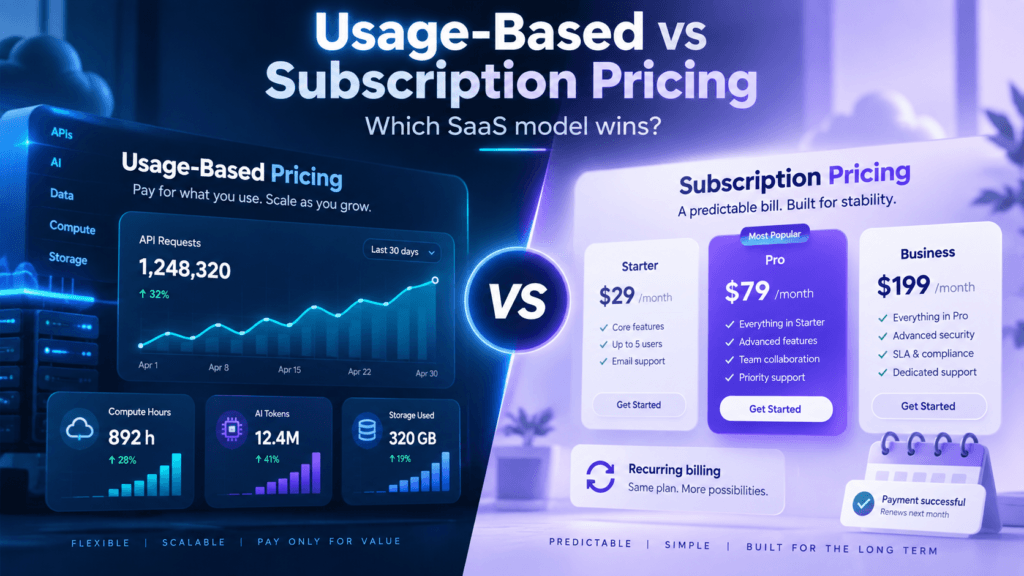
API, communications, cloud, and infrastructure products often charge according to transactions, requests, compute, data, messages, or another measurable unit because consumption varies dramatically between customers. A small startup may make a few thousand requests while a large enterprise generates millions, so one flat subscription would either overcharge the small account or undercharge the large one. Usage pricing creates a low barrier to entry and natural expansion, but it requires accurate metering and transparent spend controls. Customers need to know what unit is measured, how volume discounts work, and how to predict bills as adoption grows. The lesson is that a strong usage metric should feel closely connected to value rather than to an obscure internal technical unit. Our usage-based pricing vs subscription guide explains the trade-offs in detail.
3. Freemium Pricing: Design and Productivity SaaS
Freemium products give users meaningful free access and monetize them when they need more features, storage, collaboration, templates, exports, AI capabilities, or business controls. This model is common in design, productivity, note-taking, and creator software because individuals can experience value before paying and can spread the product organically through shared content or invitations. A successful freemium plan is not simply a cheap acquisition tactic. It needs a clear free-to-paid transition based on increased value. If the free tier is too generous, users may never upgrade; if it is too limited, the experience becomes a frustrating trial rather than a useful product. The founder lesson is to design free usage around distribution and habit formation while reserving premium value for users who have reached a level of commitment, scale, or professional need that makes paying logical.
4. Tiered Pricing: Marketing and CRM SaaS
Marketing, CRM, email, and automation software often use several public tiers because customers differ in contacts, team size, automation complexity, reporting requirements, and support needs. A small company might need basic lead management while a larger organization needs advanced workflows, permissions, forecasting, attribution, or integrations. Tiered pricing allows the company to serve multiple segments on one product while giving customers a visible upgrade path. The danger is creating a maze of limits and add-ons that makes the pricing page difficult to understand. The best examples show a clear progression in both value and customer maturity. Founders should map each tier to a real customer profile and make sure the reasons to move upward are based on genuine growth rather than artificial restrictions. Our pricing ladder framework can help structure those transitions.
5. Flat-Rate Pricing: Simple SaaS Products
Some SaaS companies deliberately use one flat subscription because simplicity is part of the value proposition. A single price reduces decision friction, removes the need for customers to compare multiple tiers, and makes budgeting extremely easy. Flat-rate pricing is most attractive when usage and cost-to-serve are relatively consistent across accounts or when the company wants to position itself against competitors with complicated pricing. The trade-off is limited monetization flexibility. A company with very small and very large customers may leave significant revenue uncaptured if everyone pays the same amount, and heavy users can damage margins when variable infrastructure costs exist. The lesson is that simplicity can be a competitive advantage, but founders should monitor whether customer value and usage eventually diverge enough to justify tiers or usage components.
6. Hybrid Pricing: Base Subscription Plus Usage
Hybrid SaaS pricing combines a recurring subscription with a variable element such as usage, overages, credits, seats, or transactions. This model is increasingly common in AI and data products because the platform itself creates ongoing value while some activities generate meaningful variable cost. A customer may pay a monthly platform fee that includes dashboards, integrations, administration, and a usage allowance, then pay additional charges when consumption exceeds that allowance. The founder lesson is that hybrid pricing can solve the tension between predictable recurring revenue and variable economics, but it must remain understandable. If customers have to track seats, credits, model types, storage, add-ons, and overages simultaneously, the pricing can become too difficult to forecast. Use each component only when it represents a distinct source of value or cost.
7. Credit-Based Pricing: AI SaaS
AI SaaS often uses credits to translate multiple costly actions into a single customer-facing currency. A text generation, image creation, transcription, or research task may consume a different number of credits depending on the model or workload, while customers purchase a recurring plan with a defined credit balance. Credits can make complex infrastructure easier to package because the company does not need to expose raw token or compute economics. The downside is customer confusion when the credit-to-outcome relationship is unclear. Strong credit-based examples show exactly how many typical actions a plan supports and provide visible usage balances, upgrade options, and overage rules. The lesson for founders is that credits should simplify several usage metrics into one understandable unit; they should not be used to hide unpredictable costs behind an abstract number.
8. Enterprise Custom Pricing: Security and Complex B2B SaaS
Enterprise SaaS products often use negotiated pricing because large accounts require security, procurement, implementation, legal terms, service levels, support, and integrations that vary substantially by customer. Public pricing may cover smaller tiers while the enterprise plan uses “contact sales” and an internal pricing framework based on users, usage, modules, minimum commitments, and service requirements. The commercial benefit is the ability to capture higher value and adapt to complex accounts, while the downside is longer sales cycles and less transparency. The lesson is that custom pricing should not mean arbitrary pricing. Sales teams need consistent floors, discount rules, value metrics, and approval processes so two similar customers do not receive radically different economics without a reason. See our enterprise software pricing models guide for a deeper structure.
9. Platform Fee Plus Seats: B2B SaaS
A platform fee plus seats is a useful model when the software creates organization-wide value beyond the people actively logging in. The company charges a recurring base amount for access to the platform, data infrastructure, administration, reporting, or integrations and then adds a per-user component as adoption expands. This structure creates a revenue floor while still monetizing team growth. It can work well in systems where a small group of power users manages workflows that benefit many people across the business. The lesson is that the base fee needs a clear value story. If customers feel they are paying twice for the same access, resistance will increase. Founders should explain what the platform fee includes and use the seat component only when additional users create incremental value.
10. Volume Pricing: Payments, Messaging and Data
Volume pricing gives customers lower effective unit rates as they commit to or consume more, which is common in payments, messages, API requests, storage, and data processing. Larger accounts often expect better unit economics because their total contract value is higher and their demand is more predictable. The vendor benefits when a commitment creates revenue visibility and reduces customer switching risk. However, large-volume customers can also create infrastructure, support, or operational costs, so the discount curve must protect gross margin. The lesson is to reward commitment rather than simply giving away price. A well-designed volume structure uses graduated tiers, minimum commitments, or negotiated rates that still preserve attractive economics at scale. Our SaaS volume pricing article explains the calculation methods.
11. Feature-Based Pricing: Business Software
Feature-based pricing is common when customers become more sophisticated as they grow. A basic plan may include core functionality while higher tiers unlock advanced automation, analytics, permissions, integrations, security, administration, or support. The model is attractive because feature requirements often correlate with willingness to pay, particularly in B2B SaaS. The risk is placing essential product functionality behind a premium plan simply to manufacture differences. Customers may accept paying more for enterprise governance or advanced automation but can resent being forced upward for a capability that feels fundamental. The lesson is to package around customer maturity. Use product research and sales data to identify which features naturally matter to small, growing, and large customers, then price those bundles according to the value each segment receives.
12. Outcome-Based Pricing: AI and Automation
Outcome-based pricing charges for a result rather than access or activity, such as a resolved customer issue, recovered payment, qualified lead, or completed workflow. As AI systems replace some human tasks, outcome-based pricing is becoming more attractive because charging by employee seat can stop reflecting the value created. The model can create very strong alignment when the outcome is clear and measurable, but it is operationally demanding. The company must define exactly what counts as success, determine how attribution works, and handle disputes or situations where several systems contributed to the result. The lesson is that outcome pricing works best in narrow workflows where success is objectively measurable. If attribution remains ambiguous, founders can combine a platform fee with outcome or usage components instead of relying on a pure outcome model.
13. Annual Discount Pricing
Many SaaS pricing examples include both monthly and annual billing, with an annual plan priced lower on an effective monthly basis. This is not a separate value metric, but it is an important commercial layer because it changes cash flow, retention, and customer commitment. Annual discounts can encourage customers to commit longer and give the SaaS company upfront cash, but the discount should be based on economics rather than copied automatically. A large discount may improve annual adoption while unnecessarily reducing revenue from customers who would have committed anyway. Founders should test how annual pricing affects conversion, churn, cash flow, and lifetime value. Our SaaS pricing discounts guide explains how to structure annual and volume incentives.
14. Good-Better-Best Pricing
Good-better-best is a specific tiered structure that gives customers three clear choices and often highlights the middle plan as the recommended option. The first plan reduces entry friction, the middle plan captures the most common use case, and the highest plan serves customers with greater scale or complexity. This design works because customers can compare a small number of meaningful options without navigating a large matrix. The founder lesson is that the middle plan should not simply be the plan the company wants to sell; it should genuinely solve the needs of the largest attractive customer segment. The premium plan should add value that more sophisticated buyers recognize, while the entry plan must remain useful enough to generate trust and adoption rather than feeling intentionally crippled.
15. Product-Led Upgrade Pricing
Product-led SaaS creates pricing around moments users encounter inside the product rather than relying entirely on sales conversations. Upgrade triggers may include collaboration, higher usage, more history, exports, premium templates, AI features, integrations, automation, security, or team administration. The product itself teaches the user why paying more creates additional value. This approach can make expansion efficient because customers upgrade when a real need appears instead of because a salesperson pushes a plan. The risk is turning every limit into a paywall and creating frustration before the user experiences enough value. The lesson is to place monetization after meaningful activation. Free or lower-tier users should reach a useful outcome first, then encounter upgrade triggers that correspond to genuine growth or professional needs.
How to Use SaaS Pricing Examples Correctly
Pricing examples should be used to study patterns, not to copy numbers. First identify the company’s value metric and ask whether the same metric applies to your product. Then examine how plans segment customers, how the bill scales, where enterprise starts, and what causes upgrades. Consider cost structure as well: an AI generation product has different economics from a collaboration tool even if both show three subscription tiers. Finally, remember that public prices change frequently and may not show discounts, enterprise contracts, add-ons, or negotiated terms. Use competitor examples as market context, then combine them with your own customer research, willingness-to-pay evidence, usage distribution, and margin analysis. The goal is to understand why a pricing architecture works for a particular business rather than to imitate the visible page.
Final Verdict
The strongest SaaS pricing examples all share one principle: the model reflects how customers receive value. Per-user models scale with team adoption, usage-based models scale with consumption, tiered models scale with customer maturity, freemium models use product access to drive acquisition, and hybrid models combine recurring value with variable economics. Founders should study these patterns and then build pricing around their own customers rather than copying a successful brand. A pricing model that fits someone else’s cost structure and customer base can be wrong for your product even if the pricing page looks excellent. The best architecture is the one customers understand, the company can operate reliably, and revenue can expand naturally as customers become more successful.
Frequently Asked Questions
What are examples of SaaS pricing models?
Common SaaS pricing examples include per-user plans for collaboration software, usage-based billing for APIs and infrastructure, freemium models for productivity tools, tiered plans for CRM and marketing software, credit-based plans for AI products, flat-rate subscriptions for simple SaaS, and custom enterprise contracts for complex B2B software. Many products combine several models, such as tiered subscriptions with included usage and paid overages.
What is a good SaaS pricing example for startups?
For an early-stage startup, a simple flat-rate plan or a small number of clear tiers is often a better example to follow than a complex enterprise or usage model. Startups need pricing that is easy to explain and easy to change while they learn customer behavior. Once the company understands which users receive the most value, it can introduce more precise value metrics, tiers, usage allowances, and enterprise packages.
Should I copy competitor SaaS pricing?
No. Competitor pricing is useful for understanding market expectations, plan conventions, and possible value metrics, but it should not replace customer research. Competitors may have different costs, segments, features, positioning, or willingness to pay. Use their pricing as one input and then validate your own structure with customer interviews, usage data, margin analysis, and real purchase behavior.
What SaaS pricing model creates the most expansion revenue?
Models that scale naturally with customer success tend to create strong expansion. Usage-based pricing expands as consumption grows, per-user pricing expands as teams add seats, and tiered or hybrid pricing expands when customers need more capacity, features, or control. The best expansion model is the one tied most closely to the value metric your customers naturally grow on.
Are SaaS pricing examples reliable if prices change?
The exact prices on public SaaS pages can change, so examples are most useful for studying structure rather than memorizing numbers. Focus on the model, value metric, plan segmentation, upgrade logic, annual billing, enterprise path, and usage rules. If you need a specific vendor’s current price for a purchase decision, verify it directly on the vendor’s current pricing page.
What should a SaaS pricing page show?
A strong pricing page should make it clear who each plan is for, what the customer pays, what is included, what causes the price to change, whether billing is monthly or annual, and what happens after the customer clicks the call to action. It should also address important limits, overages, enterprise requirements, and common objections so buyers can make a decision without unnecessary uncertainty.