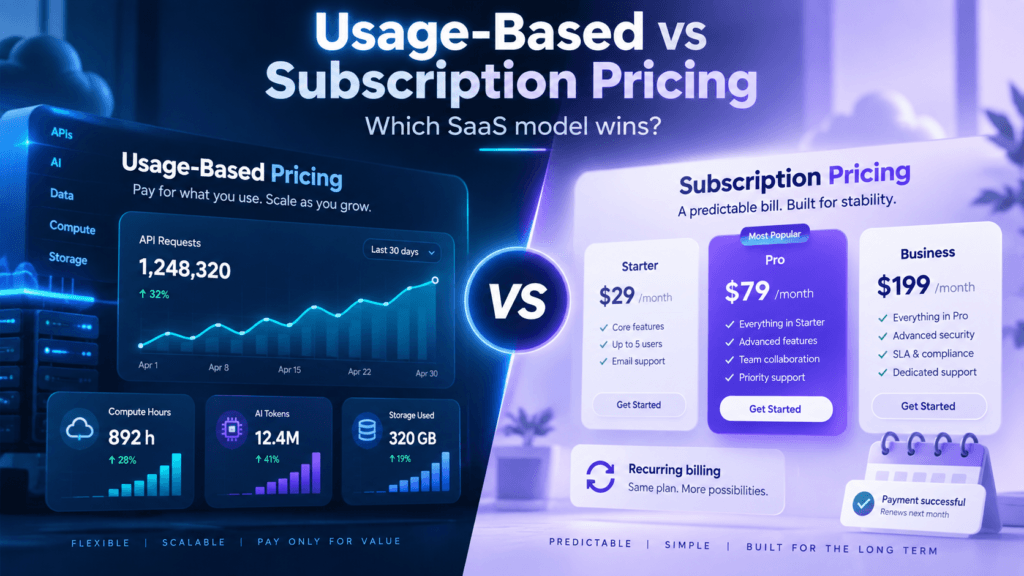

SaaS pricing best practices are not about finding one perfect price and leaving it unchanged. Strong pricing is a system that connects customer value, product packaging, cost-to-serve, willingness to pay, sales motion, retention, and expansion revenue. The best-performing SaaS businesses make it easy for customers to understand what they are buying, why a higher plan costs more, and how the bill will change as the account grows. They also review pricing as the product evolves instead of allowing years of feature growth, AI cost, discounting, and customer segmentation to accumulate under an outdated commercial model. The practices in this guide are designed for founders, product leaders, revenue teams, and finance teams that want pricing to support conversion and long-term economics at the same time. Each rule focuses on a practical decision that can materially affect recurring revenue quality rather than cosmetic changes to a pricing page.
1. Start With Customer Value, Not Competitor Prices
Competitor pricing is useful context, but it should not determine your price. Two products can appear similar while serving different customer segments, creating different business outcomes, or carrying very different support and infrastructure costs. Start by identifying the problem customers are paying to solve and the economic or operational value created when the software works well. Interview customers about alternatives, current spending, the consequences of not solving the problem, and the results they receive after adoption. This research reveals whether customers view the product as a convenience, a productivity tool, a revenue driver, or mission-critical infrastructure. Those categories can support very different willingness to pay. Use competitor prices later to understand market expectations and packaging conventions, but anchor the strategy in your own customers. A pricing decision becomes much stronger when customer value, usage data, margin analysis, and competitive context all point in the same direction.
2. Choose a Value Metric Customers Understand
The value metric is the unit that causes price to grow, and it should feel intuitive to the buyer. Seats work when more users create more value, transactions work when activity scales with business outcomes, storage works when capacity is the product, and API calls or AI credits can work when consumption reflects usage. A weak value metric creates tension because customers feel the bill increases without a corresponding increase in benefit. The metric should also be measurable, predictable enough for budgeting, and difficult to manipulate. Before committing, model several customer profiles and ask whether the price grows logically from a small account to a large one. If a customer receiving ten times more value pays only slightly more, the company may be under-monetizing. If cost grows ten times faster than value, the metric may create churn. Our SaaS pricing models guide explains how value metrics interact with seats, usage, tiers, credits, and hybrid structures.
3. Keep the Pricing Structure Easy to Explain
Pricing complexity can become a hidden acquisition cost because every confusing rule creates more questions for buyers, salespeople, support teams, and finance. A customer should be able to understand the basic commercial model quickly: what the plan costs, what is included, what can increase the bill, and what triggers an upgrade. Complexity is sometimes necessary in enterprise, infrastructure, or AI products, but each pricing component should have a clear economic purpose. Avoid stacking seats, credits, storage, feature gates, minimums, add-ons, and overages unless each variable solves a real monetization problem. Simplicity is especially important for self-service SaaS, where a confused buyer can leave without speaking to anyone. If the product needs a calculator to estimate cost, provide one and make the assumptions visible. Good pricing is not necessarily one number, but it should feel coherent enough that customers can predict how their spending changes as they grow.
4. Build Tiers Around Real Customer Segments
Pricing tiers should represent differences in customer maturity, scale, or requirements rather than arbitrary bundles. A small team may need core functionality and basic support, while a growing company may need integrations, automation, reporting, and collaboration. Enterprise buyers may require SSO, audit logs, compliance controls, procurement, SLAs, implementation, data residency, and dedicated customer success. When tiers map to these real differences, customers can identify the right plan with less friction and upgrades occur naturally. When tiers are created by randomly withholding desirable features, customers may feel forced rather than persuaded. Three or four public plans are often enough to provide meaningful segmentation without overwhelming the buyer, though there is no universal rule. Our SaaS pricing ladder and pricing plan names guides show how to design upgrade paths and plan positioning around real buyer groups.
5. Give Every Upgrade a Clear Value Story
A higher-priced plan should answer a simple question: why is this worth more? The answer can be more usage, more users, stronger automation, advanced analytics, additional security, higher limits, premium support, or another capability that becomes more valuable as the customer grows. If the upgrade is driven only by a frustrating artificial limit, customers may look for a competitor instead of moving up. Good SaaS pricing best practices treat expansion revenue as a consequence of increasing customer value rather than as a series of traps. Review the reasons customers currently upgrade and downgrade. Those behaviors reveal whether plan boundaries are aligned with real needs. If most upgrades happen because of one feature, that feature may be carrying too much of the packaging strategy. If customers frequently downgrade after buying a higher tier, the premium package may not deliver enough ongoing value. Pricing should create durable expansion, not short-term plan movement that later turns into contraction.
6. Model Light, Average and Heavy Users Before Launch
Every proposed pricing model should be tested against realistic customer scenarios before it reaches the pricing page. Model what a light user, average user, power user, small company, growing team, and enterprise account would pay, then compare each bill with the value received and the cost to serve the account. This is especially important in AI, cloud, API, data, and communications products where variable costs can change dramatically with consumption. A flat plan may appear profitable on average while a small group of heavy users creates material margin pressure. Usage pricing may solve that problem but introduce customer bill volatility. Hybrid pricing may create a better balance by combining a recurring platform fee with an allowance and overages. Scenario modeling exposes these trade-offs early. Use your own usage distributions rather than relying on industry averages because the economics of one product can differ substantially from another even when both operate in the same SaaS category.
7. Use Annual Discounts Deliberately
Annual billing can improve cash flow, forecasting, and customer commitment, but the discount should be treated as an investment rather than a default design pattern. Calculate what the company receives in exchange for the lower effective monthly price: upfront cash, reduced churn risk, lower payment-processing frequency, fewer renewal decisions, or more predictable revenue. Then compare those benefits with the revenue given up through the discount. A 20% annual discount may be sensible for one business and unnecessarily generous for another. Also make the billing presentation transparent. If the pricing page shows a monthly equivalent but charges the full annual amount at checkout, state that clearly beside the price rather than hiding it in small text. Customers should understand both the commitment and the savings. For sales-led B2B SaaS, annual or multi-year agreements can also be connected to implementation, procurement, and volume commitments rather than simply offering a public percentage discount.
8. Protect Pricing Integrity With Discount Governance
Discounts become dangerous when they are easier to approve than to justify. If sales teams routinely reduce price to close deals, customers learn that list pricing is negotiable and the company loses visibility into true willingness to pay. Establish discount bands, approval thresholds, reasons, expiration dates, and the value received in return. A discount can be exchanged for annual prepayment, a longer contract, higher minimum usage, larger seat commitment, reference participation, or another commercially meaningful concession. Track discount rate by salesperson, customer segment, plan, geography, and renewal. A pattern of heavy discounting may signal that the list price is wrong, but it can also reveal weak positioning, poor sales enablement, or an overly rigid package. Our SaaS pricing discounts guide provides a framework for annual, volume, promotional, and enterprise discounts without undermining the pricing architecture.
9. Make the Pricing Page a Decision Tool
Your pricing page should help buyers choose rather than force them to decode a specification sheet. Clearly state who each plan is for, the price and billing frequency, the most important outcomes or capabilities, meaningful limits, and the next action. High-intent visitors often arrive with objections around total cost, cancellation, overages, implementation, security, annual billing, and plan differences, so address these questions directly on the page. Three or four clearly differentiated plans are easier to compare than a dense grid containing dozens of nearly identical checkmarks. Highlight a recommended plan only when it genuinely serves the largest attractive segment. If enterprise pricing is custom, explain what drives the quote instead of showing only “Contact Sales.” Current pricing-page research also consistently emphasizes clear tier differentiation, transparent costs, focused calls to action, and FAQs that answer last-minute objections.
10. Test Pricing With More Than Conversion Rate
A pricing experiment that increases signups can still damage the business if the new customers churn faster, consume more support, or produce weaker margins. Evaluate pricing changes across the full customer lifecycle. Monitor trial-to-paid conversion, average revenue per account, plan mix, annual adoption, expansion revenue, downgrade rate, logo churn, gross revenue retention, net revenue retention, gross margin, discounting, and support volume. For usage-based products, also monitor bill volatility, overage behavior, credit depletion, and whether customers intentionally reduce usage to control spend. Segment the data by customer size, acquisition channel, and use case because aggregate results can hide important differences. A lower-priced plan may improve self-service conversion while attracting accounts that are less likely to retain, while a higher enterprise price may reduce deal count but improve revenue quality. Pricing optimization should maximize long-term customer and company value, not a single top-of-funnel metric.
11. Review Pricing as the Product Changes
SaaS pricing should be reviewed whenever the product, market, customer base, or cost structure changes materially, and most companies benefit from a formal review at least annually. A review does not mean prices must increase. It means checking whether the value metric still fits, whether plan boundaries match customer segments, whether heavy users remain profitable, whether sales discounts are rising, and whether new features have changed willingness to pay. AI features can create new variable costs and new customer value at the same time, which may justify credits, usage allowances, or a separate premium tier. Enterprise growth can introduce security and service requirements that do not fit the original self-service packages. Leaving pricing untouched for years often creates commercial debt: legacy plans multiply, grandfathering becomes complex, and the product delivers far more value than the price reflects. Regular review keeps monetization aligned with the product instead of reacting only when margins or growth become a problem.
12. Communicate Price Changes With Precision
When SaaS prices change, customers need clear information about what is changing, when it takes effect, which plans are affected, and what options they have. Avoid vague messages about “continuing to invest in innovation” without explaining the commercial impact. Existing customers may require a renewal-based change, temporary grandfathering, migration path, or direct account-manager conversation depending on contract size and relationship. Sales, customer success, finance, and support should receive the same internal explanation so customers do not hear conflicting answers. Model the increase before launch and prepare for churn, downgrades, annual prepayments, or plan changes. Then measure the actual effect on gross and net revenue retention. Our SaaS price increases guide covers grandfathering, notice periods, communication, and post-change metrics in more depth.
13. Separate Enterprise Complexity From Self-Service Simplicity
A single pricing page does not need to expose every commercial rule used in enterprise sales. Smaller customers generally benefit from transparent plans, clear prices, and immediate checkout, while enterprise buyers may require custom terms based on users, usage, implementation, security, support, data residency, and minimum commitments. The best practice is to keep the self-service experience simple while maintaining a disciplined internal enterprise pricing framework. “Contact Sales” should lead to a repeatable quoting model rather than arbitrary negotiation. Define price floors, discount authority, service costs, and the variables that legitimately affect enterprise value. This allows sales teams to adapt without destroying consistency. If enterprise pricing becomes the majority of revenue, review whether the public plans still represent the customer base accurately. Our enterprise software pricing models guide explains platform fees, seats, commitments, modules, and custom contracts.
14. Use AI Pricing That Reflects Variable Economics
AI SaaS creates a pricing challenge because customer value can be high while underlying inference or model costs vary with usage. A purely flat subscription may be easy to sell but risky when power users consume far more compute than the median account. A purely usage-based model can protect margin but create budget anxiety and weaker recurring revenue predictability. Many AI products therefore use hybrid pricing: a base subscription includes a defined amount of credits, tokens, generations, or workflow activity, with paid overages or higher tiers for heavier users. Whatever structure you choose, make the unit understandable and show customers how usage translates into real outcomes. Do not invent an opaque credit system merely to hide cost. Use your own usage data and the AI API Cost Calculator to model light, normal, and heavy user economics before finalizing allowances.
15. Optimize for Long-Term Revenue Quality
The final SaaS pricing best practice is to judge pricing by the quality of recurring revenue it creates. A lower price can increase customer count while reducing lifetime value, gross margin, and expansion potential. A higher price can improve revenue per account but increase sales friction or churn if customers do not perceive enough value. Strong pricing balances acquisition, activation, retention, expansion, and profitability rather than maximizing one number. Ask whether the model attracts the right customers, whether those customers reach value quickly, whether the bill remains understandable as they grow, and whether the company earns more when customers become more successful. If those incentives are aligned, pricing becomes a growth engine rather than a source of constant negotiation. The best pricing systems make both sides comfortable with expansion: customers can see why their spend increases, and the SaaS company can invest in supporting them because the economics remain healthy.
Frequently Asked Questions
What are the most important SaaS pricing best practices?
The most important practices are to price from customer value, choose a clear value metric, keep the model understandable, build tiers around real segments, model light and heavy usage, protect margin, control discounts, make annual billing transparent, and review pricing regularly. Pricing should also be measured across conversion, retention, expansion, and profitability rather than only new sales. The objective is a commercial model that customers can understand and that allows revenue to grow naturally as customer value increases.
How many SaaS pricing tiers are best?
There is no universal number, but three or four public tiers are common because they provide enough segmentation without overwhelming buyers. The better rule is that every tier should serve a distinct customer type and have a clear reason to exist. If two plans differ only through minor feature gates, they may not both be necessary. Enterprise can sit outside the main tiers when its buying process, security requirements, implementation, and contract structure are materially different from self-service customers.
Should SaaS companies show pricing publicly?
Self-service and lower-ACV SaaS generally benefits from public pricing because transparency reduces friction and allows buyers to qualify themselves. Enterprise products can use custom pricing when account requirements vary significantly, but the page should still explain what drives the quote. Current pricing-page guidance commonly recommends public pricing for self-service products and custom sales paths for genuinely configurable B2B offers rather than hiding prices by default.
What is the best annual discount for SaaS?
There is no universally correct annual discount. The company should calculate what it gains from the longer commitment, such as upfront cash, lower churn risk, fewer billing events, and improved revenue visibility, then compare those benefits with the revenue given up. A common market discount can be useful as a benchmark, but copying it without modeling your own retention and cash-flow economics can be expensive. The discount should be a deliberate commercial trade rather than a decorative pricing-page convention.
How often should SaaS pricing be reviewed?
Pricing should be reviewed whenever customer behavior, product value, costs, segmentation, or competitive conditions change materially, and a formal annual review is a practical minimum for many companies. A review can result in no change, a price increase, new packaging, different usage limits, revised discounts, or a new value metric. Continuous monitoring of plan mix, churn, expansion, discounting, and margins helps identify when the current structure is drifting away from the business.
Should a SaaS pricing page include FAQs?
Yes. Pricing-page visitors often have final objections about billing, cancellation, trials, overages, refunds, security, annual commitments, plan changes, and enterprise requirements. Answering these questions on the page reduces the need to leave the buying flow to search a help center or contact support. Current pricing-page best-practice research specifically recommends relevant FAQs near the bottom of the page to address last-minute uncertainty.
What is the biggest SaaS pricing mistake?
One of the biggest mistakes is choosing a pricing metric that does not scale with customer value. That creates either under-monetization or customer resentment as accounts grow. Other frequent problems include too many tiers, arbitrary feature gates, uncontrolled discounting, hidden overages, and leaving pricing unchanged as the product becomes materially more valuable. Most pricing problems are alignment problems rather than simply choosing the wrong number.
How can SaaS pricing improve retention?
Retention improves when customers perceive a fair relationship between what they pay and what they receive. Predictable billing, transparent limits, sensible upgrade paths, and plans that match customer maturity reduce pricing-related frustration. Customers should also have downgrade options when their needs change rather than being forced to cancel entirely. Pricing cannot compensate for poor product value, but a well-aligned structure can prevent avoidable churn caused by confusion, bill shock, or over-packaging.