
B2B SaaS pricing models have to solve a harder problem than consumer software pricing because business customers vary dramatically in size, usage, procurement complexity, budget, security requirements, and economic value. A ten-person startup and a multinational enterprise may use the same product but require completely different contracts, onboarding, integrations, support, and governance. The pricing model therefore needs to do more than produce recurring revenue. It must create a credible self-service entry point for smaller accounts, support expansion as teams grow, preserve margin as usage increases, and give sales teams enough flexibility to close larger deals without turning every contract into a custom spreadsheet. This guide explains the major B2B SaaS pricing models, where each works best, how the model changes from SMB to enterprise, and how to choose the right value metric for product-led, sales-led, and hybrid go-to-market motions.
Why B2B SaaS Pricing Is Different
B2B software pricing is shaped by the economics of the customer organization rather than by individual consumer willingness to pay. Businesses evaluate software according to productivity, revenue impact, risk reduction, compliance, operating leverage, employee time, and the cost of alternative workflows. They also have procurement constraints: larger buyers may require annual contracts, vendor security reviews, purchase orders, service-level agreements, data-processing terms, and negotiated payment schedules. This complexity means the published pricing page is only one layer of the commercial system. A B2B SaaS company needs pricing architecture that remains understandable for small buyers while giving larger accounts room for higher commitments, additional controls, implementation, and support. If pricing scales only with a simplistic metric such as seats, the company may undercharge customers that receive enormous value without adding many users or overcharge teams that need broad access but relatively light usage.
1. Per-Seat Pricing for B2B SaaS
Per-seat pricing charges for each user, active user, agent, or licensed employee and remains one of the most familiar B2B SaaS pricing models. It works especially well in CRM, project management, productivity, sales, collaboration, and workflow tools where each additional user receives direct value. The biggest advantage is predictability: customers can estimate cost by multiplying team size by the seat price, while vendors gain natural expansion as teams grow. The main weakness is adoption friction. Customers may limit licenses, share accounts, or keep occasional users out of the product to avoid paying for every employee. The rise of AI agents also weakens the assumption that value always scales with human users. Per-seat pricing should therefore be used when seats genuinely represent value rather than simply because the competitive category has historically priced that way.
2. Tiered Pricing for Customer Segmentation
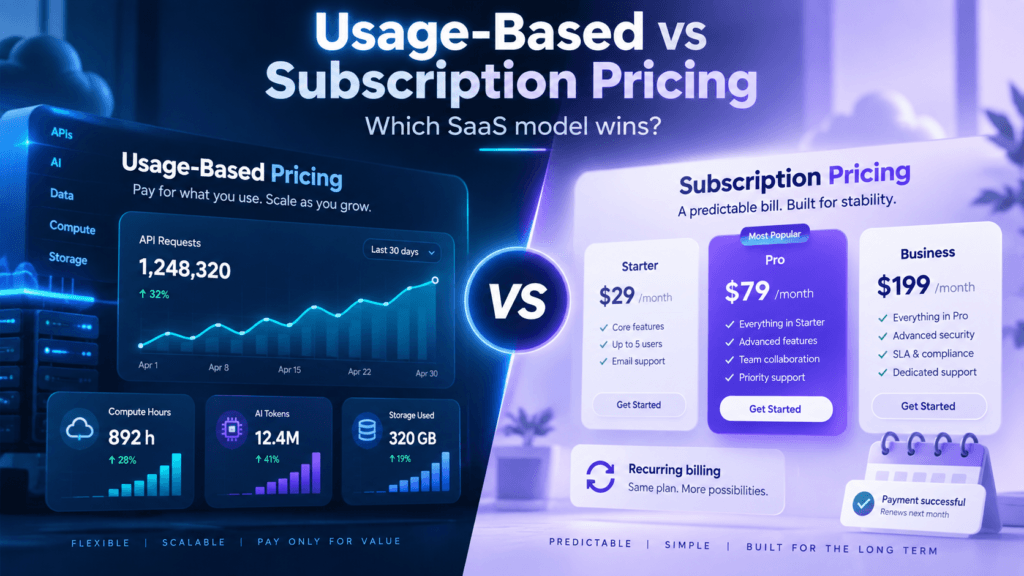
Tiered pricing packages features, limits, support, users, security, integrations, or usage into plans designed for different customer segments. A common B2B structure is Starter for small teams, Pro or Business for growing companies, and Enterprise for organizations with more complex controls and procurement. The model is effective because customers can self-select and because the company can build a clear pricing ladder that creates expansion revenue as needs become more sophisticated. However, tiered pricing fails when the company builds plans around arbitrary feature gates instead of real customer differences. A strong middle-market tier should solve the needs of that segment rather than act as an intentionally uncomfortable bridge to enterprise. Product usage and sales data should reveal which features, limits, and service levels naturally separate customer groups.
3. Usage-Based Pricing for Variable B2B Value
Usage-based B2B SaaS pricing works when consumption closely reflects customer value, such as API requests, data volume, transactions, messages, AI tokens, workflow runs, storage, or compute. It is attractive because a small customer can begin with low cost while larger customers naturally expand spending as they use more. The downside is budget unpredictability, which matters more in B2B because finance teams often need approved software budgets and purchase orders. Usage pricing also requires reliable metering, dashboards, alerts, and billing operations. Enterprise customers may prefer committed usage contracts that exchange a minimum annual spend for lower unit rates. This creates better revenue visibility for the vendor while giving the buyer predictable economics. For companies considering consumption pricing, our guide to usage-based pricing vs subscription explains the trade-offs in detail.
4. Hybrid Pricing for B2B SaaS
Hybrid pricing combines a predictable recurring fee with a variable component such as usage, seats, credits, transactions, or overages. It has become one of the most flexible B2B SaaS pricing strategies because it can reflect both platform value and variable consumption. A data platform might charge an annual platform fee for access, security, reporting, and support while billing additional data processing above an included allowance. An AI SaaS company may sell a Business subscription with a defined credit pool and then charge for additional generations or model usage. Hybrid pricing can improve gross margin protection and expansion revenue, but the customer must be able to estimate total cost. If the pricing equation contains several unrelated variables, the buying process becomes slower and sales teams spend too much time explaining invoices rather than value.
5. Platform Fee Plus Users
A platform-plus-seats model charges a base fee for the product and then adds per-user pricing. This can be stronger than pure per-seat pricing when the platform delivers meaningful company-wide value regardless of the number of active users. The base fee creates a revenue floor and covers shared capabilities such as integrations, data infrastructure, administration, analytics, or support, while the seat component captures expansion as adoption spreads. The model is common in more complex B2B systems where a small number of power users manage workflows that benefit an entire organization. Buyers can resist the base fee if they do not understand what it represents, so packaging should clearly explain which platform capabilities are included. The company should also avoid double charging for the same value through both a high base fee and aggressive seat pricing without a credible economic explanation.
6. Feature-Based B2B SaaS Pricing
Feature-based pricing places advanced functionality into higher tiers, usually reflecting the needs of larger or more sophisticated organizations. Features such as SSO, audit logs, custom roles, advanced analytics, automation, compliance controls, premium integrations, sandbox environments, data residency, and dedicated support often appear in higher-priced B2B packages because the customers that need them also have greater organizational complexity and willingness to pay. The risk is using essential security or usability features as artificial paywalls. Customers may accept that enterprise governance costs more, but they can resent being forced into a much higher tier for functionality they view as basic. Feature packaging should therefore follow segment needs and cost-to-serve rather than simply reserving attractive features for the most expensive plan. Pricing research and win-loss analysis can help identify which capabilities genuinely support higher willingness to pay.
7. Volume and Commitment Pricing
Volume pricing reduces the effective unit rate as customer commitment or consumption increases, making it useful for large B2B accounts with predictable demand. The vendor can offer better economics for larger annual commitments while still increasing total contract value. Volume models are common in messaging, payments, data, APIs, cloud infrastructure, automation, and enterprise platforms. The key is designing the discount curve so it rewards commitment without giving away margin. A large account may create additional support, infrastructure, compliance, or implementation cost that offsets some benefits of scale. Companies should model the gross margin of each volume tier and set minimum commitments where appropriate. Our SaaS volume pricing guide explains graduated, block, and commitment structures in greater detail.
8. Outcome-Based B2B Pricing
Outcome-based pricing charges for a measurable business result, such as a resolved ticket, recovered payment, qualified opportunity, verified transaction, or completed workflow. The model is attractive because the price is connected directly to an outcome the buyer cares about, which can reduce resistance to paying more when the software delivers more value. It is especially relevant as AI automates work that was previously performed by human employees and therefore weakens seat-based pricing. The operational difficulty is attribution. The vendor needs a clear definition of the outcome, a reliable way to verify it, and rules for edge cases and disputes. Outcome pricing works best when the result is objectively measurable and the software has a strong causal relationship to it. When attribution is unclear, a hybrid platform-plus-outcome model can create a safer balance.
9. Enterprise Custom Pricing
Enterprise custom pricing is appropriate when account requirements vary enough that a public fixed price cannot represent the full scope of value and service. Large customers may require implementation, custom integrations, premium support, security reviews, data residency, contractual SLAs, procurement terms, legal negotiation, and dedicated customer success. The price can combine a platform fee, user or usage metric, minimum annual commitment, services, and negotiated discounts. The main risk is inconsistent deal economics when sales teams have too much freedom. Enterprise pricing should therefore be governed by clear floors, discount rules, value metrics, and approval thresholds. Our enterprise software pricing models article provides a deeper framework for building that structure without turning every large deal into an unrepeatable exception.
How B2B SaaS Pricing Changes by Segment
Small-business customers usually prefer transparent prices, monthly flexibility, simple onboarding, and low commitment because procurement is lightweight and budgets are smaller. Mid-market customers may accept annual contracts, implementation, and higher plan prices in exchange for stronger integrations, reporting, permissions, and service. Enterprise customers often prioritize security, governance, procurement, legal terms, implementation, and operational reliability more than the headline list price. This means a single pricing model can be presented differently across segments. A product might use self-service tiered pricing for SMBs, annual platform-plus-seat contracts for mid-market buyers, and custom minimum commitments for enterprise accounts. The objective is to preserve one coherent value metric while adjusting packaging and commercial terms to the buying process of each segment.
How to Choose the Best B2B SaaS Pricing Model
Start by identifying what expands when the customer receives more value. If more employees using the product creates more value, seats can work. If transactions, AI usage, data, or workflow volume increases, usage may be better. If customer complexity grows through security, analytics, automation, or governance needs, tiered feature packaging may provide stronger alignment. Then model cost-to-serve and sales motion. A self-service product needs simplicity, while a high-ACV enterprise product can support more sophisticated contracts. Finally, test the pricing against real customer scenarios. Calculate what a 10-person startup, a 200-person mid-market company, and a 5,000-person enterprise would pay and compare those prices with the value delivered, margin profile, and alternatives. The model should remain defensible across the range rather than only looking attractive for the median account.
Final Verdict
The best B2B SaaS pricing model is the one that scales with customer value while remaining understandable and operationally sustainable. Per-seat pricing offers simplicity, tiered pricing supports segmentation, usage-based pricing aligns revenue with consumption, hybrid pricing protects both predictability and expansion, and enterprise custom pricing handles complex requirements. Many successful B2B SaaS companies eventually combine these approaches rather than choosing one pure model. The key is maintaining a coherent value metric and avoiding unnecessary complexity. Pricing should make it easy for small customers to start, give growing customers natural upgrade paths, and allow large customers to pay more because they receive more value—not merely because sales discovered that the budget is larger.
Frequently Asked Questions
What is the most common B2B SaaS pricing model?
Per-user and tiered subscription pricing are among the most familiar B2B SaaS models because they are easy for customers to understand and relatively simple to bill. Usage-based and hybrid pricing are becoming more important in AI, API, data, and infrastructure products where consumption varies significantly. The most common model in a category is not automatically the best model for a specific product. The right choice depends on the value metric, customer segment, cost structure, and sales motion.
Is per-seat pricing still good for B2B SaaS?
Per-seat pricing remains effective when each additional user receives direct value from the product and team size is a good proxy for customer value. It becomes weaker when customers need broad access for occasional users or when automated workflows and AI agents create substantial value without adding human seats. Companies should study whether customers intentionally restrict adoption because of seat cost. If they do, another metric or a platform-plus-seat model may create better alignment.
What is the best pricing model for enterprise SaaS?
Enterprise SaaS often uses a hybrid structure that combines a platform fee or minimum annual commitment with seats, usage, modules, or service requirements. Large accounts vary widely, so custom pricing can reflect implementation, security, compliance, support, and procurement complexity. The important discipline is having internal pricing rules so enterprise deals remain repeatable and margins are protected. Custom pricing should not mean arbitrary pricing.
Should B2B SaaS show prices publicly?
Self-service and lower-ACV B2B SaaS generally benefits from transparent public pricing because buyers want to know whether the product is within range before investing time. Enterprise pricing can reasonably use “contact sales” when the contract depends on usage, scale, implementation, or security requirements. Even then, the page should explain what drives the price so buyers are not left with zero commercial context. Transparency reduces unnecessary sales friction.
How many B2B SaaS pricing tiers should there be?
Three or four public tiers are common, but the correct number depends on whether the company serves meaningfully different customer segments. Each tier should have a clear target customer and upgrade trigger. If two tiers differ only through arbitrary feature gates, the pricing can become confusing. Enterprise may sit outside the main three plans when its buying process and requirements are materially different from self-service customers.
How should B2B SaaS annual discounts work?
Annual discounts should compensate customers for making a longer commitment while giving the SaaS company improved cash flow, retention, and forecasting. The discount should be based on economics rather than copied automatically from competitors. Companies should compare the revenue given up through the discount with the expected benefit of annual commitment and should avoid making the monthly plan so unattractive that the choice feels manipulative.