
Software pricing models determine the mechanism a company uses to turn product value into revenue. The model can charge for access, users, usage, features, transactions, capacity, outcomes, or a combination of several variables. Choosing the right model matters because software products have unusual economics: development cost can be high, marginal delivery cost may be low, enterprise support can be expensive, and AI or cloud usage can introduce meaningful variable cost. The pricing model therefore affects not only revenue but also product adoption, customer budgeting, sales cycles, gross margin, expansion and retention. This guide compares twelve common software pricing models used across SaaS, desktop software, B2B platforms, APIs and AI products. It also explains the difference between a pricing model and a pricing strategy, when each model works best, and how to test the economics before committing to a structure that may be difficult to change later.
Software Pricing Model vs Software Pricing Strategy
A software pricing model describes how the customer is charged, while a pricing strategy explains why the company chose that mechanism, price level, packaging and market position. Per-user pricing, subscriptions, perpetual licensing and usage-based billing are models. Value-based pricing, penetration pricing and premium positioning are strategic approaches that can influence the model and price point. A company can use a subscription model with a value-based strategy, or it can use perpetual licensing while positioning the software as premium enterprise infrastructure. This distinction matters because copying a competitor’s model does not automatically reproduce its strategy. Two products can both charge per user while serving different segments, using different discount policies and creating very different economics. Our software pricing strategies guide covers the broader commercial decisions, while this article focuses on the billing models themselves.
1. Subscription Pricing
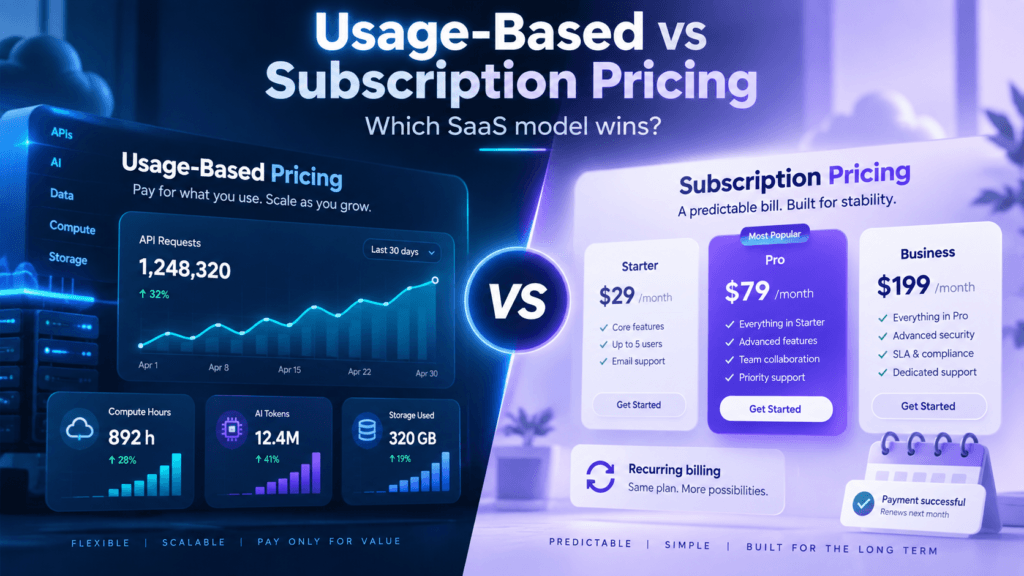
Subscription pricing charges a recurring monthly, annual or multi-year fee for continued access to software. It is the dominant model for cloud-delivered SaaS because customers receive ongoing hosting, updates, maintenance and support rather than purchasing a permanent copy. The main benefit is predictable recurring revenue and a lower upfront purchase barrier compared with perpetual licensing. The challenge is retention: customers continually decide whether the product is worth renewing, so recurring billing must be supported by recurring value. Subscription pricing can also be combined with seats, tiers, usage, credits and enterprise commitments. A flat monthly plan is therefore only one version of subscription pricing. The model works best when the software supports an ongoing workflow and when the company can continuously deliver value. Our subscription pricing models guide compares the major recurring structures in more detail.
2. Perpetual License Pricing
Perpetual licensing charges a one-time fee for the right to use a specific software version indefinitely, often with separate maintenance, support or upgrade fees. This model remains relevant in desktop applications, specialized enterprise systems and environments where customers prefer ownership, offline use or long upgrade cycles. The benefit is immediate cash collection and a clear purchase transaction, while the drawback is less predictable recurring revenue and pressure to sell new versions or maintenance contracts. For customers, a perpetual license can be financially attractive when software is used for many years without significant upgrades. For vendors, the model can create revenue volatility and support obligations for older versions. Some businesses combine perpetual licensing with annual maintenance or cloud services, creating a hybrid relationship. When comparing perpetual and subscription pricing, companies should consider deployment, update frequency, customer procurement preferences and the long-term cost of supporting multiple versions.
3. Flat-Rate Pricing
Flat-rate pricing charges one amount for a defined software package and prioritizes simplicity over segmentation. It can be recurring or one-time, depending on whether the underlying business uses subscriptions or perpetual licenses. Flat-rate pricing is easy to communicate because customers do not need to calculate seats, usage or modules before buying. It works best when customers receive relatively similar value and when cost-to-serve does not vary dramatically across accounts. The weakness is that one price rarely captures the full willingness to pay of both small and large customers. Heavy users can also create margin pressure if support, storage, compute or AI costs rise with usage. Flat-rate pricing can be an excellent early-stage model while the company learns customer behavior, but it should be reviewed once meaningful segments appear. If customers vary by team size, usage or sophistication, tiered or hybrid pricing may monetize the market more effectively.
4. Tiered Pricing
Tiered pricing gives customers several packages with different features, limits, usage allowances, users or support levels. This model is widely used because it creates a structured path from entry-level customers to higher-value business and enterprise accounts. A well-designed tier represents a real customer segment, such as individual, team, growing company or enterprise, and gives each group an appropriate combination of price and capability. The main advantage is segmentation and expansion revenue. The risk is complexity and artificial feature gating. Customers can become frustrated when a fundamental capability is reserved for a much more expensive tier without a clear value reason. Three or four public plans are common because they balance choice and simplicity, but the right number depends on the market. Our pricing ladder framework explains how to connect tiers with natural upgrade triggers.
5. Per-User or Per-Seat Pricing
Per-user pricing charges according to the number of people with access to the software. It works well for collaboration, CRM, project management, productivity, sales and workflow tools where each additional user receives direct value. Customers can forecast costs easily, and vendors gain predictable expansion when teams grow. The biggest weakness is that seat pricing can discourage adoption because customers may limit licenses or share accounts to reduce cost. It is also less suitable when software value comes from automation, transactions or AI agents rather than human users. Role-based seats can improve the model by charging different prices for power users, collaborators and viewers. Before choosing per-user pricing, study whether team size genuinely correlates with customer value. If a small number of users can create enormous organization-wide value, a platform fee or hybrid metric may capture the economics more accurately.
6. Usage-Based Pricing
Usage-based pricing charges for measurable consumption such as API calls, messages, storage, transactions, compute time, data processed or AI tokens. It is particularly effective when customers vary dramatically in usage and when cost-to-serve also scales with consumption. Small customers can start cheaply, while high-usage accounts naturally generate more revenue. The trade-off is predictability. Customers may worry about bill shock, finance teams may struggle to budget, and the vendor needs accurate metering, reporting and billing infrastructure. Usage-based pricing works best when the unit is intuitive and closely linked to value. A technical metric that customers do not understand can create friction even if it is easy for engineers to measure. Many companies add minimum commitments, included allowances or volume discounts to make usage more predictable. Our usage-based vs subscription comparison covers these trade-offs in detail.
7. Freemium Pricing
Freemium offers a permanent free product and charges customers when they need additional features, usage, collaboration, storage, security or support. It is most effective when free users can reach meaningful value without human sales or onboarding and when the product creates distribution through sharing, invitations, public content or network effects. The free tier lowers acquisition friction and can build a large installed base, but it also consumes infrastructure and support. If the free plan is too generous, paid conversion can remain weak; if it is too restrictive, users may leave before experiencing the product’s value. Freemium therefore needs a deliberate upgrade trigger. Paid plans should correspond to greater professional value, scale or organizational complexity. The model is common in productivity, design, developer tools and collaboration software, but it is less attractive when every customer requires expensive implementation or human service.
8. Feature-Based Pricing
Feature-based pricing charges more as customers unlock advanced capabilities, often through progressively higher tiers. It is useful when customer sophistication and willingness to pay increase alongside the need for automation, analytics, security, permissions, integrations, reporting or governance. The model can capture value effectively because smaller customers avoid paying for enterprise functionality they do not need, while larger buyers pay for capabilities that solve more complex problems. The risk is creating artificial feature walls. Customers can resent paying a much higher price for one essential feature, especially when the feature does not materially increase the vendor’s cost or the customer’s value. The strongest feature-based pricing follows genuine customer segmentation and is supported by usage data and research. Review which features drive upgrades and whether customers continue using them after purchase. A premium feature that generates upgrades but little long-term adoption may create short-term revenue without durable value.
9. Volume Pricing
Volume pricing changes the unit price as customers purchase more seats, transactions, API calls, messages, storage or another measurable quantity. Larger commitments generally receive better unit economics while total revenue increases with scale. This model is useful in software categories where customers can predict volume and where the vendor benefits from commitment. It can be structured through graduated tiers, block pricing, all-units pricing or negotiated enterprise rates. The key is protecting margin. A steep discount curve can reduce profitability exactly when usage, infrastructure and support requirements increase. Companies should model the gross margin of each band and understand whether higher volume actually creates lower marginal cost. Volume pricing can also be combined with minimum commitments to improve revenue visibility. Our SaaS volume pricing guide provides detailed examples and calculation approaches.
10. Credit-Based Pricing
Credit-based pricing gives customers a balance of internal units that can be spent on different actions. It has become common in AI software because text, image, audio, research and video features can have different underlying compute costs that are difficult to explain through raw tokens or infrastructure metrics. Credits allow the company to translate those activities into one billing currency and can be sold as one-time packs or recurring subscription allowances. The benefit is flexibility and the ability to change the credit cost of individual actions as product economics evolve. The drawback is opacity. Customers may not know how many outcomes a credit pack will produce, which can reduce trust and create surprise. Good credit systems show examples, balances, alerts and clear rules around rollover and expiration. Credits should simplify complexity rather than deliberately making unit economics difficult to compare.
11. Value-Based and Outcome Pricing
Value-based pricing sets the commercial level according to the economic value the software creates, while outcome pricing charges directly for a measurable result. The two concepts overlap but are not identical. A company can use value-based research to set a per-user subscription, while another company may charge only when a payment is recovered, a lead is qualified or a support issue is resolved. Value-based thinking is useful across nearly every software model because customers buy outcomes rather than development effort. Pure outcome pricing is more difficult because the vendor must define and verify success and manage attribution disputes. AI automation is increasing interest in outcome pricing because human seat counts may no longer reflect the work performed. When outcomes are measurable and strongly attributable, the model can align customer and vendor incentives exceptionally well. When attribution is ambiguous, a hybrid subscription or usage model is usually easier to operate.
12. Hybrid Pricing
Hybrid pricing combines two or more models, such as a platform subscription plus usage, per-seat pricing plus AI credits, tiers plus overages, or a minimum enterprise commitment plus variable consumption. It is increasingly common because modern software often delivers both fixed platform value and variable value that grows with usage. The benefit is economic flexibility: the company can maintain a predictable revenue floor while monetizing heavy consumption or advanced capabilities separately. The downside is complexity. Every additional metric creates more billing logic and more questions for customers. A successful hybrid model should have a clear purpose for each component and should allow customers to estimate total cost without a spreadsheet full of assumptions. Hybrid pricing should not become a collection of unrelated charges. Use it when one model cannot fairly represent both recurring platform value and meaningful differences in usage, users or outcomes.
How to Choose a Software Pricing Model
Start with the customer value driver and ask which measurable unit increases when customers receive more value. Then examine cost-to-serve, especially infrastructure, support, AI, data and implementation costs. Consider the sales motion as well: self-service products require simple and transparent pricing, while enterprise software can support negotiated commitments and modules. Model light, average and heavy users under several approaches and compare revenue, gross margin and customer affordability. Finally, test the model against real customer language. If buyers naturally talk about users, projects, transactions, contacts or outcomes, that language can reveal a strong value metric. Avoid choosing a model simply because it is common in the category. The best software pricing model aligns customer success with vendor revenue while remaining understandable enough to buy and operationally realistic enough to bill accurately.
Final Verdict
Software pricing models should be chosen according to value, cost and customer behavior rather than fashion. Subscription pricing creates recurring revenue, perpetual licensing suits ownership-oriented environments, flat-rate pricing maximizes simplicity, tiers support segmentation, seats work when people drive value, usage works when consumption drives value, and hybrid pricing solves products with multiple economic dimensions. Freemium, credits, volume discounts and outcome pricing add further options when the product or go-to-market motion requires them. Start with the simplest model that fits the customer and gradually introduce complexity only when real data justifies it. A pricing model becomes strong when customers understand what drives the bill, the company preserves sustainable margins, and revenue increases naturally as customers become more successful.
Frequently Asked Questions
What are the most common software pricing models?
Common software pricing models include subscriptions, perpetual licenses, flat-rate pricing, tiered plans, per-user pricing, usage-based billing, freemium, feature-based pricing, volume pricing, credits, value-based or outcome pricing, and hybrid models. SaaS products frequently combine several of these approaches, such as tiered subscriptions priced per user with usage overages or AI credit allowances.
What is the best pricing model for software?
There is no universal best model. The right choice depends on what customers value, how the product is used, how costs behave, and how the product is sold. Seats work when human adoption drives value, usage works for infrastructure and APIs, tiers work for customer segmentation, and hybrid pricing is useful when both recurring access and variable consumption matter. Test several models against real customer scenarios before deciding.
What is the difference between SaaS pricing and software pricing?
SaaS pricing usually assumes recurring cloud access and therefore frequently uses subscription, usage, seat and tier models. Software pricing is broader and can include perpetual licensing, maintenance fees, one-time purchases and self-hosted enterprise contracts. As more software moves to cloud delivery, the categories increasingly overlap, but deployment and ownership still influence the commercial model.
Is subscription pricing better than perpetual licensing?
Subscription pricing gives vendors recurring revenue and customers lower upfront cost plus ongoing updates, while perpetual licensing gives customers long-term usage rights after a larger initial payment. The better model depends on product delivery, update frequency, procurement preferences and support obligations. Some vendors combine perpetual licenses with recurring maintenance or cloud services to capture benefits from both approaches.
How do you price software with high variable costs?
Products with significant compute, AI, messaging, data or infrastructure costs should model usage carefully and avoid unlimited flat plans unless margins can tolerate heavy users. Usage pricing, included allowances, credits, overages or hybrid subscriptions can align revenue with variable cost. Use light, average and heavy customer scenarios to identify where margin pressure appears before setting plan limits.
How do you choose between per-user and usage-based pricing?
Choose per-user pricing when each additional person receives direct value and team size is a good proxy for account value. Choose usage-based pricing when transactions, requests, storage, AI activity or another consumption metric better reflects value. If both users and usage matter, a hybrid model can combine a base seat or platform fee with variable consumption. Customer budgeting preferences should also influence the decision.
Can software use more than one pricing model?
Yes. Many mature software companies use multiple models across customer segments or within one invoice. A product can sell flat subscriptions to individuals, per-seat tiers to teams, usage overages for AI, and custom annual commitments to enterprises. The important requirement is coherence: each component should represent a clear value driver and customers should be able to understand how total cost is calculated.
How often should a software pricing model be changed?
Review the model when product value, cost structure, customer segments or buying behavior changes materially. A formal annual review is a useful discipline, but the model should not be changed simply for the sake of change. Sometimes the best action is adjusting prices or packaging while keeping the same model. Major model changes require careful customer communication and billing implementation because they affect both expectations and contracts.