
Learning how to price software requires more than calculating development cost and adding a margin. Software pricing sits at the intersection of customer value, willingness to pay, product usage, competition, cost-to-serve, packaging, sales motion and long-term expansion. A price that is too low can attract customers while leaving insufficient margin and no room for growth; a price that is too high can slow adoption even when the product is strong. The challenge is greater for SaaS because pricing is rarely one number: the company must also decide the value metric, plans, annual billing, free or trial access, usage limits, discounts, enterprise rules and upgrade paths. This guide provides a practical ten-step framework for pricing a software product from the earliest customer research through launch and ongoing optimization. The objective is not a mathematically perfect price but a defensible commercial system that customers understand and that improves as real data becomes available.
Step 1: Define the Ideal Customer and the Problem
Pricing begins with segmentation because the same software can be worth very different amounts to different customers. Define the ideal customer in terms of company size, role, industry, workflow, urgency and the cost of the problem being solved. A scheduling tool used by a freelancer has different economics from the same workflow deployed across a large sales organization, and a security platform used for compliance can have dramatically higher willingness to pay than a convenience tool. Write down what the customer does today without your product, what alternatives cost, how much time or money the problem consumes and what happens if it remains unsolved. This research gives pricing a business context rather than treating all users as one market. If several customer groups receive fundamentally different value, they may require different plans or even different sales motions. Good pricing begins by deciding whose willingness to pay you are actually trying to measure.
Step 2: Quantify the Value Created
Estimate the measurable value the software creates through time saved, revenue gained, risk reduced, errors prevented, labor replaced, throughput increased or another business outcome. The calculation does not need to be perfect, but it should establish the order of magnitude. If the software saves a team hundreds of hours every month, pricing it only according to hosting cost will probably understate value. If the benefit is mostly convenience and alternatives are inexpensive, premium enterprise-level pricing may be difficult to defend. Value research should combine customer interviews with observed outcomes because buyers often describe value differently from how the company initially positions the product. Ask what changed after adoption, which workflow became easier, what they would do if the product disappeared and which feature they would protect if the price increased. These conversations reveal which outcomes matter most and provide language that can later improve packaging, sales and pricing-page copy.
Step 3: Calculate the Cost-to-Serve Floor
Customer value determines the commercial opportunity, but cost-to-serve determines the financial floor. Map infrastructure, third-party APIs, AI inference, storage, payment processing, support, onboarding, implementation, customer success and any human service required to maintain the account. Software often has low marginal cost, but modern AI and cloud products can have substantial variable expenses that make unlimited flat pricing risky. Calculate economics for light, average and heavy users rather than relying only on an overall average because a small group of power users can create significant margin pressure. Cost-plus pricing should not be your entire strategy, yet understanding cost prevents the company from selling high-usage customers at a loss. The AI API Cost Calculator can help model variable AI expenses, while the broader pricing model should still be set according to customer value and willingness to pay.
Step 4: Research Alternatives and Competitor Pricing
Competitor pricing helps establish market expectations, common value metrics and the range buyers are already accustomed to seeing. Study direct competitors, substitute software, internal workflows and the cost of doing nothing. Do not simply copy the lowest or most recognizable competitor. Compare which segments each company serves, whether pricing is public, how plans are packaged, what enterprise adds, which features are gated and what metric controls expansion. A lower-priced competitor may have a product-led model with minimal support, while your product may require implementation and serve a more valuable enterprise use case. A higher-priced competitor may have stronger brand trust or compliance capabilities. Competitive research is most useful when it identifies patterns and gaps. For example, if every vendor charges per seat but customers complain that seat pricing discourages adoption, a platform or usage model could become a differentiation opportunity. Treat competitor prices as evidence, not as the answer.
Step 5: Measure Willingness to Pay
Willingness-to-pay research can use interviews, surveys, sales conversations, proposal acceptance, discount behavior and controlled pricing tests. Avoid asking only “what would you pay?” because hypothetical answers are often unreliable. Instead, explore trade-offs and ranges. Ask which alternatives are being considered, what budget exists, which capabilities are essential, at what point the product begins to feel expensive and what value would justify a higher price. Sales teams can provide useful evidence from lost deals, accepted proposals and recurring objections, while product-led companies can test pricing on new cohorts. The goal is to identify a range rather than one exact number. Different segments may have substantially different willingness to pay, which is a strong signal that tiered or enterprise pricing is necessary. Our planned SaaS pricing research guide explains interview and survey methods in more detail.
Step 6: Choose the Value Metric
The value metric is the measurable unit that causes price to scale. Common software metrics include users, active seats, transactions, projects, contacts, storage, API calls, messages, AI credits, locations, revenue processed and feature packages. A strong metric increases when customer value increases and is understandable enough that buyers can estimate what they will pay. A weak metric can punish adoption or create confusing bills. For example, per-user pricing can work well for collaboration software but can discourage broad access when many occasional users need the product. Usage pricing can align revenue with consumption but may create budgeting anxiety. Model several customer profiles under different metrics and compare the relationship between price, value and cost. If no single metric works well, a hybrid structure may combine a base subscription with seats or usage. Our software pricing models article compares the main options.
Step 7: Choose the Pricing Model
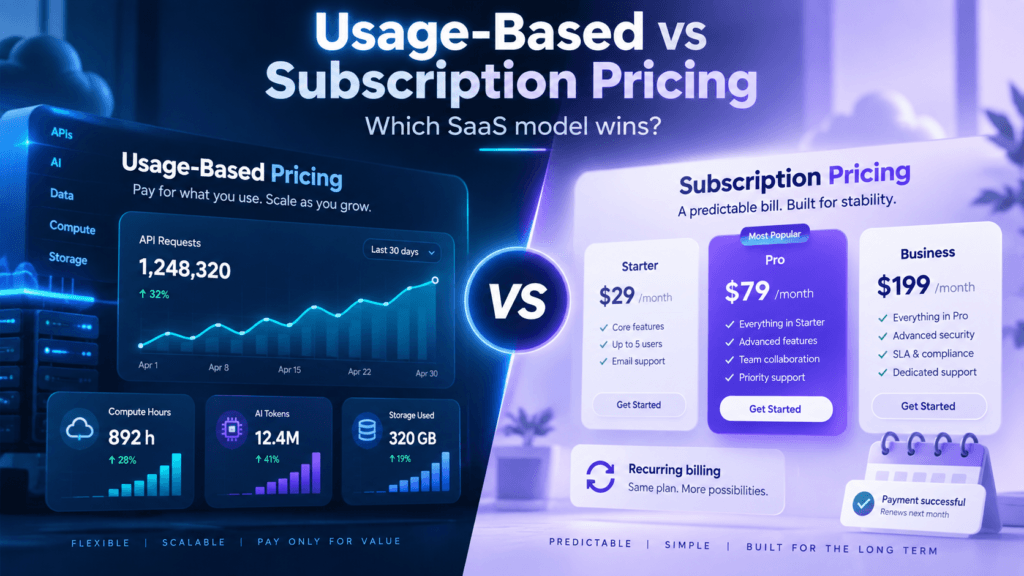
Once the value metric is clear, choose the commercial mechanism that best fits it. Subscription pricing works when customers receive ongoing value, perpetual licensing can fit ownership-oriented or offline software, tiered pricing supports segmentation, usage-based billing works when consumption varies, freemium supports low-friction product-led acquisition and hybrid pricing handles products with both fixed and variable value. The model should fit the sales motion as well. A self-service product needs enough transparency that customers can buy without a conversation, while enterprise software can support minimum commitments and negotiated terms. Avoid adding complexity merely because sophisticated pricing seems more mature. Early-stage products often benefit from one or two simple plans while they learn customer behavior. Complexity should be earned by evidence: add tiers when segments appear, usage pricing when variable economics matter and enterprise terms when the buying process genuinely requires them.
Step 8: Build Packages and Price Points
Packaging determines what the customer receives at each price level. Build plans around customer maturity and use cases rather than distributing features randomly. An entry plan should solve the core problem, a professional plan can add automation and integrations, a business plan can add administration and analytics, and enterprise can address security, compliance, procurement and service. Set price gaps according to additional value rather than a fixed mathematical multiplier. If the next plan costs three times more, customers should be able to understand why the economic value or organizational complexity also changes materially. Test the packages with customers and sales teams before finalizing the public page. If one feature dominates every upgrade conversation, the packaging may be relying too heavily on that gate. Our pricing ladder and plan naming guides can help refine the structure.
Step 9: Launch and Measure More Than Conversion
After launch, evaluate pricing using conversion, retention, expansion and profitability. Track visitor-to-paid or trial-to-paid conversion, average revenue per account, plan mix, annual adoption, gross margin, logo churn, gross revenue retention, net revenue retention, upgrades, downgrades and discount rates. A low price can improve conversion while attracting customers with weak retention or high support needs, so first-month sales alone do not reveal whether the pricing works. Segment the results by customer size and acquisition channel because different audiences may respond differently. For usage-based products, also track bill volatility, overage frequency and whether customers reduce usage to control cost. Combine quantitative data with sales objections, cancellation reasons and customer interviews. The strongest pricing decisions emerge when behavior and qualitative feedback tell the same story.
Step 10: Review and Reprice as the Product Evolves
Pricing should change when the product, costs, customer segments or competitive position changes materially. A formal annual review is useful, but companies should not wait for the calendar if AI costs increase sharply or the product becomes significantly more valuable. Review plan distribution, feature adoption, heavy-user margins, discounting, grandfathered accounts and enterprise deal economics. The answer may be a price increase, but it can also be new packaging, a different value metric, changed usage allowances, a new enterprise plan or simplified tiers. Existing customers may require notice, renewal-based migration or temporary grandfathering. Our SaaS price increase guide explains how to manage those transitions. Pricing is an operating system that evolves with the business, not a launch decision that should remain untouched indefinitely.
A Simple Software Pricing Formula
No formula can replace customer research, but a useful decision framework is: customer value establishes the upper commercial range, cost-to-serve establishes the lower financial boundary, willingness to pay shows where buyers are comfortable, and competitive context reveals market expectations. The final price should sit where these four sources of evidence overlap while leaving enough room for healthy margin and expansion. For a SaaS product, also model customer acquisition cost and payback because a low monthly price can create poor economics even when gross margin looks attractive. If sales and onboarding are expensive, the account must generate enough lifetime value to justify that acquisition motion. The price is therefore connected to the entire business model, including marketing, sales, implementation, support and retention.
Final Verdict
To price software well, start with the customer rather than the spreadsheet. Define the segment, quantify the problem, measure value, understand cost-to-serve, research alternatives, test willingness to pay, choose a value metric and then build the pricing model and packages around that evidence. Launch with enough simplicity to learn and measure the full customer lifecycle rather than only conversion. Pricing should give customers a clear relationship between what they pay and what they receive, while giving the company sustainable margin and a path to expansion. No initial price will be permanently correct because products and markets evolve. The companies that price software effectively treat monetization as a repeatable research and optimization process rather than as a one-time debate before launch.
Frequently Asked Questions
How do I price a software product?
Define the target customer and problem, estimate the value created, calculate cost-to-serve, research competitors and alternatives, measure willingness to pay, choose a value metric and compare several pricing models. Then package the product into plans, test the prices with real customers and monitor conversion, retention, expansion and margin after launch. The process should be evidence-driven rather than based only on cost or competitor prices.
How much should software cost?
There is no universal percentage or price because software value varies dramatically by use case and customer segment. A consumer convenience tool and an enterprise compliance platform can require similar engineering effort while supporting completely different willingness to pay. Price should be evaluated against customer value, alternatives, budget, acquisition cost, support requirements and product economics. The correct price is the one that creates a fair value exchange and sustainable business economics.
Should software be priced based on development cost?
Development cost is important for understanding the business, but it should not be the primary pricing method. Customers pay for the value the software creates, not for the number of engineering hours invested. Cost-to-serve is more directly relevant because it affects ongoing margin, especially for AI, cloud and support-heavy products. Use cost as a financial boundary and customer value as the primary commercial anchor.
How do startups price software with no customer data?
Start with customer interviews, competitor research and a simple model that can be changed easily. Estimate the economic value of the problem and test price ranges during early sales conversations. Avoid building complex pricing tiers before real usage data exists. The objective of early pricing is partly revenue and partly learning. Once customers begin using the product, plan selection, usage, churn and upgrade behavior provide much stronger evidence.
What is the best pricing model for a software product?
The best model depends on how value grows. Seats fit products where each user benefits, usage fits infrastructure and API products, tiers fit customer segmentation, subscriptions fit recurring workflows and hybrid models fit products with both fixed platform value and variable consumption. Enterprise software may require minimum commitments or custom contracts. Choose the model customers understand and that scales revenue with value.
How do you know if software is underpriced?
Signals include very little price resistance, customers receiving large measurable ROI compared with the fee, frequent voluntary comments that the product is cheap, strong conversion despite price increases and enterprise accounts generating much more value than their contracts reflect. Underpricing can also appear when support and variable costs grow faster than revenue. Use customer research and cohort economics rather than relying on one signal alone.
How do you test software pricing?
Test new-customer price points, plan packaging, annual discounts, trial structures or value metrics while measuring more than checkout conversion. Compare retention, expansion, gross margin, plan mix, discounting and support behavior across cohorts. Qualitative sales and cancellation feedback can explain why the numbers changed. Avoid changing several pricing variables at once if you need to understand which change caused the result.
How often should software prices be reviewed?
A formal annual review is a useful baseline, but pricing should also be reviewed when the product, cost structure, customer segments or market position changes materially. Reviews do not always require a price increase. They can lead to better packaging, new usage limits, simplified tiers, changed annual discounts or a different value metric. The purpose is to keep monetization aligned with the product as it evolves.