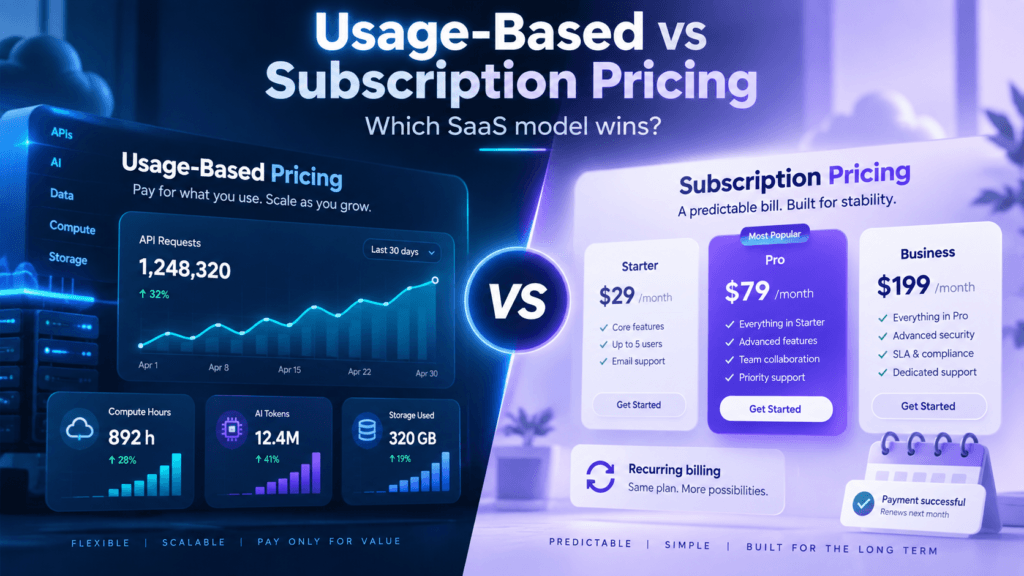

The challenges in implementing usage-based pricing are much broader than deciding what unit to charge for. A SaaS company moving from a flat subscription to metered billing has to redesign pricing, product instrumentation, customer communication, invoicing, forecasting, sales compensation, procurement workflows and retention measurement. The model can create strong value alignment because customers pay more when they use more, but execution errors can quickly create mistrust. Inaccurate metering causes billing disputes, unpredictable invoices create budget anxiety, and a poorly chosen value metric can make customers reduce usage to control spending. Stripe’s 2026 guidance on usage-based SaaS pricing emphasizes that metric selection, packaging, customer visibility and migration sequencing all affect whether the model succeeds. This guide breaks down twelve implementation problems and practical fixes so founders, finance teams, product leaders and engineers can understand what must change before launching consumption pricing at scale.
1. Choosing the Wrong Usage Metric
The most important decision is the unit customers pay for because every other part of usage-based pricing depends on it. A good usage metric should increase as customer value increases, be measurable accurately, and be understandable before purchase. Engineering teams often prefer technical units such as compute seconds, tokens or internal events because they are easy to meter, but customers may think in transactions, workflows, messages, records processed or outcomes. If buyers cannot estimate usage from information they already understand, budgeting becomes difficult. The wrong metric can also punish adoption. A customer may reduce usage simply because the bill grows faster than perceived value. Before launch, compare several candidate metrics against real account data and customer language. Stripe’s 2026 usage-pricing framework similarly stresses that a metric customers cannot predict or control can undermine the entire model. The strongest unit creates a visible relationship between increased consumption and increased customer success.
2. Building Reliable Metering Infrastructure
Usage-based pricing depends on accurate event capture because the product itself becomes part of the billing system. Every billable API call, message, generation, transaction or workflow must be recorded, deduplicated, timestamped and assigned to the correct account. Missing events create revenue leakage, while duplicate events can overcharge customers and damage trust. Engineering also needs rules for retries, failed operations, refunds, partial usage and delayed events. The challenge grows when customers operate at high volume because metering systems must remain reliable under spikes. A separate rating layer may be needed to convert raw usage into billable quantities, especially when rates vary by plan or volume tier. Teams should design auditability from the beginning so support and finance can explain exactly how an invoice was calculated. Usage dashboards shown to customers should reconcile closely with billing records. If internal and customer-visible numbers differ, disputes become harder to resolve and confidence in the model declines.
3. Preventing Bill Shock
Bill shock is one of the biggest customer-experience risks in usage-based SaaS because higher product adoption can unexpectedly produce a much larger invoice. Customers may like paying only for what they consume until a traffic spike, automation loop or sudden growth event multiplies usage. If the company treats this only as a finance problem, it misses the product responsibility. Customers need real-time usage visibility, spend estimates, configurable alerts, caps and clear overage rules. Stripe’s current guidance explicitly frames bill shock as a product problem and recommends in-product visibility and proactive notifications. A strong implementation lets customers understand their position before the invoice arrives. Enterprise buyers may prefer commitments or prepaid credits because these structures convert uncertain spend into a more manageable budget. Usage pricing works best when customers feel they control consumption rather than discovering the cost after the fact.
4. Forecasting Revenue Under Variable Usage
Subscription businesses are accustomed to forecasting from contracted recurring revenue, while usage-based revenue moves with customer activity. Seasonality, market conditions, product adoption and customer business cycles can all affect usage, which makes monthly revenue more volatile. Finance teams need new forecasting models based on historical consumption, customer cohorts, contracted minimums and expected expansion. A pure pay-as-you-go structure can be difficult for both vendor and customer, which is why many B2B SaaS companies introduce a minimum commitment, base subscription or prepaid usage component. This creates a revenue floor while retaining upside when customers consume more. Forecasting should also separate committed, expected and variable revenue so management understands the level of certainty. Usage changes can be an early signal of churn or expansion, meaning finance should work closely with product analytics. A customer reducing consumption over several months may be economically churning even if the account has not formally canceled.
5. Enterprise Procurement and Budget Predictability
Enterprise procurement teams usually want to know annual software spend before approving a contract. Pure variable pricing can conflict with fixed departmental budgets, purchase orders and legal approval processes. Buyers may resist a contract where the total cost cannot be estimated, even if the unit price appears attractive. The solution is often a committed-usage structure with minimum annual spend, included capacity and defined overage rates. Volume discounts can reward larger commitments while giving the vendor better visibility. Usage estimates should be based on realistic historical data or adoption assumptions rather than aggressive sales projections. Customers also need clarity on what happens if they underconsume or exceed the commitment. Rollover rules, true-ups and renewal treatment should be explicit. A well-designed enterprise usage model preserves value alignment while giving finance enough certainty to approve the purchase. Our hybrid pricing model guide explains how recurring commitments can sit alongside variable usage.
6. Designing Pricing Tiers and Volume Discounts
Usage-based pricing can appear simple when described as price per unit, but real customers often expect different rates at different volumes. This introduces graduated pricing, block pricing, committed-use discounts or custom enterprise rates. The discount curve needs careful design because large customers can create both economies of scale and additional support or infrastructure requirements. Reducing the unit price too aggressively can destroy margin even while total usage grows. Finance should model gross margin across usage bands and test how a customer moving from one tier to another experiences the effective rate. Customers also need to understand whether discounts apply only to units above a threshold or to all units once the threshold is reached. Ambiguous volume logic creates invoice confusion. The SaaS volume pricing guide covers graduated tiers and commitment structures in more detail.
7. Communicating the Pricing Model Clearly
A technically correct usage model can still fail if customers do not understand it. The pricing page should explain what is measured, the unit price, included allowances, volume discounts, minimums, overages and an example bill. Avoid forcing buyers to infer cost from engineering terminology. If usage depends on several dimensions, provide a calculator or representative customer scenarios. Sales and customer-success teams need consistent language because contradictory explanations create distrust before the first invoice. Documentation should also address edge cases such as failed transactions, retries, canceled operations and usage timing. During migration, provide a “what is changing” page and account-specific estimates so existing customers can compare old and new costs. Customers do not need to understand every internal rating rule, but they should understand the commercial logic well enough to estimate normal spending and know what behavior causes the bill to change.
8. Migrating Existing Subscription Customers
Moving an installed base from flat subscriptions to usage pricing is riskier than launching the model for new customers. Existing customers have established budgets and expectations, so even a theoretically fair model can feel like a price increase if their projected bill changes materially. A staged migration reduces risk. New customers can adopt the usage model first, followed by opt-in migration, segment-by-segment rollout and carefully managed enterprise transitions. Stripe’s 2026 migration guidance recommends sequencing changes rather than forcing the entire base at once. Use historical usage to estimate what each account would have paid and identify customers with extreme increases. Some accounts may require grandfathering, caps or renewal-based transition. Provide usage dashboards before billing changes so customers can understand their consumption. The goal is not only technical migration but expectation migration: customers need time to learn how the new metric relates to the value they receive.
9. Redesigning Sales Compensation
Traditional SaaS sales compensation often rewards annual contract value booked at signature, while usage-based revenue may materialize only as the customer consumes the product. This creates a difficult incentive question: should salespeople be paid on committed spend, expected usage, actual revenue or a combination? Paying entirely on forecast consumption can create incentives to overestimate adoption, while paying only on initial commitments may discourage sales teams from promoting a lower-friction usage model. Companies need compensation rules aligned with the commercial structure. Enterprise commitments can provide a clear basis for commissions, while customer-success or account-management teams may receive incentives tied to adoption and expansion. Finance should also define how true-ups, overages and downsells affect credit. Pricing changes often fail operationally because downstream processes remain designed for subscription contracts. Sales compensation should be reviewed before launch rather than after representatives discover that the new model reduces their predictable earnings.
10. Recognizing Churn When Customers Do Not Cancel
Usage-based SaaS changes the meaning of churn because customers can reduce spending without closing the account. A traditional subscription may show a clear cancellation event, while a consumption customer can quietly drop usage by 60% and remain technically active. Retention analysis therefore needs revenue and consumption signals, not only logo status. Track usage trends, account activity, gross revenue retention, net revenue retention and reactivation patterns. Sudden declines can indicate product dissatisfaction, seasonal behavior, budget control or a customer moving workloads elsewhere. Customer-success teams should receive alerts when consumption drops materially so they can investigate before revenue disappears. This is one reason usage models can provide better behavioral data than fixed subscriptions: spending is closely connected to product activity. The downside is that retention becomes more nuanced. A “live” account with negligible usage may be economically churned and should not be counted as healthy simply because billing has not stopped.
11. Managing Customer Behavior and Usage Suppression
Usage-based pricing is designed to align price with value, but it can accidentally encourage customers to use less of the product. If every additional action is visibly expensive, teams may optimize around avoiding the software rather than adopting it fully. This is particularly harmful when greater usage would create stronger product value or lock-in. The pricing unit should therefore grow in a way customers consider fair and economically positive. Included allowances, volume discounts and subscription floors can reduce the psychological cost of every small action. Product teams should watch for signs that customers are changing behavior purely to manage bills, such as deleting data, limiting workflows or routing activity to alternative tools near usage thresholds. If customers are suppressing successful behavior, the pricing model may be monetizing too aggressively. The best usage metric lets customers feel comfortable growing because the additional cost remains small relative to the additional value received.
12. Operating Billing, Support and Finance at Scale
Usage pricing creates operational complexity across teams. Finance must reconcile metered events with invoices, support must explain bills, product must expose usage, engineering must maintain instrumentation, and revenue operations must manage plan rules and discounts. Tax and revenue-recognition treatment can also become more complex when variable charges and commitments coexist. The company needs a clear source of truth for account entitlements, usage and pricing rules. Manual exceptions should be minimized because they become difficult to audit as the customer base grows. Support teams need access to the exact event history and rating logic behind a disputed charge so they can resolve issues without engineering involvement. Before launch, run shadow invoices that calculate what customers would owe without actually charging them. Comparing shadow bills with expected behavior can reveal metering errors, unexpected outliers and confusing rules before real money is involved.
A Practical Implementation Sequence
A safer usage-based pricing rollout begins with customer research and value-metric selection, then moves into historical usage analysis, economic modeling, metering architecture and customer-facing visibility. Next, create pricing packages and test them through shadow billing and new-customer offers. Build dashboards, alerts and spend controls before introducing variable invoices at scale. Sales, finance, support and customer success should receive training on the same commercial rules. Only after new-customer performance is understood should the company migrate existing customers, beginning with lower-risk segments. Measure conversion, average revenue, gross margin, usage growth, bill volatility, support volume, churn and procurement friction. The model should evolve based on this evidence. Usage-based pricing is not a billing feature that engineering can ship independently; it is a company-wide monetization change that affects nearly every stage of the customer lifecycle.
Final Verdict
The hardest part of usage-based pricing is not charging per unit; it is building a commercial and operational system customers trust. The company must choose a value metric that reflects success, meter it accurately, make spending visible, protect customers from unexpected bills, support enterprise budgeting and redesign forecasting and retention measurement. Hybrid commitments can reduce volatility, while staged migration can protect existing relationships. Most implementation problems become more manageable when customers understand the unit and can control their consumption. The model should encourage greater product use rather than making customers afraid of their own success. If the unit is fair, the infrastructure is reliable and the bill remains transparent, usage-based pricing can create strong alignment between customer growth and vendor revenue. If any of those foundations are weak, the same model can generate disputes, suppressed adoption and churn.
Frequently Asked Questions
What is the biggest challenge with usage-based pricing?
The biggest challenge is usually choosing and operating a metric that customers understand, can predict and perceive as fair. Even perfect billing infrastructure cannot rescue a metric that does not track customer value. Once the metric is chosen, accurate metering and cost visibility become critical. Customers need dashboards, alerts and clear pricing rules so they can control spending. Vendors also need forecasting and retention systems designed for variable revenue rather than fixed subscriptions. Usage-based pricing succeeds when value, measurement and customer predictability work together.
Why is usage-based billing hard to implement?
Billing is connected directly to product events, so engineering must capture and reconcile every billable unit accurately. The system needs rules for retries, failures, volume tiers, commitments, overages and plan changes. Finance must forecast variable revenue, support must explain invoices and product teams must expose usage to customers. This makes usage billing a cross-functional architecture rather than a simple payment setting. Running shadow invoices and maintaining an auditable usage ledger can reduce implementation risk before real customer charges begin.
How can SaaS prevent bill shock?
Provide real-time usage dashboards, proactive alerts, estimated spend, configurable caps and clear overage rates. Customers should understand where they stand before the invoice arrives. Included allowances or minimum-commitment packages can also make normal spend more predictable. Enterprise customers may prefer prepaid credits or annual commitments. Bill shock should be treated as a product-design issue because customers need tools to control usage, not merely an explanation after an unexpectedly large charge has already occurred.
How do you forecast revenue with usage-based pricing?
Use historical consumption, customer cohorts, seasonality, product adoption trends and contracted minimum commitments. Separate committed revenue from expected variable usage so management understands the level of certainty. Hybrid pricing can create a revenue floor through a base subscription or minimum spend while preserving upside from additional consumption. Forecasting should be updated frequently because customer usage can change faster than traditional subscription contracts. Declining consumption should also be treated as a retention signal.
Should existing customers be migrated to usage pricing?
They can be, but migration should be staged and supported by historical usage analysis. Start with new customers, then consider opt-in or segment-by-segment migration. Estimate each existing account’s bill under the new model and identify extreme increases before communicating the change. Enterprise customers may need renewal-based migration, caps or negotiated commitments. Provide usage visibility before the change takes effect so customers understand how the new billing logic relates to their actual consumption.
Is hybrid pricing easier than pure usage pricing?
Hybrid pricing can reduce some difficulties because a base subscription or minimum commitment creates revenue and budget predictability while usage captures expansion. It is not necessarily simpler to explain or bill, however, because the customer must understand both fixed and variable components. The hybrid model works best when the base fee represents clear platform value and the usage component represents a separate variable dimension. Use it when pure usage creates too much volatility but a flat subscription would undercharge heavy customers or expose margins.