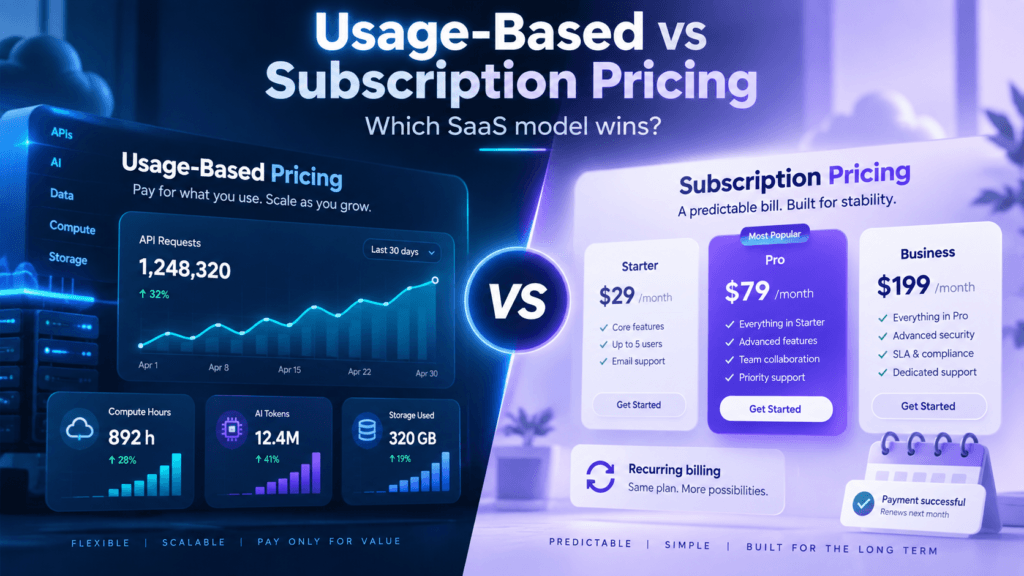

Value-based pricing for SaaS sets price according to the economic and operational value customers receive rather than according to development cost or a competitor’s price list. The method begins with customer outcomes: time saved, revenue generated, risk reduced, errors prevented, labor avoided, faster execution or another result buyers care about. It does not mean charging the maximum amount a customer can tolerate. A strong value-based price leaves the customer with an attractive return while allowing the SaaS company to capture more of the value it creates. The model can be implemented through tiers, seats, usage, enterprise contracts or hybrid pricing, because value-based pricing is a strategy rather than one billing mechanism. Stripe’s current pricing guidance similarly describes value-based pricing as customer-centric and recommends combining customer research, usage data and willingness-to-pay evidence rather than relying on cost alone. This guide explains how to quantify SaaS value, segment customers, choose a value metric, test willingness to pay and turn value research into practical packages.
What Is Value-Based Pricing in SaaS?
Value-based SaaS pricing starts with the question “what is this outcome worth to the customer?” rather than “what did the software cost us to build?” Software often has unusual economics because the marginal cost of serving one more customer can be low while the business impact of the product can be extremely high. A workflow tool that saves hundreds of employee hours, a security product that reduces serious risk, or an automation platform that generates additional revenue can create far more value than its hosting cost suggests. Value-based pricing uses this gap to build a more rational commercial structure. The company identifies which outcomes matter, estimates the magnitude of value for different customer segments and sets prices that allow customers to retain part of the return. The strategy can still use per-user, subscription, usage or tiered models. The key is that the amount and packaging are anchored in customer outcomes rather than an arbitrary markup on internal cost.
Value-Based Pricing vs Cost-Plus Pricing
Cost-plus pricing calculates the cost to build and serve the product and then adds a margin. It is straightforward and useful for understanding the minimum sustainable price, but it does not reveal how much the product is worth to the customer. Value-based pricing moves in the opposite direction: it estimates the customer’s value ceiling and works downward to a fair commercial price. Both perspectives are useful. Cost-to-serve protects gross margin, while customer value protects against chronic underpricing. Stripe’s guidance on cost-based and value-based pricing notes that value-based approaches require customer research and work particularly well when products create measurable outcomes such as time savings, revenue, convenience or risk reduction. SaaS companies should therefore use cost as a boundary rather than as the entire pricing logic. If the product costs $20 per month to operate but saves the customer thousands of dollars, a small cost-plus markup can leave substantial value uncaptured.
Start With the Customer Outcome
The strongest value research begins with what changes after the customer adopts the product. Map the workflow before and after implementation and identify measurable improvements. A sales tool may increase rep productivity, a billing platform may reduce failed payments, an AI assistant may reduce manual analysis time and a compliance product may reduce risk exposure. Ask customers what they were doing before, what alternatives they considered, how much the problem cost and what changed after adoption. Avoid framing every benefit as a feature. “Automated reporting” is a capability; “saves the finance team twelve hours every month” is an outcome that can be valued. The company should also identify emotional and strategic value such as confidence, control or reduced operational complexity. These benefits can influence willingness to pay even when they are difficult to convert into a precise dollar amount. Pricing becomes stronger when the commercial story mirrors the outcomes customers already use to justify the purchase internally.
How to Quantify Customer Value
Quantification can use a simple ROI model. Estimate annual time saved, multiply by the loaded cost of the relevant employees, add measurable revenue gains or avoided costs, and subtract any implementation or switching expense. Risk reduction can be more difficult but can still be framed through expected loss, compliance exposure or operational downtime. The objective is not to produce a fake level of precision. It is to establish whether the product creates hundreds, thousands or millions of dollars in value for the target segment. The same product can create very different value across customers, which is why segmentation matters. A five-person team and a global enterprise may use the same workflow but experience radically different financial impact. This difference can justify separate tiers, value metrics or custom enterprise contracts. Use real customer data whenever possible and update the model as product adoption changes. Value is not static, especially when new automation or AI features materially improve outcomes.
Measure Willingness to Pay, Not Just Value
Economic value does not automatically equal willingness to pay. A product may create substantial value but still face budget constraints, competitive alternatives or low perceived urgency. Willingness-to-pay research combines interviews, surveys, historical sales data, discount behavior and real purchase decisions. Ask customers which alternatives they considered, what budget they expected, what price would feel expensive, which features they would protect, and what outcome would justify paying more. Avoid relying only on the question “what would you pay?” because hypothetical answers can differ from real buying behavior. Stripe’s value-driven pricing framework likewise recommends combining interviews, quantitative research, usage data and behavioral evidence. Sales teams can contribute accepted and rejected proposals, procurement objections and discount patterns. Product-led SaaS can compare new-customer cohorts under different packages. The goal is to identify a defensible range for each segment rather than pretending one survey produces a permanently correct number.
Segment Customers by Value Received
Value-based pricing becomes much more useful when customer segments receive meaningfully different outcomes. Segment by company size, use case, transaction volume, revenue impact, operational complexity, risk, team size or another driver that changes economic value. Do not create segments only because marketing uses different personas. The pricing segmentation should explain why willingness to pay differs. For example, a small business may use reporting software for convenience while an enterprise relies on it for regulatory governance and executive decision-making. Those customers are not receiving the same value even if they use some of the same features. Tiers can then be designed around these differences, with enterprise capabilities such as SSO, audit logs, controls and support matching the higher-value segment. Our B2B SaaS pricing models guide explains how SMB, mid-market and enterprise structures can diverge while remaining part of one coherent pricing architecture.
Choose a Value Metric That Tracks Customer Success
The value metric is the unit that causes the customer’s price to scale, and it should grow as the customer receives more value. Seats can work when more employees create more benefit, contacts can work for marketing tools, transactions can work for payments, usage can work for infrastructure, and revenue processed can work when the product is directly connected to customer economics. Value-based pricing does not require a custom negotiation with every customer. A strong metric translates varying value into a repeatable pricing system. The metric should be understandable, measurable and difficult to manipulate. If customers can grow substantially without the metric changing, the company may fail to monetize expansion. If the metric grows faster than customer value, customers may restrict adoption. Test several customer profiles before committing. Our software pricing models guide compares how seats, usage, tiers and hybrid structures behave under different value drivers.
Build Packages Around Increasing Value
Value-based tiers should represent a progression in customer outcomes or organizational complexity rather than a random distribution of features. An entry plan can solve the core problem for small teams, a professional plan can add automation and integrations, a business plan can add analytics and administration, and enterprise can add security, governance, implementation and service. Each higher tier should have a clear reason to cost more. If a customer cannot explain why the next plan is worth the difference, the packaging may not reflect value strongly enough. Avoid putting one essential feature behind an expensive tier purely to force upgrades. That creates artificial pressure rather than value alignment. Use customer interviews and product usage to identify which capabilities matter at each stage of maturity. The SaaS pricing ladder provides a practical framework for linking upgrade triggers to genuine increases in customer scale, sophistication or need.
How Value-Based Pricing Supports Higher Margins
Software can create high customer value with relatively low marginal delivery cost, so value-based pricing often produces stronger margins than a simple cost-plus model. The company captures part of the economic benefit it creates instead of limiting price to a fixed markup. This is particularly important for specialized B2B and enterprise SaaS where the cost of the problem can be large. Higher margins are not automatic, however. The company must communicate value clearly and deliver the outcomes customers expect. If sales teams discount heavily or focus only on feature comparisons, the value-based strategy can collapse into price competition. Product and customer-success teams should also help customers realize the promised outcome so renewal value remains visible. A high initial price without sustained customer impact can increase churn. Value-based pricing is therefore connected to positioning, sales enablement and customer success. The price works best when the company can repeatedly demonstrate why the product is financially or strategically important.
Value-Based Pricing for Enterprise SaaS
Enterprise SaaS often uses value-based thinking because large accounts vary significantly in economic impact, requirements and willingness to pay. A vendor may combine a minimum platform fee, users, usage, modules, implementation and service into a custom annual contract. The commercial team can estimate account value through business outcomes, organizational scale, risk reduction or replacement of existing costs and then apply a repeatable internal pricing framework. Custom should not mean arbitrary. Similar accounts should receive defensible economics, discount rules should be governed and sales teams should understand what drives price. Enterprise buyers also need an ROI story that can survive procurement. A strong business case explains the cost of the current process, expected improvement, implementation effort and payback period. Our enterprise software pricing models guide covers platform fees, commitments, modules and negotiated structures in more detail.
Value-Based Pricing for AI SaaS
AI SaaS creates an interesting value-based pricing problem because underlying costs may scale with model usage while customer value can scale with completed work or outcomes. Pricing only on tokens can be technically accurate but commercially weak if customers think in reports generated, tasks completed, cases resolved or hours saved. Pricing only on outcomes can be difficult when attribution is uncertain. Hybrid pricing can bridge the two by charging a base subscription for platform value and a usage or credit component for variable AI activity. The company should research which unit customers understand and whether it correlates with the benefit they receive. A credit system may simplify multiple model costs, but the customer still needs a clear connection between credits and useful work. Use the AI API Cost Calculator to protect margin, while value research determines the commercial ceiling and packaging strategy.
Common Value-Based Pricing Mistakes
The first mistake is assuming that internal estimates of customer value are accurate without research. Founders often overestimate how important a product is or underestimate strong alternatives. The second mistake is treating value as identical across every customer, which leads to one price that fits no segment particularly well. The third is using a value metric that customers cannot understand or control. Another common problem is allowing sales teams to discount heavily while claiming the company uses value-based pricing; frequent discounting teaches customers that the published value story is negotiable. Finally, companies can fail to update pricing as product value changes. New automation, AI, integrations or enterprise capabilities can materially increase outcomes while legacy prices remain unchanged. Value-based pricing requires an ongoing research loop. Customer interviews, usage data, win-loss analysis, retention and expansion should continuously test whether the current price still reflects perceived and realized value.
How to Test Value-Based Pricing
Testing should combine qualitative and quantitative evidence. Conduct customer interviews across segments, build ROI models, analyze usage and outcomes, review competitor alternatives and test new packages with prospects. Sales teams can compare proposal acceptance at different price levels while product-led companies can run cohort tests for new customers. Avoid testing several variables simultaneously if you need to learn whether the price, packaging or value metric caused the result. Measure more than conversion: retention, expansion, gross margin, discounting, downgrade behavior and customer success all matter. A higher price that reduces conversion slightly but creates stronger lifetime value may be a commercial improvement. Conversely, a price that maximizes initial revenue but causes churn can be poor value alignment. The SaaS pricing research guide in this cluster explains interviews, surveys and willingness-to-pay methods in greater depth.
Final Verdict
Value-based pricing is one of the strongest approaches for differentiated SaaS because it connects price to the customer outcome rather than to the vendor’s internal cost. The method requires more research than cost-plus pricing, but that work reveals customer segments, willingness to pay, value metrics and upgrade triggers that can improve the entire commercial model. Start by identifying the outcome, quantify the economic impact, understand alternatives, measure willingness to pay and choose a metric that scales with customer success. Use cost-to-serve as a margin floor rather than as the primary pricing anchor. Then keep testing as the product and market evolve. Value-based pricing works when customers can see an attractive return and when the SaaS company captures a fair share of the value it creates without making the commercial model feel arbitrary or exploitative.
Frequently Asked Questions
What is value-based pricing in SaaS?
Value-based pricing sets SaaS prices according to the value customers receive, such as time saved, revenue generated, risk reduced or operational improvement. It differs from cost-plus pricing because the amount is not determined primarily by development or hosting cost. The strategy can still use subscriptions, seats, usage or tiers. The key is that customer outcomes and willingness to pay determine the commercial range. Companies usually combine customer interviews, usage data, ROI analysis and real sales behavior to build a defensible value-based structure.
How do you calculate value-based SaaS pricing?
Estimate the measurable annual value created for the customer, including labor savings, additional revenue, avoided cost or risk reduction. Then compare that value with alternatives, customer budgets and willingness-to-pay evidence. The final price should allow the customer to retain an attractive share of the return while the vendor captures enough value to support strong economics. There is no universal percentage because perceived value and competitive conditions vary. Use the calculation as a range and validate it through real buying behavior rather than treating the ROI model as an exact answer.
Is value-based pricing the same as outcome-based pricing?
No. Value-based pricing is a strategy for setting prices according to customer value, while outcome-based pricing is a billing model that charges directly for a measurable result. A SaaS company can use value-based research to set a per-user subscription without billing by outcome. Outcome pricing is more specific and requires clear attribution and measurement. The two approaches can overlap when a measurable result is both the value driver and the billing unit, but value-based thinking can be applied to nearly any pricing model.
What are the advantages of value-based pricing?
The main advantages are stronger alignment with customer outcomes, greater pricing power, better segmentation and the possibility of higher margins when the product creates significant economic value. The research process also improves positioning because the company learns which results customers care about most. Value-based pricing can create clearer upgrade paths when higher-value segments need more scale or sophistication. The challenge is that it requires ongoing customer research and internal discipline; the company cannot rely only on cost calculations or competitor price lists.
What are the disadvantages of value-based pricing?
Value is subjective and can differ significantly across customers, which makes research and segmentation more demanding. Willingness to pay can also change as budgets, competitors and market conditions move. The company may overestimate value, choose the wrong metric or create prices that feel unfair if the commercial logic is not transparent. Sales teams need to communicate outcomes effectively, and customer success must help accounts realize the promised value. These requirements make value-based pricing more operationally demanding than a simple cost-plus formula.
When is value-based pricing best for SaaS?
It is strongest when the product is differentiated, creates measurable business outcomes and serves customers that receive varying levels of value. B2B, enterprise, automation, security, financial and specialized workflow software often fit because customers can connect the product to revenue, cost, risk or productivity. It is less useful when the product is highly commoditized and customers choose mainly on price. Even then, value research can still help identify the strongest segment and positioning.