
A hybrid pricing model for SaaS combines two or more monetization methods inside one commercial structure. The most common version pairs a predictable recurring subscription with a variable component such as usage, seats, credits, transactions, storage or outcomes. Hybrid pricing has become increasingly important because modern software often creates both fixed platform value and variable value that changes dramatically from one customer to another. A base subscription can cover access, administration, support and a standard allowance, while the second pricing dimension captures expansion or protects gross margin when usage rises. The model is especially relevant for AI, API, cloud, data and B2B platforms where a pure flat subscription may undercharge heavy users and pure usage pricing may create too much budget uncertainty. The challenge is complexity: every additional pricing component has to be understandable, measurable and commercially justified. This guide explains when hybrid SaaS pricing works, how to design the components, and how to avoid turning one invoice into a confusing collection of unrelated charges.
What Is Hybrid SaaS Pricing?
Hybrid pricing means the customer’s total bill is determined by more than one pricing model or value metric. A SaaS company might charge a monthly platform fee plus usage, a per-user subscription plus AI credits, a tiered plan plus paid overages, or an enterprise minimum commitment plus transactions. The purpose is not to make pricing more sophisticated for its own sake. Each component should represent a distinct source of customer value, cost or commercial commitment. For example, a platform subscription can represent persistent access, security, analytics and support, while usage charges represent variable consumption that differs materially between customers. Hybrid pricing is therefore a practical response when one model cannot describe the economics fairly. The broader SaaS pricing models guide compares the individual components, while hybrid pricing focuses on combining them without losing the clarity customers need to budget and buy confidently.
Why Hybrid Pricing Is Growing in SaaS
SaaS products have become more economically diverse. Traditional collaboration software could often rely on seats or tiers because delivery costs remained relatively stable as usage increased. AI, infrastructure, messaging, data and automation products can have meaningful variable costs that rise with customer activity. At the same time, buyers still prefer a predictable recurring relationship rather than an invoice that changes dramatically every month. Hybrid pricing solves this tension by creating a revenue floor and a variable upside. A customer may pay a recurring fee that includes baseline usage, then pay more only when activity exceeds the included amount. This structure can also improve value alignment because growing customers spend more as they receive more output. The rise of AI intensifies the need because human seats may remain constant while model usage and economic value increase. Hybrid pricing lets the company monetize both persistent platform value and expensive or high-value consumption without abandoning the familiar subscription relationship.
Subscription Plus Usage Pricing
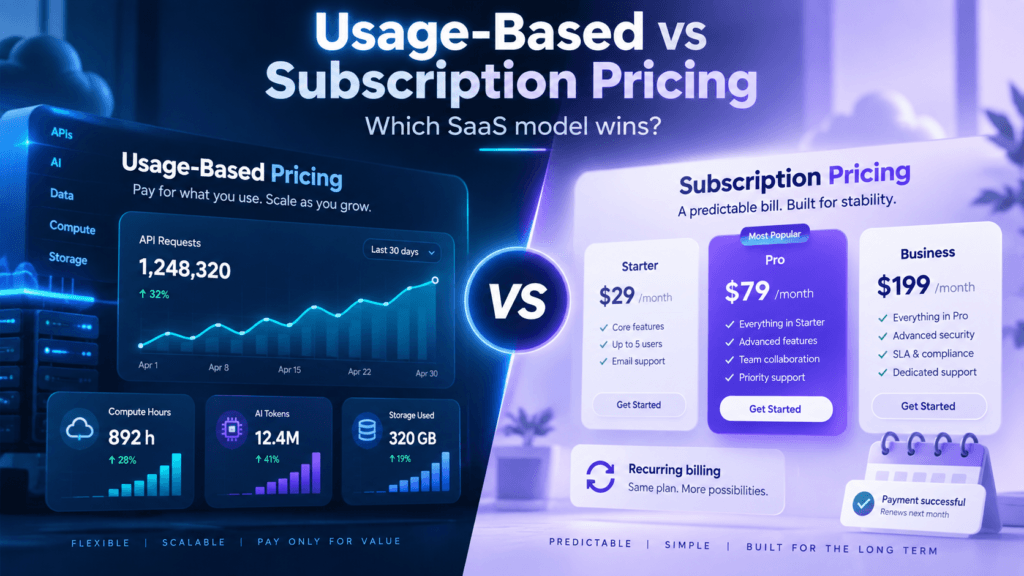
A base subscription plus usage is one of the most common hybrid structures. The recurring fee pays for platform access, dashboards, integrations, support, administration and a defined allowance of consumption, while additional API calls, messages, compute, AI generations or other units are billed beyond that allowance. The model gives customers a predictable baseline and gives vendors protection against unusually heavy usage. It also creates expansion revenue without requiring customers to jump abruptly into a higher plan. The allowance should be based on real usage distributions rather than an arbitrary round number. If most normal customers exceed it, the subscription feels misleading; if almost no one reaches it, the variable component adds complexity without generating meaningful value. Usage dashboards, alerts and spend controls are essential because customers need to understand when they are approaching variable charges. Our usage-based pricing vs subscription guide explains the economics behind this balance.
Per-Seat Pricing Plus Usage
Per-seat plus usage works when both human access and consumption independently create value. An AI productivity tool, for example, may charge each employee for collaboration, permissions and workspace access while also metering expensive AI generations or model calls. This can prevent a small number of seats from producing unlimited variable cost and can capture more value from power users. The danger is double charging. Customers may feel that the seat fee should already cover normal activity, so the usage layer needs a clear explanation and usually an included allowance. The company should define what the seat purchases and what the variable charge represents. If both components appear to monetize the same activity, procurement resistance will increase. Role-based seats can further complicate the structure, so use them only when user roles are genuinely different. A successful seat-plus-usage model feels like two logical dimensions of value rather than two unrelated ways to increase the invoice.
Subscription Plus Credits
Credit-based hybrid pricing is particularly common in AI SaaS because credits can translate several expensive actions into one customer-facing currency. A plan may include a recurring credit balance that can be spent across text generation, images, research, video, transcription or agent tasks. The subscription preserves plan identity and recurring revenue, while credits reflect variable activity and can be replenished through higher tiers or add-on purchases. This structure can be easier to operate than exposing raw tokens or multiple model-specific prices. The weakness is opacity. Customers must understand approximately how many useful outcomes their credit allowance represents, otherwise the plan becomes difficult to compare and budget. Provide concrete examples, usage history, alerts and clear rules for rollover or expiration. Credits should make several technical cost drivers easier to understand rather than disguising them. Use the AI API Cost Calculator to model how credit allowances perform across light and heavy users.
Platform Fee Plus Seats
A platform fee plus seats is useful when the product creates organization-wide value before individual users are counted. The base fee can represent the shared data layer, integrations, administration, reporting, security, infrastructure or customer success, while seat charges capture wider employee adoption. This structure creates a higher revenue floor than pure seat pricing and can better monetize products where a small group of users manages workflows that benefit the whole company. The challenge is demonstrating what the platform fee actually buys. If customers see it as an arbitrary charge added on top of user licenses, the model will feel expensive without a corresponding value story. Packaging should therefore make the shared platform capabilities explicit. The base fee may also vary by segment or contract size, while seat discounts apply as adoption expands. This model is common in more complex B2B software where organizational value extends beyond individual login activity.
Minimum Commitment Plus Usage
Enterprise customers often prefer a committed spend rather than completely open-ended usage billing. In this hybrid model, the customer agrees to a minimum annual or monthly amount and consumes usage against that commitment. The vendor receives a revenue floor and stronger forecasting, while the customer can receive better unit economics, capacity guarantees or enterprise service in exchange for commitment. Overages can be billed when usage exceeds the contracted amount, and unused capacity may expire or roll forward depending on the commercial rules. The key is setting a commitment that reflects realistic adoption. An oversized commitment can create dissatisfaction at renewal when customers feel they paid for capacity they never used. Sales teams should model expected growth and offer commitment levels that encourage adoption without forcing waste. Volume discounts should also preserve gross margin after infrastructure, support and enterprise service costs are considered. The SaaS volume pricing guide covers this structure in more detail.
Feature Tiers Plus Usage
Another hybrid approach combines feature-based tiers with variable usage. Customers first choose a package according to capability and organizational complexity, then usage inside that plan can scale the bill further. A Business plan may include advanced automation, analytics and administration plus a larger usage allowance, while Enterprise adds security, support and negotiated consumption rates. This structure can serve multiple segments while still protecting the economics of variable activity. The risk is stacking too many upgrade triggers. If customers have to understand feature tiers, usage bands, add-ons and credits simultaneously, the pricing page can become difficult to navigate. Each layer should solve a separate problem: tiers should represent customer sophistication, while usage should represent variable scale. If the same customer behavior affects both the plan and the usage charge, the model may feel duplicative. Keep the number of public variables low and move highly customized enterprise logic into the sales process.
How Hybrid Pricing Protects Gross Margin
The strongest economic argument for hybrid pricing appears when variable cost differs dramatically among customers. A fixed subscription creates a predictable revenue floor, but high usage can compress gross margin if expensive infrastructure is included without limits. Adding a usage or credit component allows revenue to rise as cost rises. This is especially important in AI because one customer may make a few model calls while another runs agents continuously. Margin protection should not become pure cost-plus pricing, however. The variable unit should still reflect customer value closely enough that the charge feels commercially fair. Model light, average and heavy customers under the proposed structure and compare revenue, infrastructure cost, support cost and perceived value. If heavy users remain materially less profitable, the allowances or rates may need adjustment. If light users pay far more than the value they receive, the base subscription may be too high. Hybrid pricing is strongest when it improves both value alignment and economics.
How Hybrid Pricing Improves Expansion Revenue
Hybrid pricing can create multiple paths to expansion: customers can add seats, increase usage, purchase more credits, move to a higher tier or commit to additional modules. This can support strong net revenue retention because the company earns more as the customer’s adoption and sophistication increase. The expansion mechanism should remain intuitive. A customer should understand whether higher spending is caused by more employees, more activity, higher service levels or additional functionality. When several components move unpredictably at the same time, expansion can feel like billing inflation rather than customer success. Product analytics should identify which dimension best reflects value for each segment. Some companies discover that one variable dominates expansion and can simplify the model later. Hybrid pricing does not need to be permanently complex. It can be used to learn which value metrics matter and then evolve as customer behavior becomes clearer.
The Biggest Risk: Pricing Complexity
Every additional pricing dimension creates cognitive, operational and technical cost. Customers need to understand the model, sales teams need to explain it, finance needs to forecast it, engineering needs to meter it, support needs to resolve disputes and billing systems need to invoice it accurately. A hybrid model that looks elegant in a spreadsheet can become painful if customers require a calculator simply to estimate normal monthly spend. Complexity also increases the risk of hidden revenue leakage when usage data is incomplete or pricing rules are implemented inconsistently. Before adding a second or third metric, ask whether it solves a meaningful business problem that cannot be addressed through simpler tiers or allowances. Pricing pages should show the fixed component, the included amount and the variable rules clearly. For enterprise quotes, sales calculators and approval rules should create repeatable economics instead of allowing every account to become a custom exception.
How to Design a Hybrid Pricing Model
Start by identifying the fixed value and the variable value separately. Fixed value may include platform access, security, integrations, reporting and support, while variable value may be driven by users, transactions, AI activity, storage or outcomes. Choose one primary metric for each dimension and avoid introducing multiple variables before the need is proven. Use product usage data to set allowances and model customer scenarios across segments. Then test the pricing with customers using realistic examples: what would a small account, growing team and power user pay? Ask whether each component is understandable and whether the total bill still feels connected to value. Finally, instrument the product so customers can monitor the variable element in real time. Spend alerts, usage dashboards and forecasts are part of the pricing product itself. The SaaS pricing guide provides the broader research and testing framework.
Final Verdict
Hybrid pricing is one of the most flexible SaaS monetization structures because it can combine predictable recurring revenue with expansion tied to usage, users, credits or customer complexity. It is especially valuable when one pure pricing model creates an obvious mismatch between customer value and vendor economics. The trade-off is complexity, so every component must have a clear commercial purpose. A base subscription should represent persistent platform value, while the variable component should represent something that genuinely changes with customer success or cost. Model the economics carefully, use allowances and spend controls to protect predictability, and keep the public pricing explanation simpler than the internal billing architecture. Hybrid pricing works best when customers can understand why their bill changes and when the vendor earns more precisely because the customer is receiving more value.
Frequently Asked Questions
What is a hybrid pricing model in SaaS?
A hybrid pricing model combines two or more pricing mechanisms, such as a recurring subscription plus usage, seats plus AI credits, a platform fee plus users, or an enterprise commitment plus transactions. The purpose is to capture more than one dimension of customer value while maintaining a predictable revenue floor. Hybrid pricing is common when one model alone cannot represent both fixed platform value and variable consumption. The model should remain understandable enough that customers can estimate normal spend and identify what causes the bill to increase.
What is an example of hybrid SaaS pricing?
A common example is a monthly Business subscription that includes a defined number of API calls or AI credits and then charges overages beyond the allowance. Another example is an enterprise platform fee combined with per-user licenses. In both cases, the fixed component represents ongoing access and shared capabilities, while the variable component captures growth or usage. The best hybrid structures make the role of each charge clear rather than stacking several unrelated fees onto one invoice.
Why is hybrid pricing popular for AI SaaS?
AI products often have meaningful variable model and compute costs that can vary dramatically among customers. Pure flat subscriptions can expose the vendor to heavy-user margin risk, while pure usage pricing can make customer bills difficult to budget. A hybrid structure combines a predictable subscription with credits, tokens, generations or another usage unit. This creates a revenue floor while protecting margin and allowing customer spend to grow with AI activity. Clear usage visibility and alerts are essential to prevent bill shock.
Is hybrid pricing better than usage-based pricing?
Not automatically. Hybrid pricing is stronger when customers value predictable access but consumption varies enough to require additional monetization. Pure usage pricing can be simpler when the product is naturally understood in one consumption unit and customers are comfortable with variable bills. Hybrid pricing adds complexity, so the fixed component should create meaningful value rather than existing only to guarantee revenue. Test both approaches against customer budgeting preferences, cost-to-serve and usage distributions before deciding.
How many pricing components should a hybrid model have?
Use as few as possible. Two clear components are easier to understand and operate than four or five interacting metrics. A base fee plus one variable metric is often enough. Add seats, credits, modules or overages only when each solves a distinct value or cost problem. If customers need a complex spreadsheet to estimate normal spend, the model may have become too complicated. Enterprise contracts can contain more internal complexity, but the underlying logic should still be consistent and explainable.
How should SaaS migrate to hybrid pricing?
Start with new customers or a new package before moving the installed base. Use historical usage to model what existing customers would pay and identify accounts at risk of large increases. Provide dashboards, examples, spend alerts and clear migration communication. Some customers may need grandfathering, opt-in migration or renewal-based transition. Measure conversion, revenue, margin, usage behavior and churn after the change. The objective is better value alignment, not simply introducing more billing variables.