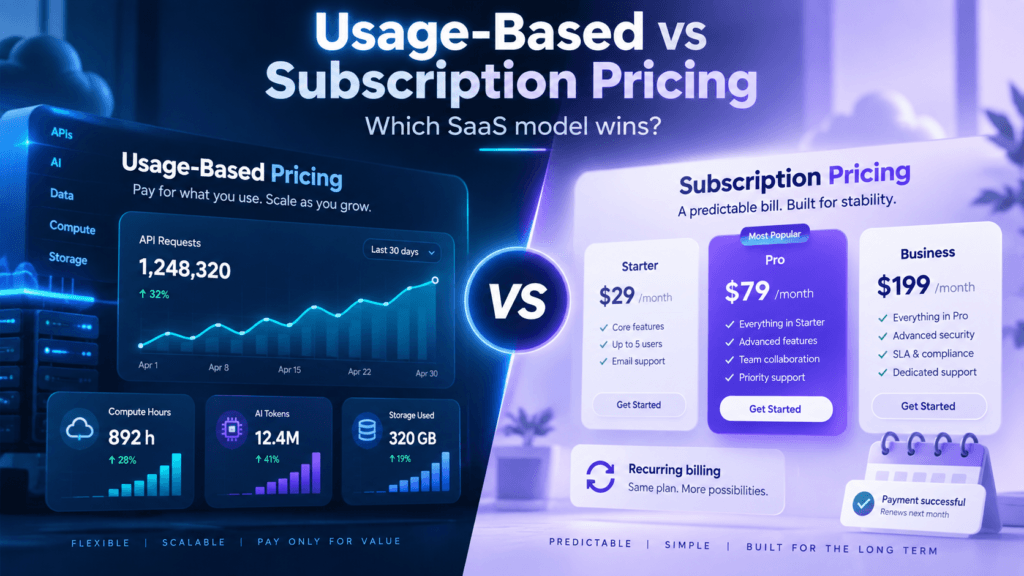

SaaS pricing is one of the most important growth decisions a software company makes because it affects acquisition, retention, expansion, profitability, positioning, and the expectations customers bring into the product. A strong SaaS pricing strategy does more than choose a monthly number. It identifies the customer segment, defines the value metric, packages capabilities into understandable plans, protects margins, creates upgrade paths, and gives buyers enough predictability to make a confident decision. The challenge is that pricing changes as the product matures: an early-stage startup may need simplicity, while a larger B2B SaaS business may need enterprise contracts, usage components, annual commitments, and discount governance. This guide explains how to price a SaaS product from first principles, using customer value, willingness to pay, usage data, cost structure, and commercial strategy rather than copying competitors blindly.
Start SaaS Pricing With Customer Value
The strongest starting point for SaaS pricing is the economic or operational value the product creates for the customer. Buyers do not care how many engineering hours were required to build a feature; they care whether the software saves time, reduces errors, increases revenue, lowers risk, improves compliance, automates work, or enables an outcome that matters to them. Value can be quantified through labor saved, revenue generated, incidents prevented, tasks completed, transactions processed, or another business measure, but it can also be qualitative when the software reduces complexity or creates strategic control. Pricing research should therefore begin with customer interviews and use cases before the company debates whether the plan should cost $29 or $49. When the company understands what customers value most, it becomes much easier to choose a pricing metric and to package features in a way that makes higher prices feel connected to higher value.
Choose a Value Metric That Scales Naturally
A value metric is the unit that determines how price grows as the customer receives more value. Common SaaS value metrics include seats, active users, transactions, contacts, storage, API calls, AI tokens, projects, locations, workflows, revenue processed, or feature depth. The ideal metric is understandable, measurable, difficult to manipulate, and positively correlated with customer success. If the company prices on a metric that does not track value, high-value customers can remain underpriced while low-value customers feel overcharged. A CRM may naturally scale by users or contacts, while an API platform may scale by requests and an AI product may need usage, credits, or a hybrid model. The value metric sits underneath the broader SaaS pricing model, so it should be selected before the company spends too much time designing plan cards or deciding plan names.
Set SaaS Price Points With Research, Not Guesswork
Price points should be informed by several sources of evidence rather than one formula. Customer interviews reveal budget expectations and perceived value, sales conversations show where objections appear, product usage identifies natural segments, competitor pricing provides market context, and cost analysis establishes the margin floor the company cannot sustainably cross. Willingness-to-pay research can be performed through structured interviews, surveys, pricing tests, or controlled offer experiments. The important discipline is to test ranges and packaging rather than asking customers a vague question such as “what would you pay?” Customers often answer hypothetical questions differently from real purchase decisions. Instead, explore trade-offs: which features are essential, what alternatives cost, what outcome is worth, and at what price the product starts to feel too expensive. SaaS pricing becomes more reliable when qualitative research, observed behavior, and financial modeling point in the same direction.
Build Pricing Tiers Around Real Customer Segments
Pricing tiers should represent different customer needs rather than arbitrary bundles created to fill a three-column pricing page. A Starter plan may serve individual users or small teams, a Pro plan may serve growing organizations that need automation and integrations, and an Enterprise plan may serve buyers that require SSO, audit logs, advanced permissions, procurement, SLAs, or dedicated support. Each tier should answer three questions clearly: who is this plan for, what additional value does it provide, and what naturally causes a customer to move upward? If the only difference between two tiers is one small feature that every serious customer needs, the packaging can feel punitive. If the plans differ in meaningful levels of capability, scale, control, or support, customers can self-select more confidently. Our SaaS pricing ladder and pricing plan names guides cover tier architecture in more detail.
Balance Monthly and Annual SaaS Pricing
Monthly billing lowers commitment and can improve initial conversion because customers can try the paid product without making a long-term decision. Annual billing improves cash flow, revenue visibility, and often retention because the customer commits for a longer period. Many SaaS companies offer a discount for annual payment, but the discount should reflect the economic value of the commitment rather than becoming an automatic 20% giveaway. Finance should compare the cash-flow benefit and potential churn reduction with the revenue surrendered through the discount. Self-service SaaS may prominently show both options, while enterprise software often defaults to annual or multi-year contracts because procurement and implementation costs justify longer commitments. The billing cycle also affects how prices are displayed: a “per month, billed annually” number should be clearly labeled so customers do not feel misled when checkout requires a full-year payment.
Protect Gross Margin as SaaS Usage Grows
Pricing must account for the cost of serving customers, especially in AI, cloud, data, communications, and infrastructure products where variable costs can rise sharply with consumption. A fixed subscription can appear attractive until a small percentage of heavy users consume enough compute, API calls, support, or storage to compress gross margin. This does not mean SaaS should be priced only on cost. Customer value still determines the commercial opportunity, but cost-to-serve establishes boundaries and reveals whether a usage or hybrid component is necessary. Companies should model unit economics for light, average, and heavy customers under each proposed pricing structure. If heavy users become materially less profitable, consider usage allowances, overages, credits, higher tiers, volume commitments, or a hybrid model. Our AI API Cost Calculator can help model variable AI cost scenarios before a pricing decision is finalized.
Use Discounts Without Destroying Pricing Integrity
Discounts can be strategically useful for annual contracts, larger commitments, strategic partnerships, startup programs, nonprofits, competitive deals, or multi-product bundles, but uncontrolled discounting can quickly undermine SaaS pricing. If sales representatives routinely discount every deal, list prices stop communicating value and customers learn to negotiate rather than accept the published structure. Discount policies should therefore define approval thresholds, acceptable reasons, expiration periods, and the value the company receives in exchange, such as a longer contract, prepaid commitment, or higher volume. Track discount rate by segment, plan, salesperson, and renewal because patterns can reveal whether the pricing problem is really positioning, packaging, or sales execution. Our SaaS pricing discounts guide provides a more detailed governance framework.
Test Pricing Without Creating Customer Chaos
SaaS companies should treat pricing as an ongoing commercial discipline rather than a once-per-year debate. Testing can include new-customer cohorts, packaging experiments, different annual discounts, plan presentation, trial structures, or willingness-to-pay research before changing prices across the installed base. Large pricing changes should be modeled carefully because an increase in average revenue per account can be offset by higher churn, downgrades, sales discounting, or weaker conversion. Existing customers may need a transition period, grandfathering policy, or renewal-based change rather than an immediate adjustment. Pricing tests should also be measured beyond conversion: watch activation, retention, net revenue retention, gross margin, support volume, and the distribution of customers across plans. A pricing change that produces more signups but significantly weaker retention may not be an improvement.
SaaS Pricing Metrics to Monitor
The most useful pricing metrics connect monetization with customer behavior. Track average revenue per account, plan mix, visitor-to-paid conversion, trial-to-paid conversion, expansion revenue, upgrade rate, downgrade rate, logo churn, gross revenue retention, net revenue retention, gross margin, annual-plan adoption, discount rate, and CAC payback. For usage-based products, also monitor consumption distribution, bill volatility, overage frequency, and the percentage of customers approaching usage caps. Segment these metrics by customer size and acquisition channel because averages can hide important differences. A pricing plan that works well for small teams may perform poorly in the mid-market, while enterprise buyers may accept higher prices if security and service requirements are addressed. The objective is to understand whether the pricing system attracts the right customers, preserves value over time, and allows revenue to expand as the customer becomes more successful.
Final Verdict
Effective SaaS pricing is the intersection of customer value, product economics, segmentation, and simplicity. The right price should not be chosen because it looks competitive on a pricing page or because a spreadsheet produced a precise number. It should be supported by evidence that customers understand the value, that the chosen metric scales logically, that margins remain healthy, and that the plans create natural upgrade paths. Start simple when the company is early, collect real usage and willingness-to-pay data, and refine the structure as customer segments become clearer. Pricing should evolve alongside the product rather than lagging years behind it. When SaaS pricing is treated as a continuous operating discipline, it becomes one of the strongest levers for increasing revenue quality without relying entirely on more traffic or acquisition spend.
Explore the SaaS pricing cluster
Frequently Asked Questions
How do you price a SaaS product?
Start by defining the customer segment, the problem solved, and the value created. Then identify a value metric that grows with customer success, estimate cost-to-serve, research alternatives and willingness to pay, and test several pricing structures against realistic customer scenarios. The final price should balance customer value, market expectations, gross margin, sales motion, and expansion potential. Early-stage companies should keep the structure simple enough to learn from, while mature SaaS businesses can introduce more sophisticated tiers, usage components, enterprise contracts, and discount rules as customer segments become clearer.
What is a good SaaS pricing strategy?
A good SaaS pricing strategy makes the offer easy to understand, aligns price with customer value, preserves sustainable margins, and creates a natural path for customers to spend more as they receive more value. It should define the pricing model, value metric, tiers, annual discounts, trial or free-plan structure, enterprise rules, discount governance, and the process for reviewing pricing over time. The strategy should also match the sales motion: self-service products generally need transparent, simple pricing, while complex enterprise software can support custom contracts and negotiated terms.
Should SaaS pricing be based on competitors?
Competitor pricing is useful context but should not be the primary method for setting price. Competitors may serve different customers, use different value metrics, have different cost structures, or simply have poor pricing themselves. Use competitive research to understand market conventions and the range buyers may expect, then combine it with customer value, willingness-to-pay research, product usage, and unit economics. A differentiated SaaS product can often justify a different pricing model or higher price when the value proposition is stronger.
How many SaaS pricing plans should there be?
Three or four public plans are common, but the correct number depends on customer segmentation. Each plan should serve a distinct customer type or level of complexity and should have a clear reason to exist. More plans are not automatically better because excessive choice can increase decision friction. If the company cannot explain who a tier is for and why someone would upgrade to it, the tier may be unnecessary. Enterprise can also be separated from the main self-service plans when procurement and service requirements are materially different.
How often should SaaS pricing be changed?
There is no required schedule, but pricing should be reviewed regularly and changed when evidence shows the current structure no longer matches customer value, costs, segmentation, or market position. Many companies benefit from an annual formal review while monitoring pricing metrics continuously. A review can lead to no change, a price increase, new packaging, a different value metric, or changes to discounts and billing terms. The key is to avoid leaving pricing untouched for years while the product and customer base evolve significantly.
What is the difference between SaaS pricing and SaaS packaging?
Pricing determines what customers pay and how the amount scales, while packaging determines what capabilities, limits, support, and entitlements are included in each plan. The two are inseparable in practice because customers evaluate the price relative to what they receive. A strong price attached to weak packaging will still convert poorly, and excellent packaging with a poor value metric can leave revenue uncaptured. SaaS companies should therefore design pricing and packaging together rather than treating the pricing page as a final marketing exercise.