
Flat-rate pricing for SaaS charges customers one recurring amount for a defined package of software instead of changing the bill according to users, usage, transactions or feature combinations. The model is attractive because it is extremely easy to explain, easy to forecast and easy to operate. A visitor can look at the pricing page and understand the cost immediately, while the SaaS company avoids complex metering, seat management and pricing calculations. That simplicity can improve conversion when the product serves a narrow audience with relatively similar needs. The problem is that customers rarely remain equally valuable forever. Some accounts consume far more support, infrastructure, AI, storage or product capacity than others, while large customers may receive much more economic value without paying more. This guide explains when flat-rate SaaS pricing works, where it breaks, how to calculate a defensible flat price, and when a tiered, per-user, usage-based or hybrid model becomes a better long-term choice.
What Is Flat-Rate Pricing in SaaS?
Flat-rate pricing means the customer pays one fixed subscription price for access to a defined product package during the billing period. The fee may be monthly or annual, but it does not automatically increase because the customer adds another user or consumes more of the product within the plan’s normal boundaries. A company can offer one truly universal plan or use a flat price within a specific package, such as one Business plan with generous limits. The key distinction is that the price is not calculated from a changing value metric. This makes flat-rate pricing one of the simplest SaaS pricing models to communicate. It also means the company accepts more variation inside the package. Light users may subsidize heavy users, while high-value customers may pay less than their willingness to pay. The model therefore works best when account differences are limited enough that simplicity is more valuable than precise segmentation.
Why Flat-Rate Pricing Can Improve Conversion
Pricing complexity creates friction because buyers have to estimate users, usage, modules, credits or overages before they know the likely bill. Flat-rate pricing removes much of that work. Customers see one number, understand what it includes and can make a fast decision without involving finance or sales. This is especially useful for product-led SaaS, creator tools, small-business software and narrowly scoped products where the buyer is often one person making a low-risk purchase. Simpler pricing also makes advertising and landing-page messaging easier because the company can promote one clear commercial offer instead of explaining a matrix. The conversion benefit is not automatic, however. A flat price still needs to feel appropriate for the target segment. If the company chooses one price intended to serve both freelancers and large enterprises, the number can become too expensive for the former and far too cheap for the latter. Simplicity helps only when the target market itself is reasonably focused.
The Main Advantage: Predictable Bills and Predictable Revenue
Flat-rate SaaS gives both sides strong short-term predictability. Customers know exactly what they will pay each billing period, which reduces budget anxiety and makes approval easier. The vendor can forecast recurring revenue without modeling seat growth, usage volatility or consumption spikes. Billing operations are also simpler because there are fewer invoice adjustments, usage disputes and entitlement rules. These benefits can be meaningful for early-stage SaaS teams that want to spend engineering time on the product rather than on sophisticated billing infrastructure. Predictability also improves the customer experience because there is little risk of bill shock. However, the vendor’s revenue predictability can hide economic variation underneath the account base. Two customers paying the same amount can create very different gross margins if one uses significantly more support, AI, storage or compute. Flat-rate pricing therefore simplifies the bill, but the company still needs to monitor customer-level economics behind the scenes.
The Main Disadvantage: Revenue Does Not Scale With Customer Value
The central weakness of flat-rate pricing is that revenue remains fixed even when customer value grows substantially. A small team and a much larger organization can receive radically different economic benefit while paying the same subscription. This limits expansion revenue and can make net revenue retention weaker than models that naturally grow with seats, usage or customer maturity. It also creates a segmentation problem: one flat price must be low enough to win smaller customers but high enough to capture reasonable value from larger ones. Companies often discover that this becomes impossible as the customer base diversifies. A business that originally served freelancers may later attract agencies, mid-market companies and enterprise buyers with larger budgets and more complex needs. At that point, retaining one universal price can leave significant revenue uncaptured. The SaaS pricing ladder becomes useful when customer value begins separating into distinct groups.
Flat-Rate Pricing and Heavy-User Risk
Flat-rate pricing can create margin risk when the product has meaningful variable costs. AI inference, data processing, storage, messaging, video rendering, API calls, premium support and third-party services can all become more expensive as customers use the software more. Under a flat subscription, heavy users can consume far more resources without creating additional revenue. The company may still be profitable on average, but a small number of power users can materially reduce gross margin. This is why flat-rate pricing is more comfortable for products with low marginal delivery costs and relatively stable support requirements. If variable costs are important, the company should model light, average and heavy customer economics before publishing an unlimited plan. Usage allowances, fair-use thresholds, credits or overages can protect the model without immediately abandoning the simplicity of a subscription. The AI API Cost Calculator is especially useful for testing whether heavy AI usage makes an unlimited flat plan financially risky.
When Flat-Rate Pricing Works Best
Flat-rate pricing works best when customers are similar in size, usage and willingness to pay; when product delivery costs are stable; and when simplicity itself is a competitive advantage. Narrow SaaS products serving freelancers, creators, solo professionals or small businesses can often use one price successfully because the difference between accounts is limited. The model can also work when the company intentionally positions itself against competitors with complicated plans and hidden add-ons. Early-stage founders may choose flat pricing while they learn which customer segments and usage patterns actually exist, because starting simple keeps the feedback clean. The critical requirement is monitoring how the customer base evolves. If account usage begins spreading widely, enterprise buyers appear, or customers regularly ask for capabilities that only some segments need, the company has evidence that one package may no longer represent the market. Flat-rate pricing should be treated as a model that earns its simplicity through customer similarity.
When Flat-Rate Pricing Usually Fails
Flat-rate pricing usually becomes weak when customer value varies dramatically, when large accounts require security or support that small accounts do not, or when usage creates significant variable cost. B2B software frequently encounters all three problems as it moves upmarket. A ten-person company may need basic functionality, while a five-thousand-person enterprise may require SSO, audit logs, procurement, legal negotiation, implementation and dedicated customer success. Charging both the same amount is rarely sustainable. The model can also fail when customers differ by orders of magnitude in API calls, transactions, storage or AI consumption. In these cases, a tiered or hybrid structure can preserve a simple entry point while creating room for expansion. Founders should not wait until margins or sales negotiations become painful. Signals such as frequent custom discount requests, heavy-user cost pressure, enterprise feature requests and obvious willingness-to-pay differences indicate that the market has outgrown one universal price.
How to Set a Flat SaaS Price
Setting one price still requires research. Begin with the target customer segment and quantify the value the product creates through time saved, revenue generated, risk reduced or workflow improvement. Then examine competitor pricing and substitutes to understand the range buyers already expect. Calculate cost-to-serve so the price preserves healthy margin even for heavier customers, and test willingness to pay through interviews, sales conversations and new-customer experiments. The final number should sit comfortably above the economic floor while remaining attractive relative to customer value. Avoid choosing the price only by averaging competitor plans because competitors may serve different segments or have different costs. Also model the annual discount separately. A flat monthly price can be paired with annual billing, but the discount should reflect the value of longer commitment rather than automatically copying a market convention. Our how to price software framework provides a broader step-by-step process.
Flat-Rate Pricing vs Tiered Pricing
Flat-rate pricing prioritizes simplicity, while tiered pricing prioritizes segmentation. With one plan, every customer receives broadly the same package and pays the same recurring amount. With tiers, customers choose among packages designed for different levels of usage, functionality, support or organizational complexity. Tiered pricing usually creates stronger expansion revenue because growing customers can move upward, but it also increases decision friction and packaging work. The right choice depends on whether the customer base is meaningfully segmented. If nearly everyone uses the same capabilities and receives similar value, tiers can add unnecessary complexity. If customer needs separate clearly into individual, team, business and enterprise groups, one flat price will usually leave either conversion or monetization on the table. A practical transition is to keep a simple core plan and introduce one higher tier only when a distinct segment justifies it, rather than launching five plans before the data exists.
Flat-Rate Pricing vs Usage-Based Pricing
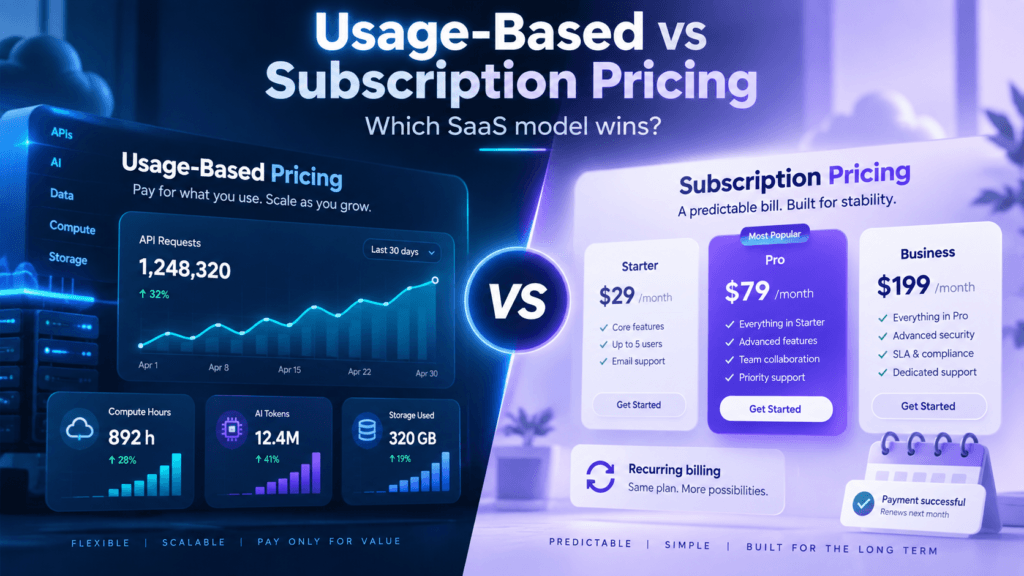
Flat-rate pricing gives customers a predictable bill regardless of normal consumption, while usage-based pricing changes the amount according to activity. Flat pricing is easier to buy and forecast, but usage pricing can align revenue more closely with both customer value and variable cost. Infrastructure, API, communications and AI products often benefit from usage because one account can consume vastly more resources than another. The trade-off is customer anxiety around unpredictable spend and the operational burden of accurate metering. A company does not always need to choose one extreme. A hybrid structure can charge a flat subscription that includes a generous allowance and then bill overages only when consumption moves beyond the normal range. This preserves predictable value for most customers while protecting margins from power users. Our usage-based pricing vs subscription guide compares those trade-offs in greater depth.
How to Transition Away From One Flat Price
If flat-rate pricing is no longer working, change the model in stages rather than disrupting every customer at once. Start by identifying the segments or usage patterns that create the problem. New customers can be placed on the new tiered, per-user or hybrid structure first while existing customers remain on the legacy plan temporarily. This gives the company real conversion and retention data before a wider migration. Communicate the reason in customer language: explain new capabilities, clearer packages, usage fairness or support levels rather than presenting the change only as a revenue decision. Existing accounts may need grandfathering, renewal-based migration or a transition period depending on contract size. Measure churn, downgrades, plan selection and support questions after the change. The goal is not simply to charge more. The goal is to create a pricing system that better reflects differences in customer value while preserving the trust created by the original simple offer.
Final Verdict
Flat-rate pricing can be an excellent SaaS model when customers are similar, costs are stable and simplicity materially improves the buying experience. It is easy to explain, easy to bill and highly predictable for both the customer and the vendor. The limitation is structural: one fixed price cannot capture widely different customer value forever, and it can become dangerous when heavy users create significant variable cost. Founders should therefore use flat pricing deliberately rather than treating it as the permanently simplest answer. Monitor usage distribution, enterprise demand, support cost, willingness to pay and customer segmentation as the business grows. When the evidence shows clear differences between accounts, move toward tiers, seats, usage or a hybrid model. The best pricing structure is the one that remains understandable while allowing revenue and margin to grow as customers become more valuable.
Frequently Asked Questions
What is flat-rate pricing in SaaS?
Flat-rate SaaS pricing charges customers one recurring amount for a defined package instead of calculating the bill from seats, usage, transactions or another changing metric. The plan may include reasonable limits, but the normal subscription price remains the same from month to month. It is one of the simplest pricing models to explain and is often used by focused products serving customers with relatively similar needs. The model becomes less effective when account value, usage or cost-to-serve varies significantly because the vendor has limited ability to monetize expansion or protect margin from heavy users.
What are the advantages of flat-rate pricing?
The main advantages are simplicity, predictable billing, easy sales communication and low operational complexity. Customers can understand the price immediately and do not need to estimate seats, usage or credits before purchasing. Vendors benefit from straightforward invoicing and predictable recurring revenue. Flat-rate pricing can therefore improve conversion for self-service software and early-stage SaaS where the company wants a clean offer. The model works best when customers are relatively similar and variable delivery costs are low enough that heavy users do not materially damage margins.
What are the disadvantages of flat-rate pricing?
The largest disadvantages are limited expansion revenue, weak segmentation and heavy-user risk. Large customers can receive significantly more value without paying more, while small customers may feel the universal price is too high. If infrastructure, AI, support or storage costs grow with usage, power users can also become less profitable. These problems usually become more visible as a SaaS company moves from a narrow early customer base into multiple segments. Tiered, usage-based or hybrid pricing can provide better value alignment once those differences become meaningful.
Is flat-rate pricing good for startups?
Yes, especially when an early-stage startup has limited pricing data and wants a simple model that can be changed later. One plan makes it easier to learn willingness to pay, feature usage and customer behavior without interpreting results across several complicated packages. The startup should still model costs and customer value before setting the price. Flat-rate pricing should not become permanent by default. Once customer segments, enterprise demand or variable usage become clearer, the company should review whether one universal plan is still the strongest commercial structure.
Can flat-rate pricing include limits?
Yes. A flat subscription can include limits for storage, projects, API calls, AI credits, support or another resource while keeping the recurring price fixed inside those boundaries. This is often a practical way to protect gross margin without moving immediately to fully metered billing. The limits should be high enough that normal customers do not constantly encounter them and should be explained clearly. If many customers regularly exceed the allowance, the company may need a higher tier, paid overages or a hybrid pricing model rather than relying on hard restrictions.
When should SaaS move from flat-rate to tiered pricing?
Consider tiers when customer needs separate into clear groups, when large accounts show higher willingness to pay, when enterprise features are requested, or when usage and support costs vary materially between customers. Another signal is that sales teams repeatedly create custom discounts or packages because the public price no longer fits real deals. Introduce tiers around genuine customer segments rather than arbitrary feature gates. A controlled rollout to new customers can provide evidence before moving the installed base to a new structure.